
Editor's note: All opinions, columns and letters reflect the views of the individual writer and not necessarily those of the IDS or its staffers.
In May, I bought a ticking, twelve-hour Timex watch. Sure, my phone tells time, but Big Tech designs everything on phones to distract. They interrupt us “about every 13 minutes,” behavioral scientists Alyson Meister and Nele Dael said in Harvard Business Review. Because I like reading, this presents a problem. Yet, I finished more books this summer than I had in any other, a data point I attribute to my new $20 wrist piece.
Formerly, watches proved necessary when we required many tools for as many tasks, but modern people have consolidated all these tools into one: the phone. Phones perform every task: bill paying, grocery shopping, navigation, research and writing. We’re dead to society without one. Soon, life at IU will also be lived through a phone.
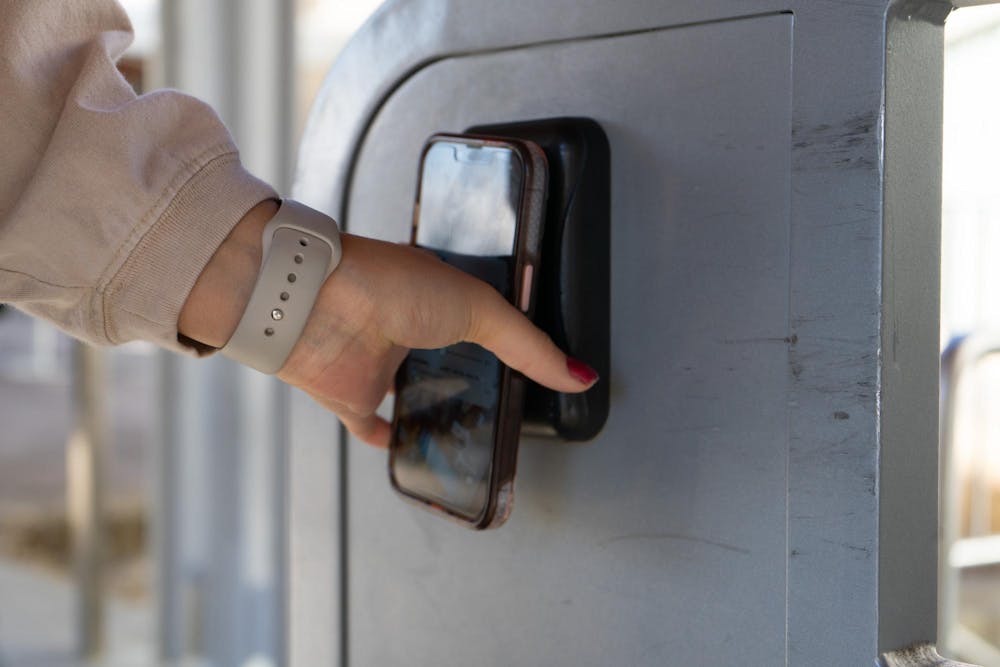
This year, IU digitized CrimsonCards. While students must opt into the new format, this could represent the first stage of unrefusable digitization. Choice now often means being chosen for later, a lesson I learned at the concession booth during my first IU football game.
With cash in hand, I was told that IU Athletics accepts only card or digital payment. Until 2022, it also accepted cash. For a time, all three payment forms coexisted. However, choice served as a means for smoothly transitioning to a cashless stadium, not an end. Presumably, the transition did not come without reason. Perhaps COVID-19 prompted it. After all, paper money changes hands more than cards do. Ultimately, going cashless proved more efficient. Efficiency, not preference, is the rule.
Currently, students may use the card they prefer. But whether in a few years or decades, would it shock you for IU to eliminate physical cards? A university would not be the first major entity to phase out a physical option over time. Between 2012 and 2017, Sweden halved the number of cash transactions in its economy. Why would IU not follow the times? Until then, sudden shifts against the status quo would cause whiplash and therefore inefficiency.
Efficiency might not be the reason stated for the move. Rather, cards fill the earth with plastic like cash spreads germs. However, efficiency will result. For example, the university could cut staff needed to hand out and activate CrimsonCards during freshmen move-in and the CrimsonCard replacement service. Rather than print any cards, IU could expect freshmen to bring their phones to campus. Yet, this is another app to download, one more thing for which we must rely on our phones, and so the growth of screen culture underlies the issue of lost choice.
Like all technology, phones do not merely solve problems but alter our way of viewing and engaging with the world. For instance, Google search demystified the question, costing us the opportunity to experience wonder at the unknown. Ceasing to appear to us as a subject that calls from the back of our minds, the question appears as an object for us to use to satisfy a dopaminic urge of momentary curiosity.
Similarly, computers destroyed the communion of the classroom. With a printed syllabus, students must be on the same page as the professor. On the other hand, an online syllabus allows students to entertain anything on the internet while the professor talks.
Cards already alter our view of identity. They dehumanize, contemporary French philosopher Jean-Luc Marion said in his book “Negative Certainties.” Marion observed this with government documentation because the government ceases to regard us for who we are — our identities — but for what we have — an assigned number.
Thus, we who are human beings can be excluded from society for what we do not have, creating a class of people who are undocumented, or “sans-papiers,” and cannot move freely in society. This is not because they “are not,” but because they “have not.” In Sweden, “the elderly, former convicts, tourists (and) immigrants” have found themselves in this situation due to the country’s emerging cashless economy.
At IU, losing a physical CrimsonCard can restrict movement and opportunity such as entering sporting events, checking out library books or returning to one’s dorm. Similarly, this is not because of what one is not — being a Hoosier goes deeper — but because of what one has not. However, cards prove necessary in a world where safety must be guarded. To be protected by a system, we must allow the system to objectify parts of our humanity. Yet, digitizing our identities costs too much in a time when the digital world threatens to consume our lives.
Paradoxically, I propose that requiring many tools for many tasks can mitigate the risk of dehumanization. Then, no tool too closely orbits our lives to be confused for us. Instead, like countless moons, many tools revolve around our lives and offer them texture. Too smooth, screens cause life’s texture to vanish. Digital CrimsonCard, where are your scratches and bends, your wear and tear, that made mine, mine?
Eric Cannon (he/him) is a sophomore studying philosophy and political science and currently serves as a member of IU Student Government.



