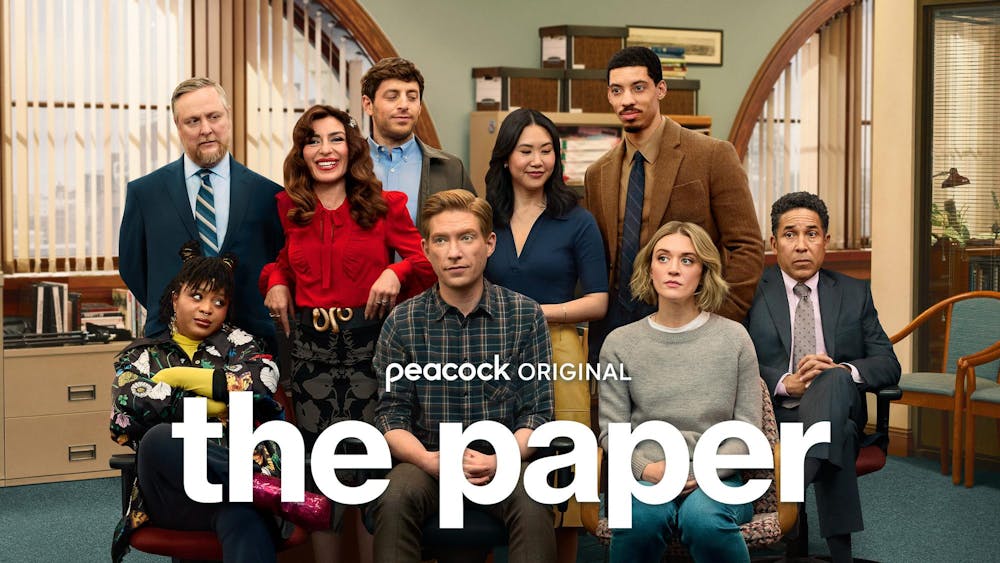
In recent years, I’ve seen an increase in sitcoms based off workplace settings. “Superstore,” “St. Denis Medical,” “Abbott Elementary” and “Parks and Recreation” are examples of sitcoms focusing on coworker dynamics instead of a quirky group of friends. Peacock’s newest show, “The Paper,” is the newest edition to this work-life comedy. However, it struggles to find its footing in its first season.
Creators of “The Office,” Greg Daniels and Michael Koman, came together to create a new mockumentary spinoff of their hit show, this time focusing on a dying Midwest newspaper, the Toledo Truth Teller. With the employment of ambitious Editor-in-Chief Ned Sampson (Domhnall Gleeson), the newspaper gets an opportunity to cheat its own death and become a paper the city can depend on.
Fans of “The Office” get to experience their love for the series one last time in the pilot, as the show opens with a small, but known, character Bob Vance (Rober R. Shafer) from Vance Refrigeration. He tells the filmmakers that Dunder Mifflin’s closed back in 2019 after Enervate, another paper product company, bought it out. Now, the same documentary crew has gone to Enervate, which also owns TTT, to continue filming.
Another familiar face makes an appearance in the new series. Oscar Martinez (Oscar Nunez), an accountant for Dunder Mifflin in “The Office,” is now the head accountant for TTT and is surprised by the documentary crew.
These characters aren’t the only “The Office” reminders. “The Paper” theme song is reminiscent of the melodical piano used in “The Office.” Instead of scenes from regular office life playing during the theme song, “The Paper” displays a montage of people using print newspapers for every purpose but for reading, highlighting the current public attitudes toward print media and why TTT would be struggling. This, however, isn’t new to journalists of today, who have to experience what it’s like to be a reporter in our climate.
The show itself follows a very predictable set of characters that you see in almost every sitcom. What this means is that “The Paper” feels familiar; it’s like we have seen it all before, and it is because we have. It’s the same story, just a different font. Instead of a Midwest department store, hospital or paper company, this time it’s a newspaper.
This isn’t television’s first attempt at a show about news. In June 2012, HBO Max released “The Newsroom,” a drama about a cable news station that does an excellent job at showing the influence news has on the average American. But where “The Newsroom” thrives, “The Paper” falls short. “The Newsroom” reveals the behind the scenes of what it is like to work in a newsroom, while “The Paper” minimizes the work of journalists. Many of the characters are unsure of basic newswriting principles or source stories in unethical ways, misrepresenting what training journalists do to uphold their responsibilities as reporters.
“The Paper” isn’t just a fictious comedic show about some random understaffed, unexperienced and underpaid reporters trying to keep their newspaper’s neck above water, but a reality of many small-town newspapers. For the past 15 years, the newspaper industry has been facing burdens that are hard to come back from. Loss of audience, financial struggles and lack of employees is something every small paper is facing as they try not to reach the chopping block.
This isn’t just a humorous take on local newsrooms of America but unfortunately the future reality of most people wanting to pursue a career in journalism. “The Paper” had an opportunity to shed light on the issue, but instead renforced the already existing narrative about newsrooms across the country.
This shift of shows focusing on average people and their day-to-day lives might be created in response to the circumstances of these jobs becoming so bleak, so the only thing one can do is laugh about it.
While “The Paper” gets its footing, I hope it reminds viewers of the reality of their local papers and encourages them to support those workers.