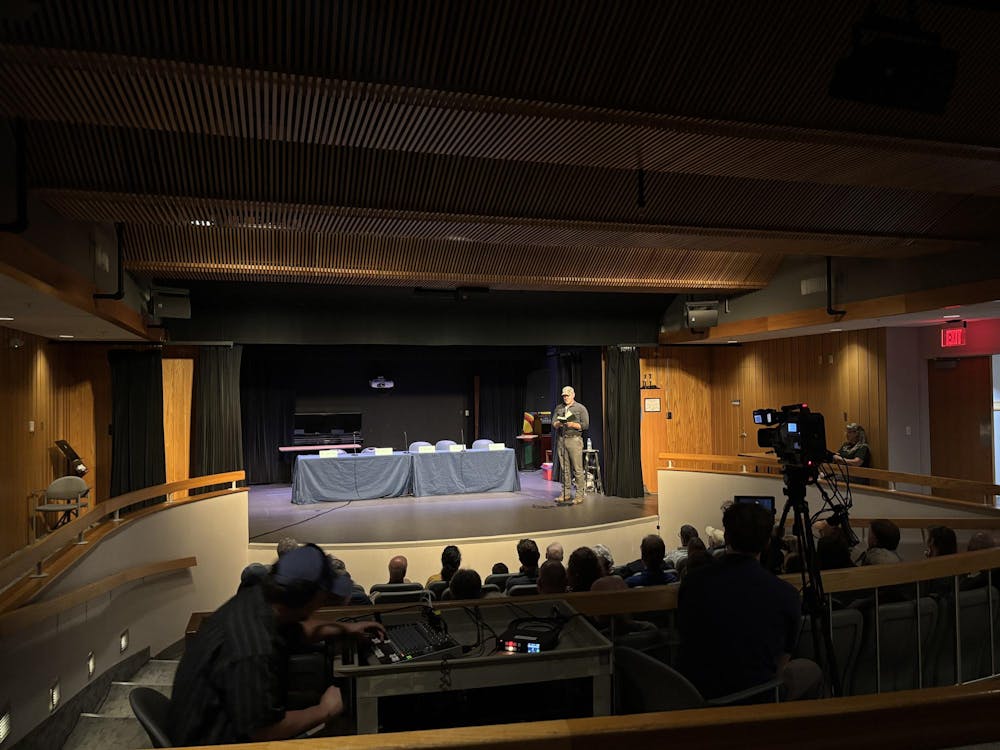
Ethan Tapper — tree lover, forester and bestselling author of “How to Love a Forest: The Bittersweet Work of Tending a Changing world” — spoke about stewardship of Indiana forests Thursday at the Monroe County Public Library in downtown Bloomington.
“Only people who love trees should be allowed to cut them down,” Tapper said.
At the event, representatives from conservation groups held a panel discussion with Tapper where audience members could ask questions.
Tapper opened the presentation by introducing his work as a forester, author and digital storyteller. Along with his book, Tapper discussed the forest he bought in Vermont in 2017, known now as Bear Island, that he has worked at healing and protecting from unhealthy trees, deer overpopulation and invasive plants. He emphasized how as his book came together through years of writing, his forest was also coming together and healing.
“My land, Bear Island, was this really degraded forest,” Tapper said. “In order to help it be healthy again, I actually had to cut a lot of trees to reverse the effects of how it had been poorly managed and to give new generations of trees a chance to grow there.”
Tapper spoke frequently about stewardship, which he described as the process of caring for the forests. He said there are plenty of causes that are optional to care about, but ecosystems are not one of them.
Though Tapper loves the forest now, he didn’t always know forestry was his calling. He gained his passion for the wilderness after going on a six-month wilderness expedition during the wintertime where his group skied north through New Hampshire and Vermont for three months, then had to build their own canoe in order to paddle back to southern New Hampshire.
“After that, all I wanted to do was be in the woods,” Tapper said. “I picked forestry out of a list of majors, not knowing what it was, but just knowing that it had the word forest in it.”
In a basic sense, to Tapper, forestry is the science of figuring out how to care for forests. While not everyone can buy forests and tend to them until they are healed, there are plenty of small acts anyone can do to help.
Tapper was previously part of a conservation community in Vermont when he worked for the state. He faced challenges with community involvement, which is why the first thing he tells people to do is to connect with local conservation groups. Local action can be very meaningful, Tapper said, but it needs to be paired with higher advocacy for politicians, policies, rules and regulations that will help protect ecosystems.
“I don’t know that I can do very much as a person myself,” Jenny Stephens, interim executive director and chair of the Board of Directors of Sycamore Land Trust, said in an interview. “But I know that the people on our staff, who are dedicated and knowledgeable, with enough support, can make great changes, significant changes.”
Sycamore Land Trust was one of the conservation groups with a booth at the event. According to Stephens, Sycamore land trust has around 11,000 acres of land in the southern part of Indiana, much of which is forested land. They practice selective forest management by controlling invasive species and helping others thrive.
Tapper emphasized humans' involvement in degrading and harming forests. However, he also stresses that humans may be the biggest aid in healing forests when using tools the correct way.
“We do have a responsibility to the ecological system, and we can’t just leave it alone and see what happens to it, we have to manage it, we have to manage forests,” Becky Fry, member of the Indiana Forestry and Woodland Owners Association, said.
Tapper’s book released in September last year. One of the main points of "How to Love a Forest” Tapper discussed is having to take steps that may seem counterintuitive in order to care for ecosystems in the long run. He said actions like cutting down trees or killing deer can be hard for him but are necessary to help the forests.
Fry said Tapper’s book is beautifully written, and she even got emotional at times reading about how many changes have happened to forests
“If we didn’t have forests, the people couldn’t exist on this planet,” Fry said. “That’s what keeps us here and so if they go away, we go away.”