
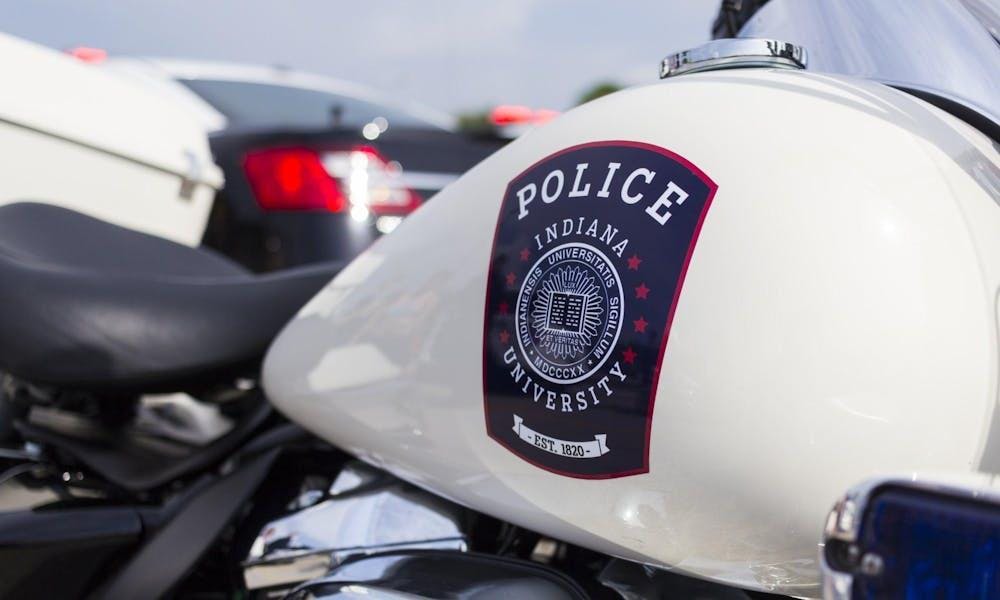
The Indiana University Police Department recently adopted a program training new cadets in American Sign Language and deaf culture. The initiative between the department and the IU ASL program was incorporated into the IU Police Academy curriculum this year.
According to the 2020 Census, Indiana has over 500,000 individuals identifying as deaf or hard of hearing.
Brennan Cox, part-time officer and student at Maurer Law School, said he advocated for the addition of ASL and deaf culture training to the academy curriculum after taking ASL classes as an undergraduate student in Bloomington.
“I realized there wasn't a lot of training, and I just wanted to be able to provide training so that law enforcement can have safer interactions with the deaf community,” he said.
Cox said when he was researching interactions between the deaf community and law enforcement officers, he came across body-camera footage from agencies across the county of officers using excessive force on deaf individuals due to a lack of understanding.
After Cox presented ASL and deaf culture training in 2023, IUPD officially incorporated deaf culture awareness into the curriculum in 2024.
Stephen “Nick” Luce, IUPD major overseeing the IU Police Academy, said he assisted Cox in implementing deaf culture training into the curriculum.
“It's always been an interest of mine, because I've had situations–very few,” he said, “but I've had situations where I've dealt with people that are deaf, and not having that skill set to communicate, it does make it difficult.”
Luce told Cox if implementing deaf culture training was feasible, he was all in on the project.
Luce said the training is like the basic Spanish language class previously implemented into the program, which allows officers to better engage with all community members.
“We want our officers to control a situation or assist the community member by using, in this instance, basic sign and cultural understanding of the deaf community,” he said.
Luce said the almost three-hour deaf community awareness training focuses on three main areas: deaf culture and community awareness, strategies for policing a deaf individual and learning basic ASL signs.
Luce said the academic nature and student focused goal of IUPD allows new policing ideas to be implemented, and the department embraces student-led initiatives.
“If they bring it to the training staff, the first thing we tell them is, ‘bring us an idea and bring us a solution,’” he said.
Luce said the department hopes to expand the training across Indiana or even nationally.
“The long-term goal was to take what they've developed collaboratively and let other police departments know,” he said. “Here in Indiana, we'd like to get this into the curriculums of all the police academies” he said.
Cox also collaborated with his IU ASL Professor, Debbie Gessinger, to help develop the curriculum and prioritize the main aspects needed for law enforcement to interact with the deaf community.
Gessinger is a member of the deaf community and has spent her life advocating for the deaf community, she said.
“We are human, and we deserve the same equal treatment as other individuals that the police serve,” she said. “Bringing awareness of the deaf community was really heartwarming to me.”
Gessinger said although the curriculum is robust, it is impossible to teach everything in one session, and officers should continue to learn after the training.
"If officers make an effort to engage with the deaf community outside of their training or just a textbook and immerse themselves in the deaf world a little bit, they would gain a deeper understanding of our community and culture," she said.
Gessinger said the training also teaches officers about the norms and expectations within the deaf community, like the importance of non-verbal cues such as eye contact and waving or lightly tapping on the shoulder to get a deaf individual's attention.
She hopes other organizations like hospitals, schools and other public services will adopt similar ASL training programs
Gessinger said ASL and deaf culture initiatives help hearing individuals understand that ASL is a robust language as complex as spoken languages.
“ASL is not some little thing that you do with your baby,” she said. “It's really a language that grown adults use on a daily basis and in the professional workforce.”
Editor's note: This story was updated to clarify the ASL training is being implemented in cadet training and not necessarily for those already on the force. This story was also updated to remove an unverifiable claim that IUPD is among the first law enforcement agencies in the nation adopting this kind of training.



