
There’s a moment of quiet respite early in Celine Song’s “Materialists” in which Lucy (Dakota Johnson) and her co-worker and friend Daisy (Dasha Nekrasova) talk about their love lives over a cigarette on the balcony. Lucy insists she’s waiting for the right man, and the implication, for both the characters and the audience, is that this imaginary husband is expected to be wealthy. At one point, the conversation turns to the topic of cosmetic surgery, and how its current prevalence might affect the romantic marketplace.
“What’s the saying?” Daisy asks. “You’re not ugly, you just don’t have money?”
The two are specifically talking about limb-lengthening surgery, about how some men are willing to break both of their legs to gain a few inches in height. In Song’s sophomore film, this sort of desperate measure is simply a symptom of modern capitalism. It’s a film interested in the economics of love and how the system we reside in influences our decision-making. Going to such great lengths just to be a bit taller might seem insane, but for the characters in this film — and for more and more men in real life — it’s a genuine investment to increase one’s value on the dating market.
In “Materialists,” Lucy is a matchmaker working for a company called Adore in New York City. She’s hired by her clients to find the perfect person, a person who fits all the attributes they desire and who they can eventually marry. It’s sort of like the material equivalent to apps like Tinder or Hinge, with Lucy taking the place of the algorithm that informs so much of our current conceptions of dating. But while those apps are free, Lucy’s clients pay her hefty sums to do their courting for them: they are, like men artificially lengthening their limbs or women getting a nose job, making an investment in their love lives.
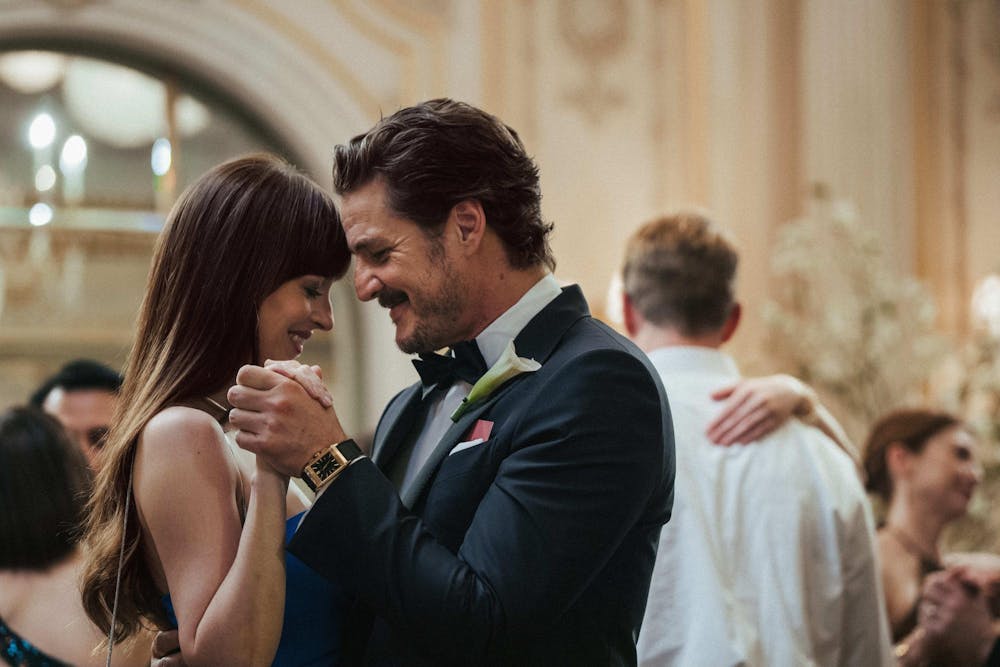
Sometimes her matchmaking methods work. She attends one of her client’s weddings, and though this client still has reservations, Lucy is there for consolation all the way up to the moment the bride walks down the aisle. It’s at this wedding that she meets Harry (Pedro Pascal), the wealthy brother of the groom and a fellow resident of the singles table. She also runs into her ex-boyfriend, John (Chris Evans), who works as a server for the event’s catering company — the total financial opposite of the suitor she’s just met. It’s here where “Materialists” falls into the standard trappings of the romantic dramedy: the surface-level conflict of the film is this love triangle, and viewers are left to decide which of these two men to root for.
At the same time, the film forces you to question this decision. It deconstructs what exactly makes someone an ideal partner for someone else. Harry is a “unicorn,” Lucy declares, because he’s everything a woman could possibly want. He’s rich, handsome, tasteful, educated, tall, put-together and he has no emotional baggage. But these preferences don’t exist in a vacuum — we only have them because we’ve been influenced by society to have them. One can’t deduce natural animal behavior from an animal raised in captivity, and one can’t deduce natural human behavior from one raised under capitalism.
Lucy and John are defined, in part, by their more negative qualities. She’s argumentative and he’s quick to anger. This isn’t a value judgement from Song — it’s an argument for the role economy plays in human behavior. The two must be soulmates, John tells Lucy: “poor, voted for Bernie, shitty family,” the two share practically every socio-political attribute that matters. It’s why they might argue in the middle of the street and not feel embarrassed, conduct that someone, like Harry, finds baffling.
Song is very aware, too, of the modern relationship between the sexes and how it exists at an intersection of capitalism and patriarchy. There’s a subplot — to go into too much detail would be to spoil a major turning point — involving a sexual assault that lays this relationship bare and exposes the subtle but life-altering contradictions at the heart of modern dating. How does one even begin to calculate this sort of risk against the chance of meeting a stranger who might be the love of your life? It’s an almost impossible question to really answer, but it’s a calculation that people — especially women — must make every day.
“Materialists” opens unconventionally, with a silent scene of two primitive humans holding and kissing each other in a love without language. The man silently twists a flower into a ring and places it on the woman’s finger, signifying the first marriage. It’s a bit on the nose, as much of the film admittedly is, but representative of the picture’s core thesis. There’s corruption and wickedness in the world, much of it directly perpetuated by our commitment to the free market, but despite it all our ability to love and our ability to find comfort in another human continues to exist without ideology.
Song’s project is by no means perfect: it’s too eager at times to hold the audience’s hand and spell out every point, and it often has a much too idealized view of the social realities it's critiquing. But all in all, “Materialists” — like the director's previous film, “Past Lives” — is a cohesive, clever and appropriate film for our times, and it cements Song as one of the principal crafters of the modern romance.

