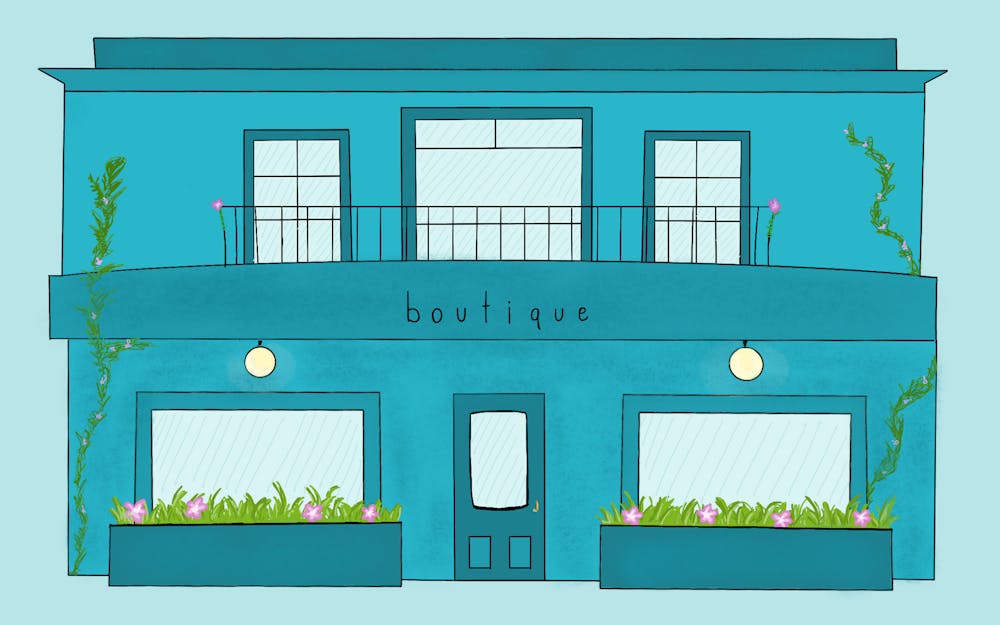
When I hear the word boutique, I immediately think of a clothing store. Specifically, a shop that curates a particular aesthetic with high-end pieces. But I have recently noticed that businesses other than clothing stores are using boutique as an adjective to describe their establishments as small but sophisticated.
Various countries have had different words for small shops since some of the earliest centuries. By the late 14th century, the French were using ‘botique’ to describe fashionable Parisian stores. Around the 1950s and 60s, British people started opening ‘boutiques’ in hopes of being associated with the haute couture of Paris.
What drew my attention to the use of ‘boutique’ in the non-fashion sector was when I was walking down Kirkwood in Bloomington and passed the construction for the Posh Hotel. I read the sign, and I couldn’t understand why the distinction was necessary; a hotel is a hotel, right? Posh Hotel describes its business with words like chic, sophisticated, luxury and stylish which are reminiscent of the exclusivity and specialization of French-inspired boutiques. I have since learned that boutique hotels have a long history and the business model was intentionally a step away from the growth of commercial hotels.
American businessmen were drawn to the cozy, intimate atmosphere of European boutique hotels, where the buildings had personalities and weren’t just a place to stay the night. They wanted to bring that kind of charming experience to U.S. hotels without the expensive price tags of other luxury hotels or the blandness of conventional hotels.
I can somewhat support this use of boutique. If hotels want to continue to draw from the upscale, specialty allure of the French term to set themselves apart from a monotonous landscape, then I can get behind that.
But there has to be a line somewhere. When I heard that a boutique cafe was opening soon in my hometown, I was excited to think that I could grab a coffee then shop in the retail space. I was disappointed to learn that the cafe would just be your typical coffee shop. ‘Boutique’ simply alludes to the European-inspired decor and refined vibe the shop hopes to bring to my downtown.
Fashion boutiques are the very opposite of commercial stores full of mass-produced clothing. When I walk into a boutique, the shop has already set the expectation that the items I will find inside will be one of a kind. Boutiques strive to make every new piece different from the last, but when I go to a hotel or cafe, I want to be greeted with familiarity and the comforts I know I like.
Even though I can understand the modern spread of boutique businesses, the term seems to be losing its meaning. Personally, I would prefer it if we held on to the original connotation of the word. If ‘boutique’ appears everywhere, it makes any business that uses it feel less special.