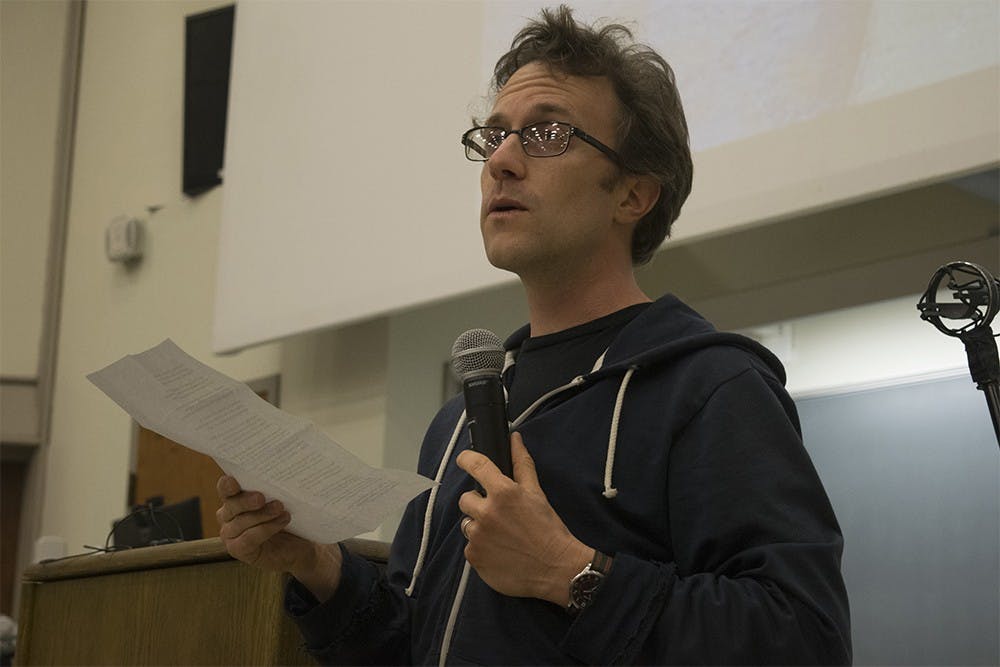
Before he read his first poem, Willy Palomo asked the audience to take off their shoes.
Palomo, and several other local artists, performed at the Bridging Toxic Links event Wednesday evening at Woodburn Hall.
His poem, “Papi’s Angel Teaches Me the Value of Shoes,” references the time Palomo’s father spent in an immigrant detention center, where a fellow immigrant from El Salvador told him to use his shoes as a pillow so they wouldn’t be stolen while he slept.
Bridging Toxic Links, brought the community together through art to examine the intersection of environmental problems and social injustices.
The event is part of SustainIU Week.
Performances included a reading of a photo essay about finding refuge in nature from racism, a song inspired by PCBs pollution in Bloomington and poems about war and destruction in Syria.
Kathleen de Onis is an organizer of the event.
She said artists like Palomo bring new perspectives to discussions about social injustice and the environment.
“Because the theme is sustainability in an unequal world, I didn’t want it to be the typical professors or an event where the same kinds of people are in the expert position,” de Onis said.
The “toxic” in the event’s title references both environmental toxins and toxic logic, de Onis said.
We need to bring societal injustices to the forefront of discussions on environmental issues, she said, because the two are intertwined, and the links between them can be used to find solutions.
The stories about Flint in the news should be seen as a sign of a systemic problem, de Onis said, where certain communities are marked as expendable.
Olivia Reda, a senior majoring in environmental science, is a student in de Onis’s class, Communicating Sustainability.
Reda said most environmental science literature is lacking in pathos.
However, art offers an emotional and spiritual connection to the issue, which inspires people to create change, she said.
Having a science-heavy background, Reda said exploring art as a way to communicate societal and environmental issues has been new for her.
“I felt a part of myself I hadn’t been able to speak to,” she said.
Art can bridge linguistic and cultural divides, Reda said.
Academic studies can’t connect these various factors in the same way as art, she said.
Palomo said he uses poetry as a healing process. It’s like diving into a wound again, he said, but the writer can now control their story.
“Especially when dealing with trauma, there’s often a narrative that gets placed on you, that you are defined by your trauma,” he said. “So it’s a way of re-working that trauma so you can take claim over it.”
Palomo said he first got into poetry and spoken word, like many young boys of color, through hip-hop artists like Nas and Mos Def.
Poetry can also function as a way to impact people and make societal change, he said.
“You get to be crazily intimate,” he said. “You’re able to humanize something that’s usually abstract for people.”