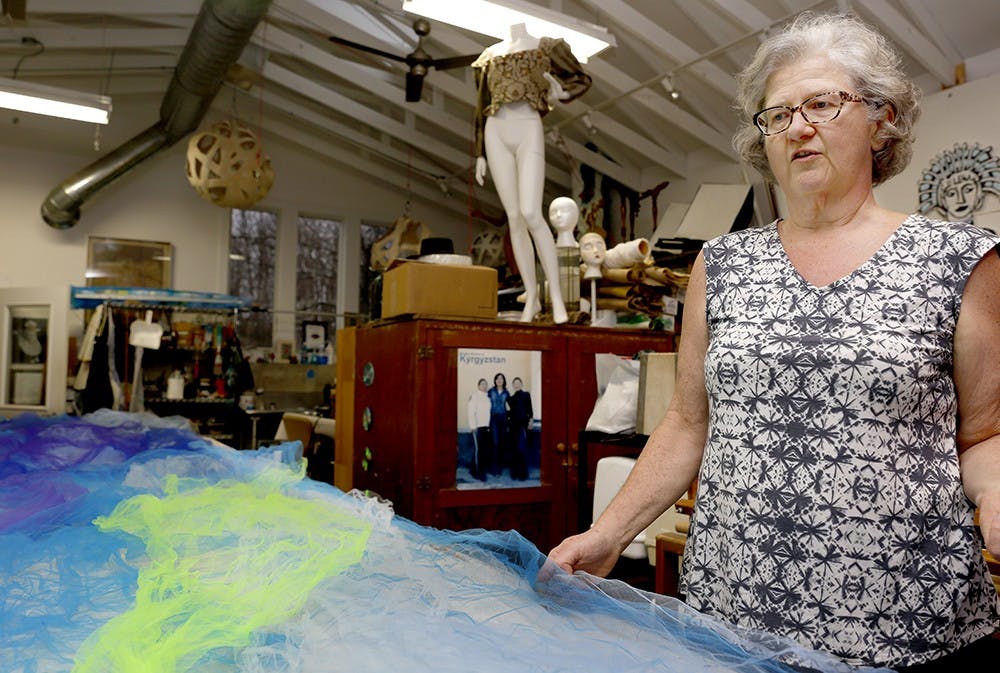
On Gail Hale’s workshop table lay strips of white, lavender, teal, aqua and periwinkle, hand-sewn back together.
The sheer fabric was discarded after a sorority dance, Hale said. She was patching it up to use as backing for the water-themed Trashion ReFashion show at the Buskirk Chumley Theater, an April 10event that will showcase designs made from recycled materials.
Hale, a textiles artist, re-uses fabrics and fabric-like materials in virtually all of her projects.
“I’m not a seamstress, you know,” Hale said. “I’m an artist. It’s not that I know everything about fabrics or sewing. I just try to be creative with solutions.”
Hale is a member of Discardia, an artistic non-profit that collects materials that drape and can be sewn for reuse, and holds monthly sewing days where community members can come use sewing machines to repair their own clothes or ask an artist for help.
As a former committee member for Trashion ReFashion, she has helped organize and decorate the stage every year.
Recently, Hale helped create a sustainable decoration collection designed for long-term use by Bloomington nonprofits.
The nylon organza streamers, edged with ribbons in orange, purple, green and blue, can be reused in different color combinations for years, Hale said.
The entire collection is currently rolled into several flexible, dollar-store laundry baskets under Hale’s workroom table.
The streamers are made from nylon organza, a stiff, sheer fabric that is transparent enough to create different shades and color effects when the fabrics are laid against one another.
“We made them so you could keep using them in different orientations,” Hale said. “And then you’ll see the colors flowing and floating.”
Keith Romaine, another textile artist who instructs at Ivy Tech, originally used the white fabric to decorate Blueline Media’s Bliss Christmas event.
Romaine dyed some the organza orange and used it again for a Pride event, then dyed more for Pride Summerfest and the Pride Film Festival in January of this year.
He approached Hale about decorating for the Hoosier Hills Soup Bowl Benefit, which was held Feb. 21.
“One of Gail’s things is always to have decorations, backdrops, fabric that can be used in multiple areas,” Romaine said. “And it’s mine too. I like to reuse things as well.”
The formerly-white organza strips were dyed two different citrusy oranges, deep purple and grass-green for the Pride events.
“The bigger an impact you can have with color, the more you change a space,” Romaine said. “So our goal is to have as much impact as possible, as compact as possible and to be reusable in multiple spaces.”
Thanks to a $500 donation from her doctor, Mary Mayhern, who merely specified that Hale “find a good cause,” Hale bought several new colors for the Hoosier Hills Food Bank fundraiser.
Hale had already wanted to create decorations the Soup Bowl could reuse from year to year.
“I thought we could do a lot of colors and have a lot of different options,” she said.
Hale said she supplemented the strips with other organza in fuchsia, teal and lavender from Gifts International Inc., a site that normally sells lengths of fabrics for wedding decoration.
Though the list price for most of the colors on the website are $35 per bolt, Hale said, she got the new colors for significantly less — only $9.50 for 25 yards.
“Because it was 38 cents a yard, that gave us enough money to get enough fabric that we could fill the convention center very reasonably,” she said.
Hale and Romaine attached lengths of ribbon to each piece of fabric so they could be tied to poles or other fixtures.
As the Bloomington Monroe County Convention Center where the Soup Bowl is held has steel i-beams, Hale used magnets to hang the colorful streamers from the ceiling.
Hale said a person could also use magnets to bunch or twist the fabric and fix it in a given shape, as organza doesn’t drape as readily as other fabrics.
“It’s flexible,” Hale said. “It’s kind of like using the nature of the fabric to its best advantage.”
Romaine said another benefit to the fabrics is knowing what they have to work with before event planning really begins.
“When we make something, we have it around and can plan new ways to use it,” Romaine said. “But when we work with new materials, we don’t know what we’re getting.”
Hale and Romaine hold the decorations now, though Romaine said they’re open to other nonprofits using the materials for events.
“It seems foolish and wasteful to use them only once,” he said.
As an artist, Hale said the two can only offer tax breaks for donations to the project if it’s to be used for a specific nonprofit or event.
“Even if I don’t make any money, I’m ‘for-profit,’” Hale said.
To that end, Hale said she’s considering asking other non-profits who are interested in using the decorations to write grants to help with storage expenses or add new colors of fabric to the collection.
She has also contacted the Hoosier Hills Food Bank about finding a place to keep the decorations.
“I want it to be sustainable — for me and for other organizations,” she said.
Hale can see a future for all of the fabric in her workshop, though, even though it may not always be in the same form.
Former projects are either pieced apart and used for new ones or decorate the space around her.
Even if a piece of fabric tears or stains, she said, she’ll find a use for it indefinitely.
“You can cover up the holes,” Hale said. “Or you can take the holes and make it part of the design, something interesting.”