
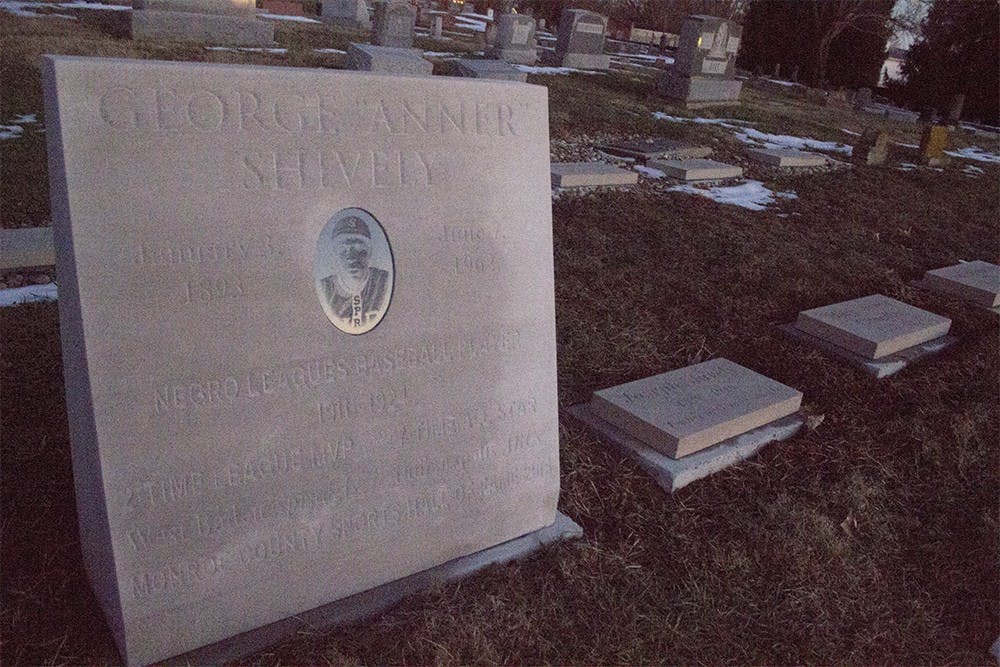
Playing for the West Baden Sprudels and the Indianapolis ABCs from 1911 to 1924, he was a two-time MVP and a seven-time All-Star.
He may have been the best player ever to come out of Bloomington. Until recently, nobody seemed to care.
His death in 1962 went without mention in the sports pages, his legacy forgotten even in his hometown. He was buried in an unmarked grave.
Last year, however, Shively’s story resurfaced.
More than five decades after Shively’s death, Bloomington sports writer Bob Hammel remembered a small note he had written about Shively in an interview with NABL player Cornelius Cook.
“So I Googled, and man, it was like striking gold,” Hammel said.
As an avid storyteller and sports lover, Hammel continued digging for information. The more he learned about the mysterious Shively, the better the story seemed to get.
Shively was born in Lebanon, Kentucky, in 1893. The grandson of a slave, he and his father Joseph moved to Bloomington when Shively was 7 years old, according to the 1900 Bloomington census.
As a child, Shively attended the Bloomington Colored School through the fifth grade.
The Shively home was on the west side of the city, not far from downtown, according to Thomas Clark’s four-volume history of Indiana University.
One night, when Shively was 10 years old, a group known as white-cappers approached the house. The violent gang terrorized Southern Indiana towns from the end of the Civil War, taking it upon themselves to enforce morality with lynching.
Around 1 a.m. the men approached Shively’s house, dragging his father and two women from their beds and into Dunn Meadow. As one of Shively’s sisters ran to notify the police, the three victims were badly whipped with barbed wire, according to Clark’s book.
When police approached the scene of the crime, they were confronted by four armed men who suggested they not go any further. With little effort, the police obliged and walked away.
Gov. Winfield Durbin, Indiana’s leader at the time, was furious when he learned of the incident. He wrote a letter to the Bloomington sheriff suggesting that if he couldn’t enforce the laws any better, Bloomington might not be a suitable home for IU any longer.
The police eventually arrested the criminals.
Eight years later, at age 18, Shively left Bloomington to begin his baseball career with the Sprudels.
He retired from the game 13 years later, never having the chance to play in the major leagues.
After learning the extent of Shively’s accomplishments, Hammel decided it was time the rest of Bloomington did too.
Shively was buried alongside his wife in Rose Hill Cemetery with eight other family members surrounding them. Not one of them could afford a headstone.
Hammel, along with IU employee Sally Gaskill, began raising funds to erect a grave marker at Shively’s final resting place.
“It’s a chance to address a really, really grievous wrong,” Hammel said.
Hammel and Gaskill said they were surprised at how quickly they raised $16,000 through local speeches and charity events.
Shively’s story struck a chord with local business owners Steve and Kathy Headley. The couple donated $10,000 as a result, making them the biggest donors to the cause.
This amount covered not only enough for Shively’s stone, but for everyone buried in his lot.
Limestone was donated from a local quarry and stone carver Casey Winningham engraved the Shively’s portrait.
“I think that every life has value and deserves to be remembered in some way,” Winningham said. “To have a grave marked is an important acknowledgement of respect.”
Kathy grew up in an abusive family, and her grandfather had been a devout member of the Ku Klux Klan.
When the memorial was unveiled in a ceremony on Easter 2015, the first day of the year’s baseball season, Kathy held hands with Shively’s descendants and smiled.
“I just hope my grandpa is turning over in his grave,” Kathy said.
Shively was inducted into the Monroe County Sports Hall of Fame in 2015.
Hammel is now working to create the George Shively baseball diamond for underprivileged kids to learn how to play.
Hammel doesn’t want anyone else to miss out on an opportunity because of who they are or the circumstances they were born into.
“Shively wasn’t around to see it happen,” Hammel said. “But that name is going to have some meaning around here.”



