
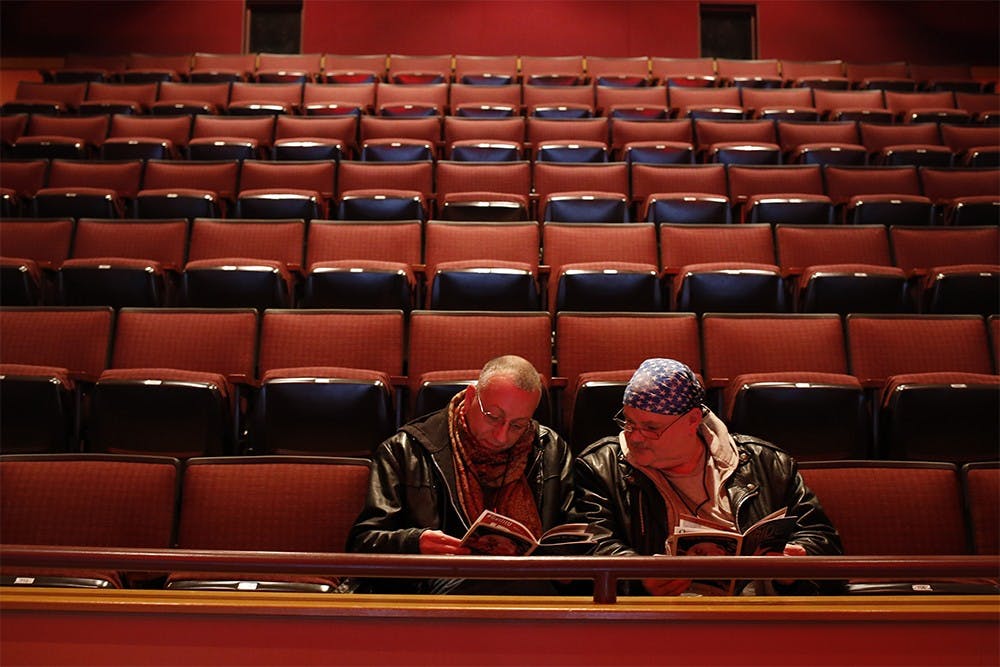
Thursday is opening night for the Bloomington Pride Film Festival, a three-day event of films, live performances and celebrations. The festival is screening 32 films that contain themes pertinent to the LGBT community and beyond.
2016 marks the 13th year of the Bloomington Pride Film Festival. Executive Director Sarah Perfetti said that over the years, the festival has grown and positively affected both the LGBT community and the wider Bloomington community.
Perfetti said the festival helps highlight the town as a progressive community that is accepting of many different cultures.
“With the stuff that’s going on right now in the statehouse with the new RFRA bill, it makes Indiana look really bad to people who might identify as LGBTQ or might just be allies,” she said. “So having a big festival like this makes Bloomington, and Indiana as a whole, look better.”
The festival began in 2003 when two School of Public and Environmental Affairs graduate students proposed the festival as part of a class project.
Doug Bauder, coordinator of GLBT Student Support Services, said when the students came to their office asking for help with the project, they were referred to Danielle McClelland, executive director of the Buskirk-Chumley Theater.
“She worked with them and developed a little evening program that was pretty small scale,” Bauder said. “More and more people got interested in supporting this event.”
More days, screenings and activities have been added over the years. This year, Perfetti said they removed the traditional dance party in order to add a sixth screening.
This year’s festival also features the Prism Youth Community, Bloomington Pride’s outreach group for LGBTQ, allied and questioning youth.
“Our youth are going to lead a public discussion about queer representation in the media,” Perfetti said.
Films in the program include directors from the United States, Colombia, Israel, South Africa, the United Kingdom and more.
“Election Night,” a short film from Los Angeles-based director Tessa Blake, will screen Saturday evening. The film revolves around the family of a campaign candidate as they desperately try to view the results of an election.
“The family goes a little crazy, things are revealed, and there are twists and there are turns,” Blake said.
Blake’s film has screened at several LGBT festivals. She said these festivals are an integral part of the culture.
“I think it’s important for there to be gay and lesbian pride festivals and films, because they still lack so much in terms of representation in mainstream media,” she said.
Despite being unable to attend the festival, Blake said she is proud to be included in the Bloomington Pride program.
“There’s wonderful leadership at the festival,” she said. “I’ve had wonderful interactions with everyone.”
Another film to be screened Saturday is “Stella Walsh,” a documentary short by Akron, Ohio, filmmaker Rob Lucas. The film follows Walsh, an intersexual Olympic runner from the 1930s.
“At one time, she was the fastest woman in the world,” Lucas said. “And Stella always considered herself as a woman.”
Lucas said pride festivals like Bloomington Pride Film Festival build an infrastructure for discussion through gathering and viewing films.
“The audiences that attend really want to build a sense of community,” he said.
Lucas said because of Walsh’s inspirational story, he hopes the audience walks away with a positive outlook.
“Even though she lived in an era of extreme discrimination, she didn’t let it hold her back in achieving her goals,” he said.
Though the festival screens films from all over the world, Bauder said the festival has also had a longstanding effect on the local LGBT community by motivating its members to become involved in politics.
“We are a significant part of this community,” he said. “We have something to contribute — not just to the arts, but to the politics.”
Bauder said the Bloomington Pride Film Festival has positively affected IU students over the years.
“For some people, it’s the first event that they’ve ever attended that honors queer people,” he said. “For students who grew up in small-town Indiana, that’s a huge thing. They recognize that Bloomington is indeed the friendly place that we say it is.”
Looking ahead, Perfetti said she hopes to see an even wider diversity of films in future years of the festival.
“I would really like to see more diverse perspectives from filmmakers,” she said. “I really hope to see that there are more stories that positively represent non-binary people.”
Perfetti said she also hopes to see more films involving LGBT people of color.
Like Perfetti, Bauder said he is optimistic about Bloomington being a positive example for the rest of the state.
“Bloomington, I hope, is impacting the state and hoping to lead the state forward with a more progressive attitude,” he said. “Many people could learn from how this community deals with diversity.”



