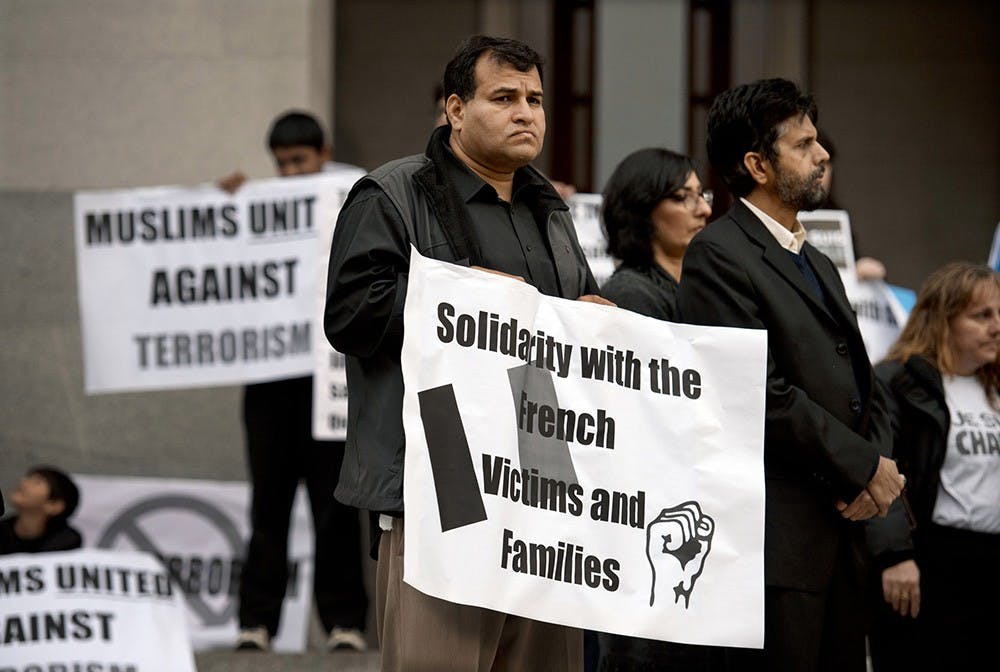
Muslims are being called “Muslim savages” and “extremists” by tweeters across the globe after Wednesday’s events, including hashtags such as, “#banIslam” flooded international Twitter ?timelines.
“I also witnessed hashtags on Twitter such as, ‘#KillAllMuslims’ and the like, which suddenly seemed to give me, a Muslim, a stake in a conflict an ocean away,” Dana ?Khabbaz said.
Khabbaz is a sophomore double major in political science and international studies. She is a declared Muslim, active in the Muslim Student Union as the philanthropy chair.
Charlie Hebdo magazine is known for its satirical caricatures of the Muslim prophet, Muhammad, as well as figures of various religions. However, due to the nature of recent events in the Middle East, the caricatures seem not-so-satirical in a country where almost 4.7 million inhabitants are declared Muslims.
The cartoons not only depict Muhammad — an act that is banned in strict Islamic societies — but they are illustrated in a way that poses the Muslim prophet as an object of comedy and conflict.
“It would be like seeing your mom or dad, or another role model in your life, being publicly ridiculed,” said Ramaze Akram, senior biology major and co-president of the MSU.
Akram and Khabbaz said they absolutely do not agree with the offensive material Charlie Hebdo published.
“I don’t know if this has anything to do with my Muslim identity — or if it’s just the person that I am — but some of the stuff (Hebdo Magazine) has published did make me a little bit uncomfortable at times,” Khabbaz said.
Khabbaz said that the offensive material she has seen was not only on satirical cartoons of religious figures, but also blatant illustrations of racism. The magazine attacked a lot of people, not just Muslims, Khabbaz said.
Khabbaz said she does believe that, in a country where it is legal, the publications did not warrant such retaliation. Though she said she does not support the material of the magazine, she fully supports freedom of expression and opinions.
Akram and Khabbaz both said they do not believe anyone should be silenced or “gagged on (the Muslims’) behalf.”
The magazine has a long history of fighting lawsuits filed by religious communities in regards to controversial and offensive cartoons of religious figures. Judicial courts of France have declared every time that freedom of speech defends the publication of these cartoons.
“I understand that not drawing or picturing a prophet is a bigger issue in Islamic countries, but in no light would someone be killed over such acts,” Akram said.
Wednesday’s attack was not the first act of retaliation the magazine received from local Islamic communities. A bomb threat and lawsuit against Charlie Hebdo dates back to 2006 — the first of many threats and violent acts from the Islamic community.
“We can either support this hate speech, or support people being killed for this hate speech, and of course we don’t want people being killed, so we tend to side with the magazine,” Khabbaz said.
In 2011, the French government outlawed the wearing of any veils or other face coverings, which is an iconic Muslim practice.
Khabbaz said in reality the idea of being both Muslim and claiming identification with non-Islamic countries do not conflict in most scenarios.
She also said that she recognizes that tensions are bound to run high between Muslim immigrants and French people, given that the majority of new immigrants entering France are Muslims.
French President François Hollande made a statement after the Hebdo shooting, declaring the country wounded in the heart of where “the spirit of liberty, and thus of resistance, breathed freely.”
A statement regarding the attacks in Paris written by President of the Islamic Center of Bloomington, Mohammad Syifa A. Widigdo, said these violent reactions to such publications are strongly against the teachings of the Muslim faith.
Widigdo, on behalf of the ICOB, refers to the French journalists as innocent victims of “heinous acts” and hopes to see justice instilled upon them.
“(Muslims) stand for justice and peace, globally, national and locally, for all,” Widigdo said.
Khabbaz said, in her understanding of the Muslim faith, the Muslim culture is a peaceful culture with limitations even on their use of self-defense.
She said she believes oftentimes the people who have hate for Muslims are typically mistranslating the Quran, or that they present arguments based on information that is “simply untrue about the Muslim faith.”
“There is nothing in the Islamic belief system that you can draw, say or write that could justify the killings,” Akram said.