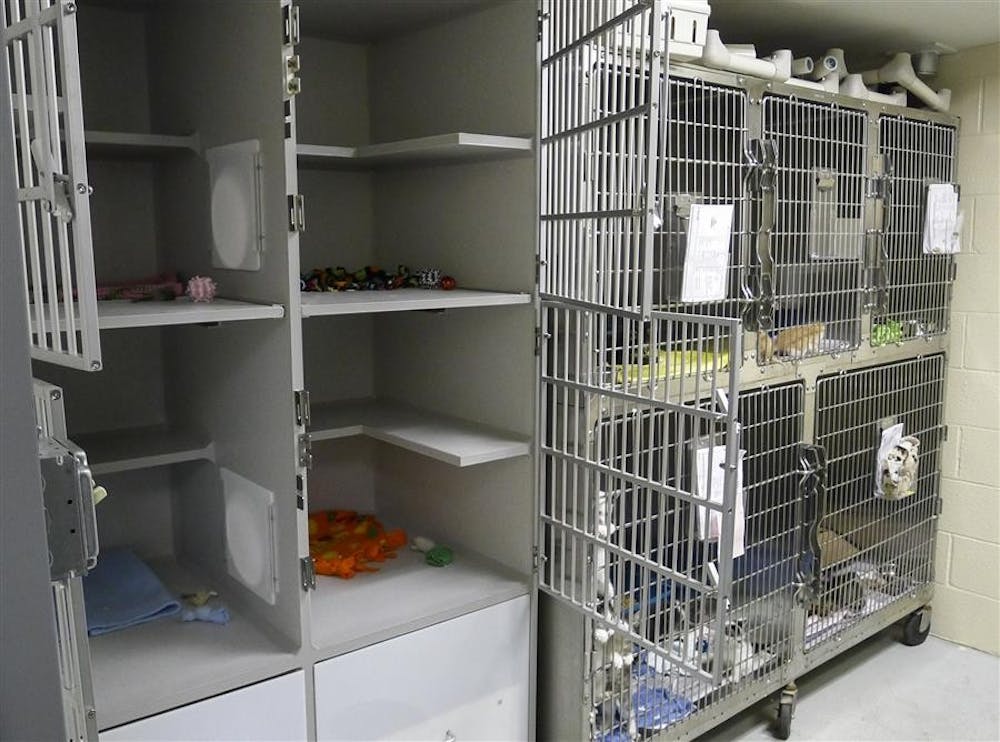
The City of Bloomington Animal Shelter announced last week the addition of a new kitten nursery to its facilities.
Grants totaling $7,000 were awarded to the shelter by the American Society for the Prevention of Cruelty to Animals (ASPCA) for its accomplishments in the 2012 ASPCA Rachael Ray $100K Challenge.
“My offices were used as the kitten nursery for the past two years, which worked, but wasn’t the best situation,” said Virgil Sauder, City of Bloomington Animal Care and Control shelter manager.
Only 50 shelters in the country were selected to be a part of this challenge.
Bloomington was selected after the local community went online to vote for the shelter.
The Bloomington shelter ranked number two in the United States due to overwhelming support by the community.
In order to be eligible for the challenge, the local shelter had to save 300 more animals between August and October than it did the previous year.
“In 2011, we saved 741 animals,” said Laurie Ringquist, director of the City of Bloomington Animal Care and Control. “In 2012, we saved roughly 1,041
animals.”
The shelter successfully competed last year, though they did not win the overall grand prize of $100,000. They were awarded $5,000 for completing the challenge and an additional $2,000 for a photography contest. Some of the adopters submitted pictures of the animals they adopted within the three-month timespan.
More funding for the kitten nursery was supplied by the City of Bloomington.
“We used the money we won from the ASPCA challenge to buy new supplies for the nursery, but ultimately the construction of the new nursery was funded by the city,” Ringquist said.
Each spring and summer, from March through late September, the shelter is flooded with hundreds of newborn kittens and nursing moms due to breeding season. From April through August of 2012, they received roughly 190 to 240 kittens or cats per month.
This feline group is most at risk to contract life-threatening upper respiratory infections and should be isolated from the rest of the cat population. This is due to their weakened immune systems at birth and the stress caused by the other cats in a confined area. The previous shelter configuration did not include any space for the isolation to prevent the spread of the infections.
“We use the metaphor of a daycare to explain the respiratory infections: if one kid sneezes, everyone starts to sneeze,” Ringquist said.
Shelter staff and City facilities staff analyzed the use of several areas of the shelter as well as animal intake trends and created a plan to renovate a small dog room, storage closets, dishwashing area and laundry room for use as a nursery.
“Since the dog intake has decreased in recent years, we knew it was feasible and affordable to use the small dog room as the new nursery,” Sauder said. “We also wanted to utilize space that we already had instead of building on.”
The grant funding was used more specifically to purchase new kennels and other items needed to outfit this room as well as to purchase soundproofing panels to make existing cat kennels less noisy and, therefore, less stressful to the animals.
“We believe this new kitten nursery will help hundreds of animals at the shelter to remain happy and healthy,” Ringquist said.
Local shelter constructs kitten nursery
Get stories like this in your inbox
Subscribe