Junior Andrea Balzano walked through the halls of Collins Living-Learning Center last spring when she saw a flyer hung in the stairwell for a geology course.
It piqued her interest.
Later that summer, she was climbing rock walls in Yosemite National Park and studying the landscape of Death Valley as a part of the course. The undergraduate course that allowed Balzano and 14 other IU students to study volcanic features of the eastern Sierra Nevada is taught as a collaboration of Collins LLC and IU’s Geological Sciences department.
“Volcanoes of the Eastern Sierra Nevada: Geology and Natural Heritage of the Long Valley Caldera” — GEOL-G 188 on a course schedule — is a 15-day travel course that takes place during Summer Session 1.
Professors lead students on a journey through the eastern mountain chains of the Sierra Nevada in California to learn about volcanic processes and geological history of the natural landscape.
Professor Michael Hamburger, the course’s instructor, said it is a unique opportunity for undergraduates who want to get hands-on experience during their summer breaks.
“It’s unusual because it offers students at the introductory level a chance to get the type of intensive, field-based experience that is offered usually to upper-level students,” Hamburger said.
He said the group visits a variety of natural sites during the trip, each with their own special geological history.
“There are so many beautiful spots out there, each extraordinary in some way,” he said. “At Dante’s View, you’re on this rugged ridge top at about a mile’s elevation, looking down at the Badwater Salt Pan and can see for 50 miles in each direction. It’s a spectacular image of a landscape that looks so foreign to someone from the Midwest, but then we get to the White Mountains a few days later, up at 11,000 feet with these mysterious, ancient trees. The view is just incredible.”
Though the course brings a lot of beauty and excitement, it is not a class for someone seeking an “easy A,” Hamburger said.
The course requires an intensive, one-credit-hour class taken the prior spring semester to acclimate the students to geological terms, scientific and societal issues of the regions and to help students introduce themselves to the group.
During the two-week journey, students are expected to collect field observations and write those ideas into a field journal. Also, students are encouraged to make sketches, take measurements and participate in group discussions about their geological observations of each landscape.
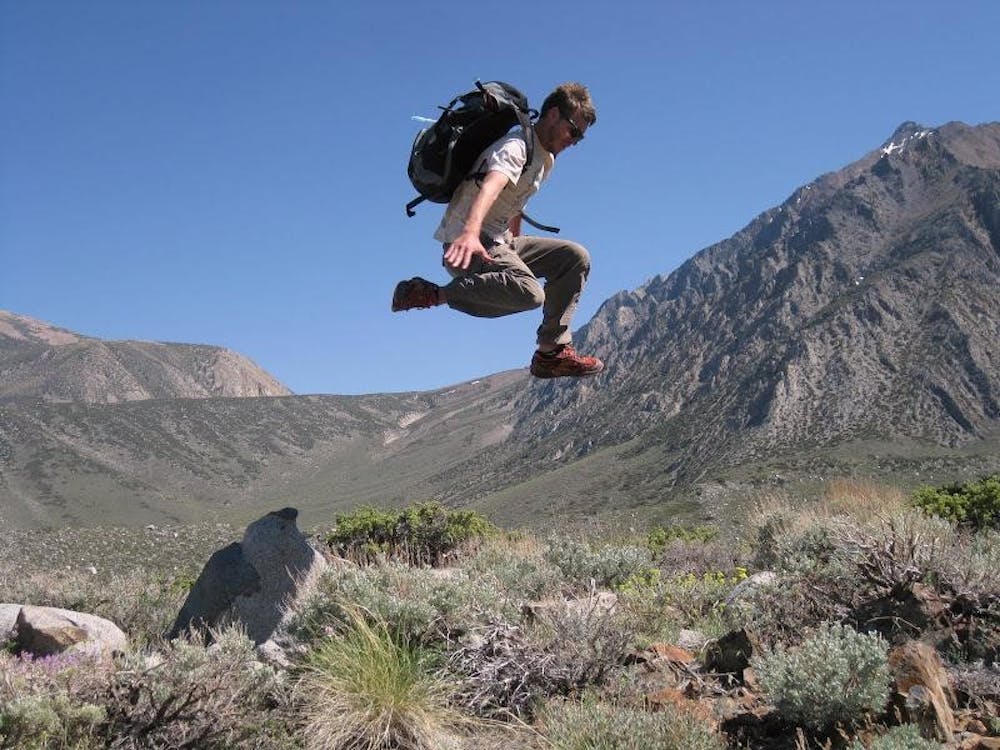
“It’s definitely a different style of learning,” Hamburger said. “We spend 12 to 14 hours a day in the field, hiking and mountain climbing, having snowball fights and jumping in ice-cold lakes, having picnics on top of mountain ridges ... it’s definitely a mix of learning and social activity.”
Balzano said her favorite destination of the trip she took in May 2012 was the group’s visit to the Mammoth Lakes region of the Sierra Nevada mountain chain.
“Everywhere we went, everything we saw was magnificent and beautiful,” she said. “Everyone out there cares so much about their community, the environment and the world, and to meet them and experience that was the best part.”
Balzano, a journalism major, said she had no experience with geology before taking the class.
She said anyone who likes adventure and the outdoors should think about enrolling in the course.
“Science was never my gig, but the class took me places I may not have otherwise been able to go,” Balzano said. “Science experience is not necessary at all. All you need is a positive attitude and a willingness to get a little dirty.”
Students scale Sierras in course
Get stories like this in your inbox
Subscribe