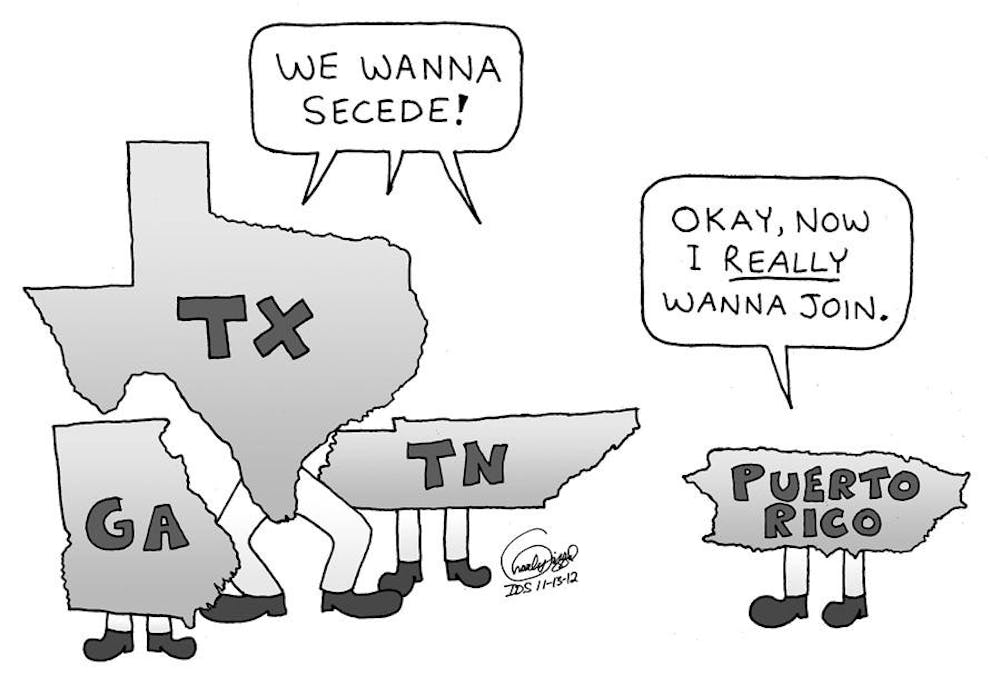
Elementary schoolers might have to learn another state capital after a vote in Puerto Rico drew the commonwealth a little bit closer to statehood.
Only a little bit closer.
What is being hailed as a vote for statehood has been largely misunderstood by the general public. To be fair, the results were pretty confusing.
Puerto Ricans were asked if they favor their current status as a U.S. territory and if they would favor statehood, independence or “sovereign free association.”
Only 54 percent of those who voted were in favor of changing Puerto Rico’s current status.
There are 61 percent of respondents to the second question who voted for statehood and 500,000 people left the question blank.
If 46 percent of Puerto Ricans do not want to change their legal status, then asking their preference for a change in legal status is nonsensical.
These numbers point to a Puerto Rico that is still unsure of its desired status. The only reason the referendum even made the news is because it was the first time Puerto Ricans seemed to vote in favor of statehood.
We would argue that the vote is largely inconclusive. Additionally, it was a nonbinding referendum, meaning that no actual change will precipitate.
It’s a little early to have any state induction ceremonies yet, but what would happen if Puerto Ricans did overwhelmingly vote to become a state?
No region that petitioned to become a state was ever denied. As long as Puerto Rico followed the proper procedures, they would almost certainly be welcomed into the Union.
Then what?
Currently residents of Puerto Rico cannot vote in presidential races and have no real representation in the legislative branch.
Upon achieving official statehood, the island would elect two senators and five representatives. Most likely these House seats would take away from those that would have otherwise been allocated to Texas, Florida, California, Washington and Minnesota.
This means that Puerto Rico would have seven electoral votes, giving the newly formed state as much weight as states like Oklahoma and Oregon.
The new state’s party affiliation is somewhat up in the air. Hispanics in general tend to align themselves with the Democratic Party, as do the majority of Puerto Ricans.
However, the 800,000 Puerto Ricans living in Florida voted for former president George Bush in 2004 and President Barack Obama in 2008.
The addition of Puerto Rico might inspire Republicans to make their platform more Hispanic-friendly, but this kind of change is likely to occur without a new Spanish-speaking state.
Spanish would likely become a point of contention for many in the contiguous 48 states. Any elected official from Puerto Rico would speak both English and Spanish, but would no doubt be more proficient in the latter. Confronting our linguistic issues would most likely be the most contentious issue upon the inclusion of a Puerto Rican state.
Still, none of these changes are going to happen anytime soon, so there’s that.
Puerto Rico won’t be 51st state
Get stories like this in your inbox
Subscribe