
Mary Winters learned four truths when she was growing up as a foster child.
The first was that she was not wanted. The second was that her body was for others’ gratification.
The third was that men are stupid. The fourth was to trust no one.
“It took 30 something years to change that opinion,” she said.
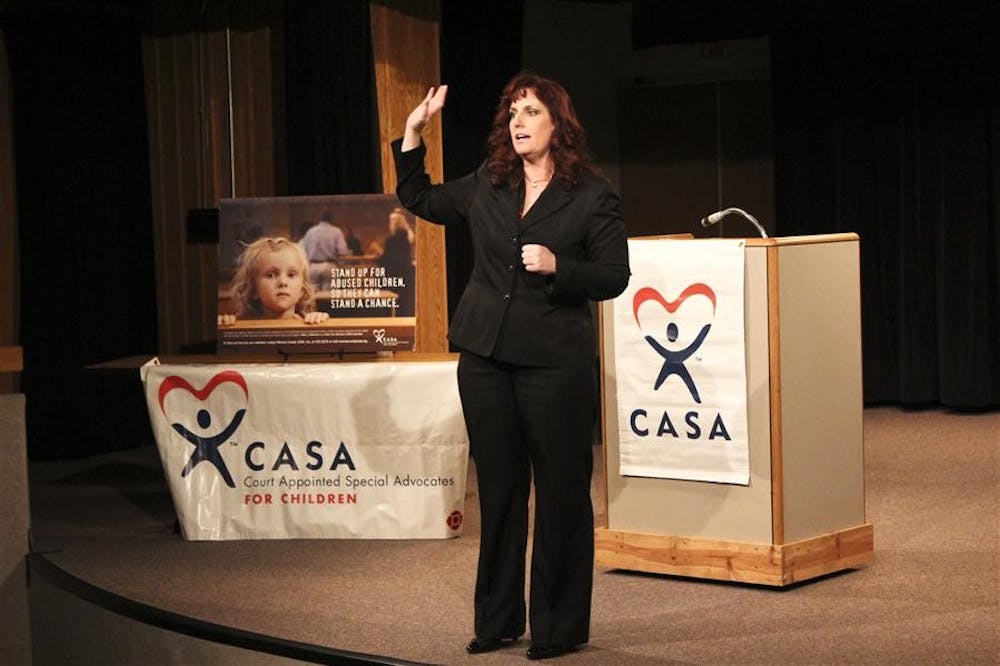
For Child Abuse Prevention Month, Monroe County Court Appointed Special Advocates, or CASAs, sponsored a presentation given by Winters about her former foster youth.
“Why Unpack My Bags?” That was the question Winters asked herself while growing up and the audience of about 40 people. Foster parents and CASAs attended the talk.
“This presentation explores the fears that children have as they come into care and how they cope with those fears,” said Kristin Bishay, director of CASA of Monroe County.
Since birth, Winters has been a “product of the foster care system in Ohio,” which she said is different than how the foster care system is now.
“Foster care sucks,” she said. “I don’t care how great the foster home is. It is what it is, and you’re going to hear me say that a lot.”
Winters and her brother were sent to the foster care system at a young age. This was when Winters learned truth No. 1.
At age 4, she was adopted out of an orphanage. Shortly after, her adoptive mother, who had mental problems, got married.
That’s when she learned truth No. 2.
“I am a vessel to somebody else’s gratification,” she said. “I am a piece of furniture.”
Winters tried to tell case managers, but she said they didn’t listen to her.
“It went from mere molest to the all-out,” she said.
Winters was 6 years old.
Later, her mother remarried a man who Winters said was stupid.
Truth No. 3: Men are stupid.
Today, her mother is still married to him.
“I’ve learned to appreciate him,” she said. “He ended up being a good guy. He was the first man to love me and expect nothing out of me.”
By the time she was 16 years old, Winters had been to 10 different schools, had 20 different case managers and had multiple stays at psychiatric hospitals.
But by that age, Winters learned her fourth and final truth: Trust no one.
Winters said she remembers being put into a foster home in which the foster parent tried to “ladify” her.
“Once again I am a pissed off kid who has some pretty good truths under her belt,” she said.
Later, Winters was back with the father who was involved in her first adoption.
Not long after, Winters had her first stint in juvenile court. When she got out, her mother sent her to a Christian school.
“It was the first time in my life, ever, that I had met people who were who they said they were,” she said. “There were no masks or pretending. These people were genuine.”
Winters ended up in the hospital when she tried to kill herself. After that, she was taken to a psychiatric hospital.
“The whole point of this is that you don’t hear sob story,” said Winters. “The whole point is to hear a living, breathing foster child answer questions.”
Today, Winters has three children.
Winters said it is important that foster parents and CASAs tell foster kids that they are important and that they are honest with them.
“CASAs are the only people who aren’t there for the money,” she said.
Mary Beth O’Brien, who has been a CASA for 10 years, said she listened to Winters’ story and tried to relate it to her own experiences.
“They need to know that they have voices,” she said. “So much of it is that people are making decisions for them, and they need to be heard.”
CASA event focuses on foster care
Get stories like this in your inbox
Subscribe



