
When settling in for a new adaptation of one of Agatha Christie’s mystery thrillers, you tend to expect the comfort of familiar puzzles and a reassuring sense that order will be restored by the final moment. Released on Jan. 15 on Netflix, and based on Christie’s 1929 novel, “Agatha Christie’s Seven Dials,” signals almost immediately that it has other ideas.
Often reduced to cultural stereotypes like the waxed moustache of Hercule Poirot or the gentle deception of Miss Marple, this story shows that Christie was also fascinated by the “Bright Young Things” of the 1920’s — a society of young British aristocrats and socialites. Aristocrats raced cars, staged pranks and wandered into danger, convinced the party would never end. The series retains that glamor and brings one of Christie’s most overlooked works to the screen.
Writer Chris Chibnall, a longtime admirer of Christie, moves the story with a modern pulse. From its opening scenes, the series is less interested in nostalgia than in consequence, placing a setting for its mystery in a 1920s Britain still haunted by the aftermath of World War I and quietly bracing for what would come next.
At the center is Lady Eileen “Bundle” Brent (Mia McKenna-Bruce). In Christie’s 1929 novel, Bundle was already something of an outlier as a young woman allowed to express curiosity and wit. McKenna-Bruce sharpens those qualities in her depiction. In the series, Bundle is pushing against a world that expects her to be decorative rather than decisive. Fresh off her BAFTA Rising Star Award win in 2024, McKenna-Bruce plays Bundle with an intelligence that carries the series, making her involvement feel like the center of action.
The three-episode mystery series begins with a prank gone wrong. A house guest at the Chimneys estate is found dead after a night of sleeping draughts, with eight alarm clocks arranged beside his bed; one is conspicuously missing. In the novel, the clocks are an eccentric curiosity, written as a puzzle designed to amuse. The television adaptation treats them differently; here, they are unsettling rather than clever, telling us that what’s unfolding is not a game.
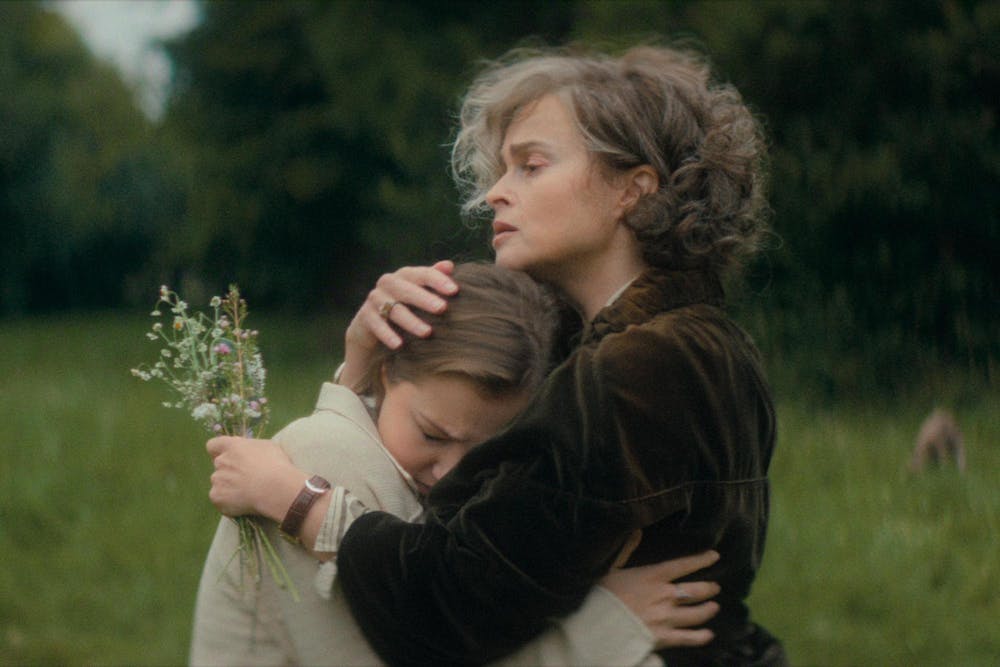
Jimmy Thesiger (Edward Bluemel) supplies the charm, but the series’ emotional gravity comes from Lady Caterham (Helena Bonham Carter). Reimagined from Christie’s pleasant Lord Caterham, Bonham Carter’s matriarch brings grief and exhaustion into the story. Her presence complicates the show’s bright surfaces, reminding us the setting of a society counting its dead, waiting for the next murder or moment of dismay.
As the plot opens in the second and third episodes, “Seven Dials” reveals itself less as a country house mystery and more as a period spy thriller. The shadowy Seven Dials group, which is playful and conspiratorial on the page, is reframed in the series as something even more dangerous, entangled with espionage and secrecy and portrayed as more than a group of youthful theatrics. Superintendent Battle (Martin Freeman) emerges as the series’ moral anchor. Once a secondary figure in Christie’s story, Battle carries the weight of experience and a man tired of treating chaos as entertainment.
Director Chris Sweeney reinforces this shift with a moving visual style. Cars hurtle through narrow streets, jazz clubs feel claustrophobic rather than glamorous and the underworld of “Seven Dials” hums. The 1920s are not presented as a museum exhibit, but as a living, volatile moment.
What the series ultimately offers is not just a fresh take on a lesser-known Christie writing, but a token of what her work does sustain. This is comfort television with an edge, which brings viewers to enjoy the pleasures of mystery while acknowledging the instability beneath the surface. Like the setting it portrays, the series understands that charm and danger often occur together and that the most interesting stories begin when the illusion of safety cracks.


