With the increased importance of sabermetrics in sports, statistical analysis is becoming more important to understanding the opponent not just from a typical scouting standpoint, but from a numbers perspective, as well.
The annual MIT Sloan Sports Analytics Conference is a look at how statistics are changing the face of sports. Because the conference was this past weekend, algebraic formulas and complex solutions are all abuzz in the world of sports.
Baseball has taken the first step in using sabermetrics to evaluate potential success, most notably with the release of “Moneyball” last year.
However, the spread of numerical analytics has reached other sports, as well.
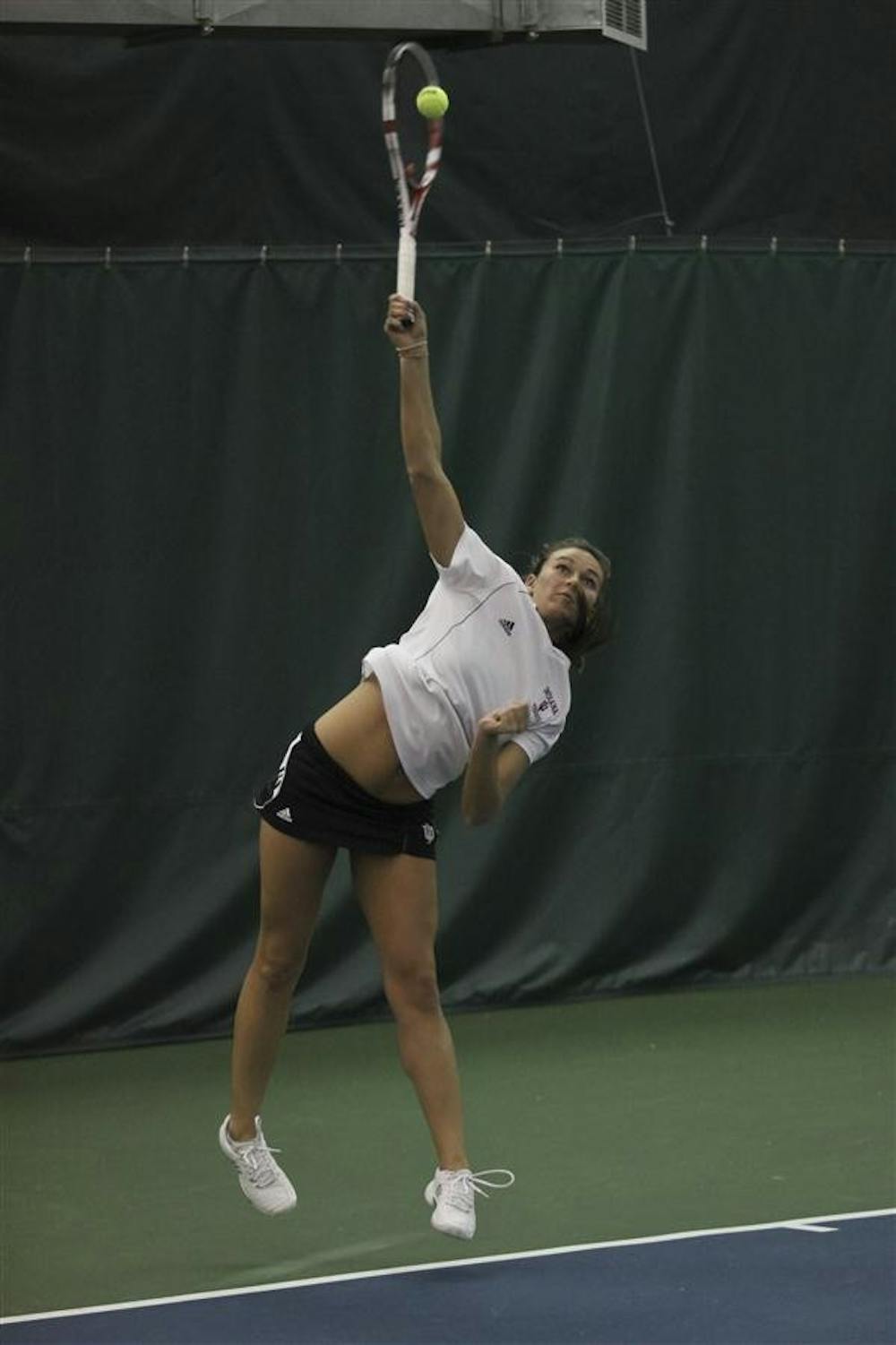
In an attempt to figure out the quality of the IU women’s tennis team, one can look at statistics other than the overall record of 11-3.
The player with the highest winning percentage for the Hoosiers this year is sophomore Kayla Fujimoto.
Fujimoto is a perfect 11-0 in singles matches, including a flawless 4-0 record against nationally-ranked teams.
Of the four nationally-ranked teams IU has played, the Hoosiers have amassed a total of eight total team points. Fujimoto alone has accounted for 50 percent of those wins.
Of the six players who usually play singles for the Hoosiers, Fujimoto has the highest winning percentage at 100 percent.
Next is junior Leslie Hureau at 73 percent and then freshmen Katie Klyczek and Carolyn Chupa, both with a winning percentage of 64 percent.
Freshman Alecia Kauss has the next highest winning percentage at 62 percent.
Lone senior Evgeniya Vertesheva is the only player to have a winning percentage below .500, at 42 percent.
The average winning percentage of the six major players together is 68 percent.
However, the team’s record stands at 11-3, good for a 79-percent winning percentage and an 11-percent increase from that 68-percent winning percentage.
What accounts for the disparity between the two percentages?
IU has played four nationally-ranked opponents so far this season, going 1-3 against them.
In those matches, the Hoosiers have been outscored by a total of 8-20 in team points, which amounts to the team winning merely 29 percent of the total team points in those matches.
Taking those four matches out of the equation, the team’s record stands at a perfect 10-0.
Against unranked opponents, the Hoosiers have outscored their opposition 62-8 in overall team points. They have won 89 percent of the total team points in those 10 matches.
Overall, the team has won 70 of the total 98 team points on the season, meaning they have won 71 percent of the total team points compared to the 68-percent winning percentage in singles matches by the individual team members.
The discrepancies between the two numbers can be explained by statistical anomalies — for instance, these six women have not played every one of the singles matches for the season.
Also, the singles action is not the only determinative of the final score, as the doubles point makes up one of the seven total team points available.
Drawing back upon ranking the six major players by the winning percentage of matches they have played, there are a number of factors to take into account.
Fujimoto has played primarily in the No. 6 slot this year, so she has played lesser competition than Vertesheva, mainly in the No. 2 slot, has played.
Therefore, a breakdown of the total number of individual games they have won and lost can account for the difference in competition that each of the women has faced.
For example, if player A wins a match 6-4, 6-2, player A would have gone 12-6 in individual games played, winning 67 percent of the games played in the match.
The standings are virtually the same when ranking the Hoosiers this way as when ranking them by match winning percentage.
However, the difference between matches win/loss percentage and individual games played for some women is different.
The following data is the winning percentage for individual games played with the change from the win/loss winning percentage of matches in parentheses.
- Fujimoto 67 percent (-33)
- Hureau 62 percent (-11)
- Kauss 58 percent (-4)
- Klyczek 57 percent (-7)
- Chupa 55 percent (-9)
- Vertesheva 52 percent (+10)
The only player to increase her percentage was Vertesheva. Though she has won just 42 percent of her matches, she has won 52 percent of the games within those matches.
She often loses in three sets or in close two-set battles, so her match winning percentage, therefore, is not completely indicative of how she has played this season.
Vertesheva is an example of why not to look simply at the winning percentage of the win/loss record when evaluating a player. Delving deeper into the statistics reveals how much better or worse a team or player is doing.