
The Russian scholar Nicholas Riasanovsky once described the Soviet Union as “neither a stable nor a happy country.”
Despite the changes in government and increased freedom and prosperity during the past few decades, this assessment is still true.
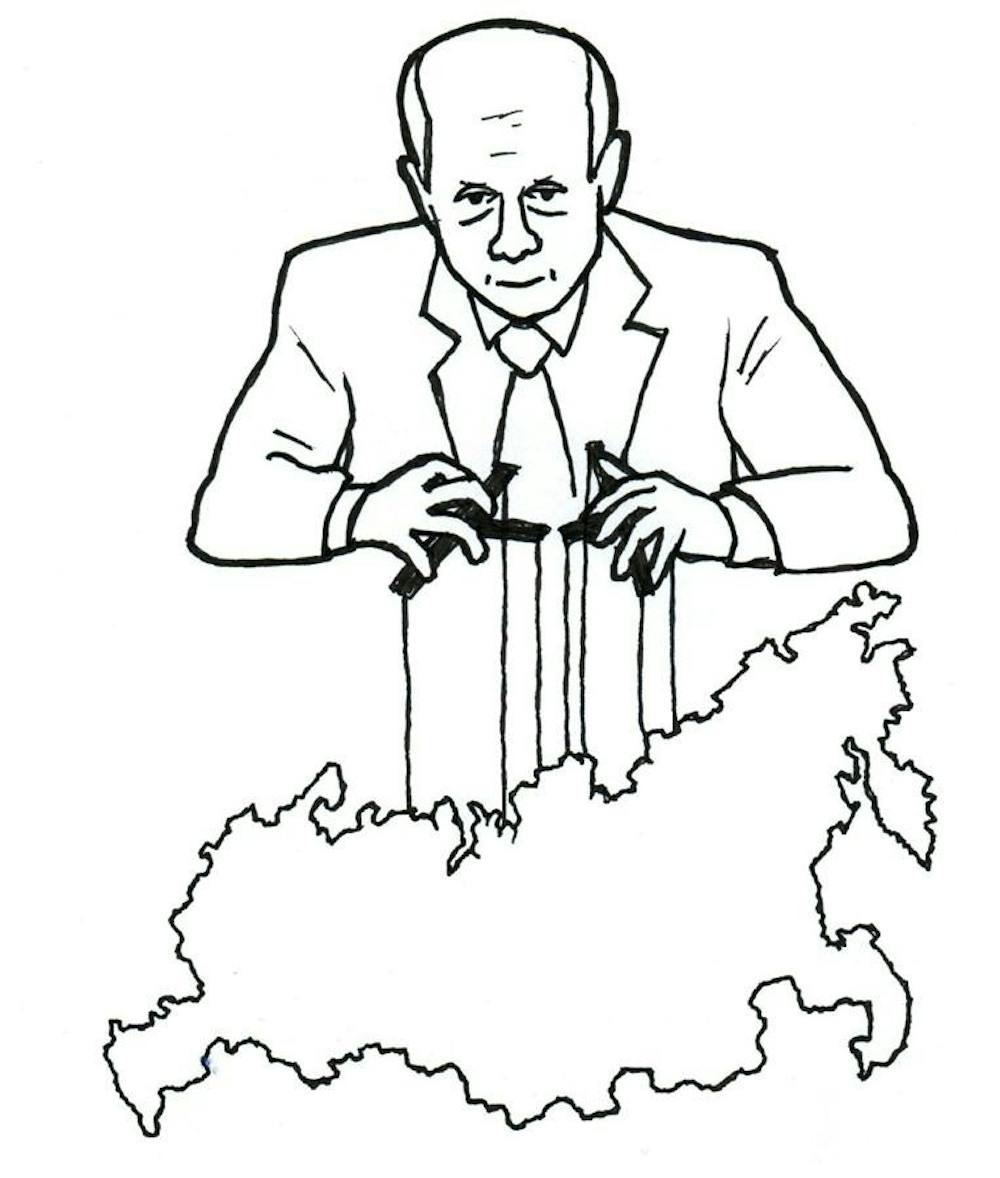
Appropriately enough, the present unhappiness and instability can mainly be attributed to newly elected President Vladimir Putin, a former KGB officer.
Putin was previously president for eight years and prime minister for the next four years.
Now, after a few strategic constitutional changes and an already controversial election, Putin is Russia’s president again, with the potential to serve two six-year terms.
Putin and his political surrogate Dmitry Medvedev have presided over an era of improvements in the Russian standard of living, mostly due to high oil revenues.
At the same time, however, government corruption has gone unchecked, press freedom has been limited and many political opponents have been bribed or jailed.
Russia desperately needs a strong anti-corruption campaign in government. Foreign companies are already wary of investing in Russia.
An economy based mainly on petroleum is susceptible to market fluctuations. If the price of oil falls, all the prosperity that has masked Putin’s authoritarianism will disappear.
Unfortunately, the opposition candidates were ineffective, splitting the anti-Putin vote four ways.
Some faced charges of corruption themselves, and others would worsen the economic situation through their policies.
This might have hurt the reputation of everyone who opposed Putin, even the principled, sincere opponents.
Last year’s example of the Arab Spring has inspired Russian protesters in Moscow.
But the two movements seem to be on fundamentally different paths. Russians live under a less oppressive government than the Egyptians or Libyans.
If Putin offers some small reforms, he might be able to quiet any opposing movements. If he can characterize the most liberal protesters as unrealistic extremists, public opinion might be on his side.
Alternatively, stricter controls on the Russian news media and minority political parties could also destroy the protest movement.
It is hard to imagine a Libyan-style uprising taking place in Russia.
Violent protests, unless they were on a massive scale and had the support of the army, are not likely to topple the Russian government.
Perhaps the best thing the Russian opposition parties and protesters can do is induce the government to make small, gradual changes.
After all, China has diversified and improved its economy despite strict Communist party control.
Russians currently have sufficient political freedom to influence the government, but not enough to make major changes.
Even though Putin won the presidential election, the Russian people might force him to reduce corruption and make slight political reforms.
This process will be slower and less dramatic than the Arab Spring, but it is probably the best that Russians can hope for after this election.
— jzsoldos@indiana.edu
Putin and the unlikely Russian Spring
Get stories like this in your inbox
Subscribe



