He has been sitting at the bench for nearly 25 years.
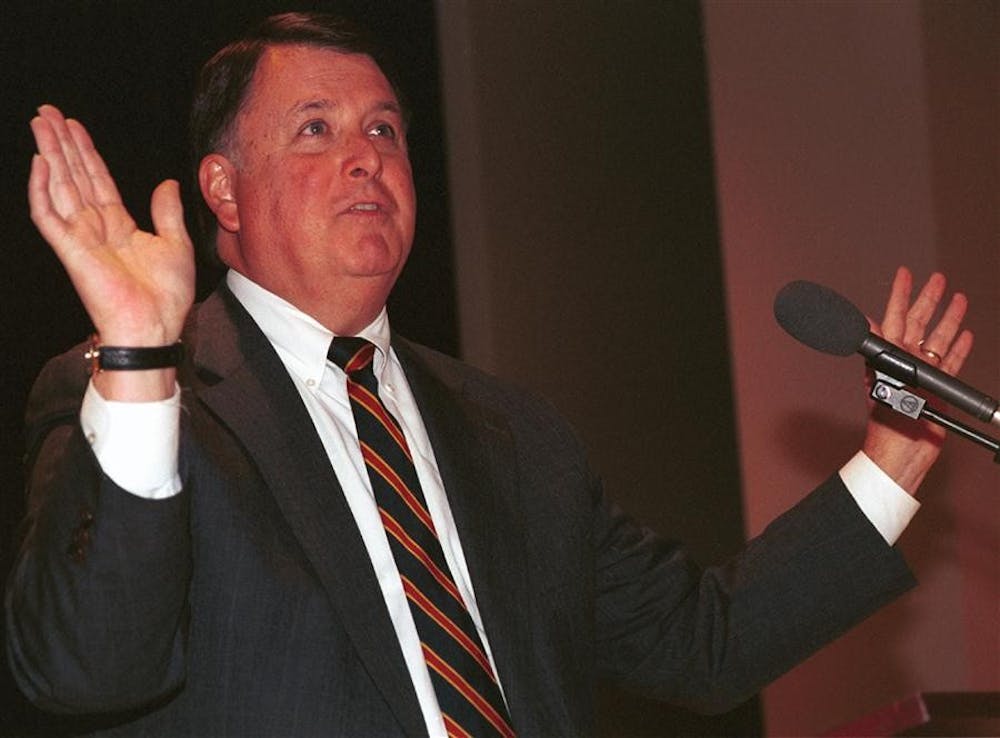
In March, he will retire from leading the state’s highest court. Chief Justice Randall Shepard has been in his position in the Indiana Supreme Court since March 4, 1987. At the time, he was the nation’s youngest chief justice and today, at 65, he is the longest-serving state chief justice in the country.
“I never imagined being a chief justice of the Supreme Court or even a judge,” Shepard said. “My high school yearbook reports three possibilities as a career: lawyer, foreign service or in the newspaper business. I am still interested in all three. In the beginning, I didn’t have an idea I was going to be a judge. It came when the incumbent judge unexpectedly stepped down. A friend talked me into filling out an application.”
After Shepard’s five-year term ends in March, he will step down and allow someone else to serve in his place.
“It naturally produces some thinking (about) whether you want to be chosen for another five-year term,” he said. “It is a good moment to let someone else do the job, and I can go off and find something new and different.”
As a seventh-generation Hoosier, Shepard said serving as chief justice of his home state has been gratifying.
“I grew up here, and so did many generations of my family,” he said. “In 1807, my first family member came to Indiana, and we’ve been part of what happens here ever since. Indiana has been very good to us and me, and I had the chance to make it a safer, more prosperous and more decent place in some way, which has been very gratifying.”
At the time of his appointment as chief justice, Shepard was a judge of the Vanderburgh Superior Court in his hometown of Evansville. He was also a private practitioner and assistant to the mayor of Evansville.
“There were a lot of very terrific opportunities to watch and participate in intriguing things,” he said.
Gov. Mitch Daniels said he will appoint a new chief justice to replace Shepard.
“Most Hoosiers recognize the historic place Randy Shepard will always hold in Indiana judicial history. What fewer people may know is there is no more nationally respected Supreme Court judge in any state in America, and this has been so for a very long time,” he said in a press release.
In his time as chief justice, Shepard said one of his most notable cases was one involving 15-year-old Paula Cooper’s murder of 78-year-old Ruth Pelke. Cooper and her friends talked their way into the elderly woman’s house pretending to look for a bible study. Once inside, Cooper stabbed Pelke with a knife multiple times, killing her.
“The jury recommended the death penalty,” Shepard said. “The death penalty was prohibited by the cruel and unusual clause of the Constitution if it applied to someone that young. The General Assembly decided that they had to be 16 for the death penalty to apply. The case got international attention, and it became quite the international cause. The Indiana Supreme Court decided Paula Cooper will impose the maximum number of years. It was a dramatic case watched all over the world.”
Shepard said areas such as improving the public defender’s office and recruiting volunteer advocacy for children show the enthusiasm of the Indiana judiciary.
“That list is a sign that the Indiana judiciary is very enthusiastic in improving the system, and I have a lot of that pride in what Indiana has been doing,” he said. “The thing that gives me the greatest satisfaction are the various protections to help the men and women who work in trial courts of our state. That is where most people either get justice or don’t.”
With his work on the change in the Supreme Court creating accessibility for people of all kinds, Shepard said he has left his mark.
“In the 1980s, the court heard entirely criminal appeals,” he said. “In my first year, 93 percent of the cases were criminal. Everyone else who had disputes had to compete for the remaining 7 percent. Today, it is more or less balanced. Half are criminal because we prize liberty so highly. Half of the docket are on issues that affect many more people in (their) family and business lives. That greater accessibility has been very good for our state.”
Despite the economic conditions of the country and the state, Shepard said there is much reason for optimism in Indiana.
“The state is blessed by good leadership in the private and public spheres,” he said. “In the difficult times, we are managing well. It is not an easy time, but it is a time where Indiana has performed better than other states.”
Immigration to Indiana is at a high, Shepard said. “This is not only a measure of what is happening now, but what will in future,” he said. “As tough as it is, there are grounds for hopefulness.”
This is the same optimistic outlook Shepard said he will share in his speech at the IU Winter Commencement on Dec. 17. IU President Michael McRobbie asked Shepard about three months ago to speak at the ceremony.
“I am pleased at the invitation, and I am glad I was able to accept it, and I will be there with bells on,” he said.
McRobbie said Shepard exemplifies the very best Hoosier values.
“Judge Shepard has dedicated himself to public service not only at the state and federal levels but within the classrooms here in Indiana and across the country, where he demonstrates his commitment to legal education,” McRobbie said in a press release. “His achievements as a scholar, a lifelong advocate for civility and professionalism in the legal community and jurist of the highest order make him an inspiration not only to our graduating class but to the people of Indiana, whom he serves.”
Shepard said he will give a general talk to young graduates who are leaving school amid a tough recession.
“It is a hard time because the world seems tougher than four or more years ago when the group of students started out,” he said.
Shepard said he is unsure of his post retirement plans.
“Something will be the next chapter,” he said. “I just don’t know what it is yet.”
Ind. chief justice to retire, speak at commencement
Get stories like this in your inbox
Subscribe