
Every good revolution is rooted in injustice, begun in anger and expanded through communication.
Whether it’s a posting on a church door in Wittenberg, Germany, anonymous pamphlets circulating the 13 colonies or a message in 140 or fewer characters that goes viral throughout the world, revolution requires effective communication.
And today, new means of communication are making revolution easier than it ever has been by giving voice to the common dissident.
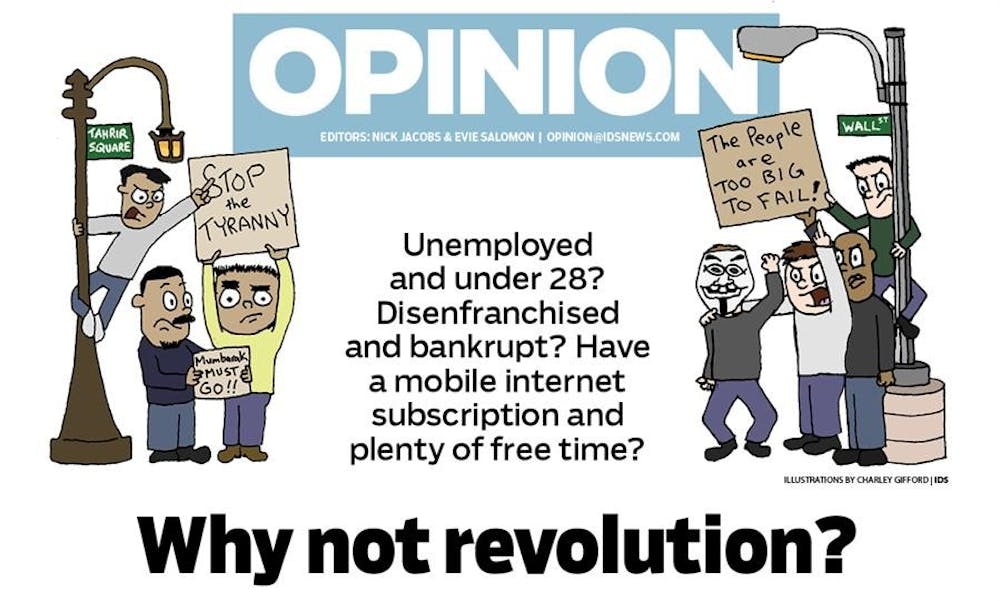
When Wael Ghonim created a Facebook page memorializing the death of an Egyptian businessman who was brutally beaten by police, protests against an oppressive Egyptian government sprung up all across the country.
“Many young Egyptians are now fed up with the inhuman treatment they face on a daily basis in streets, police stations and everywhere,” said the page created by Ghonim. “Egyptians are aspiring to the day when Egypt has its freedom and dignity back.”
Ghonim’s message was simple, and so were his means for communicating it. He didn’t need a printing press or that much money. He didn’t need a podium or a large audience. He didn’t even need to get up out of his seat. All he needed was access to the Internet.
Today, one can roll out of bed, make a bowl of Fruit Loops, sit at the computer wearing underwear and start a revolution. This is because social networking sites such as Facebook, Twitter and Youtube have democratized revolution. Because of this, we are now entering the era of leaderless revolutions.
The Martin Luther King, Jrs., the Mohandas Gandhis and the Nelson Mandelas would be irrelevant today because their voices would be diluted by people who not only believe they are leaders but have the means to speak as if they were.
It’s hard to argue this new organizational model is ineffective, though. It has toppled numerous regimes in North Africa and is sure to create a number of political victims here in the States as a result of the Occupy Wall Street protests.
But what happens once the victims have been counted and the initial goals achieved? Whose voice amongst the many determines the next step? After all, there can only be one next step.
It is the greatest problem facing this era of democratized revolution. It’s a communication problem. And one we’re seeing play out across the globe.
— nperrino@indiana.edu
The social revolution network
Get stories like this in your inbox
Subscribe



