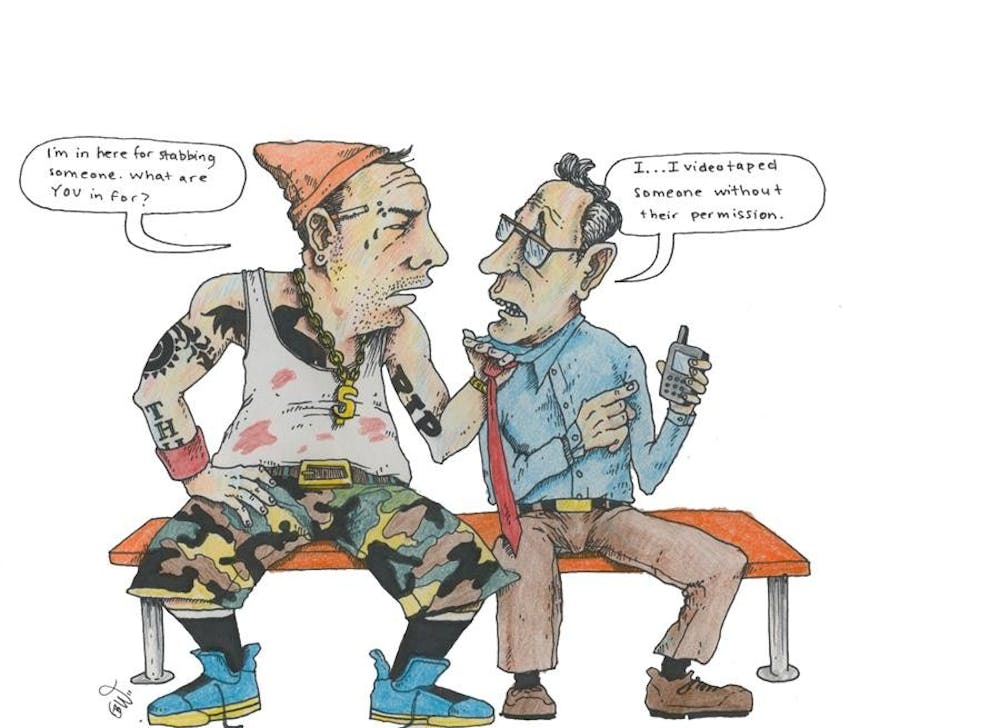
We believe current laws designed to prevent eavesdropping are being abused to protect police from supervision by the citizens of the United States.
While eavesdropping laws exist in all 50 states, some of the toughest laws have been instigated in Illinois, making it a felony to produce an audio recording on a cellphone, camera or other electronic device without the consent of all parties present.
In several cases, all from Illinois, citizens are being prosecuted for recording police officers. Christopher Drew was charged after he recorded an encounter with a police officer on a public street where Drew was selling art without a permit. Tiawanda Moore was charged after recording a conversation with two internal affairs officers while filing a complaint about another officer.
Most recently, on Sept. 27, Louis Frobe was arrested after he recorded his conversation with a policeman while dealing with, what he believed to be, an undeserved speeding ticket.
In none of these instances could any reasonable person argue that the police officers had an expectation of privacy. It is not as if these people were hiding in the closet of a police officer’s home and recording his or her conversations with a spouse. These were official encounters in which the police officers were acting as the representatives of the state. While acting in that capacity, they cease to be private citizens and become public servants.
More so, eavesdrpoping laws were written before nearly every citizen carried a phone with the ability to capture video and audio recordings. These prosecutions also ignore the stated exceptions to the eavesdropping laws, which account for public spaces where there is no reasonable expectation of privacy.
Ignoring the reasonable expectation of privacy clause transforms these laws from useful countermeasures against illegal wiretapping into oppressive impositions on the public. A police officer should have no reasonable expectation of privacy while performing his duty as a public servant in a public place.
We cannot stress that phrase enough. Police officers are public servants. They serve and protect through the consent of the public, and the public has a right to ensure that the police are obeying the law.
One way to ensure that is to record police officers. The President of the Fraternal Order of Police has stated recording “can affect how an officer does his job on the street.” This is exactly the case. Recording officers will affect their performance, in the sense that police officers will be forced to follow the law and serve the public in a respectable and appropriate manner. Recording on-duty police officers should be legal, in any and all circumstances.
Keeping the police honest
Get stories like this in your inbox
Subscribe