Long before the days of changing your relationship status on Facebook and tweeting about the romantic things done for you, there were more permanent and public ways to express your feelings for someone. Carving initials into freshly laid concrete and defacing a tree in the heart of campus were just two of the more popular ways to symbolize your love would last forever.
Perhaps if you lived in Kentucky or in the southern reaches of the country, you would’ve pursued the classier route of a tattoo on your lower back. Children in grade school followed the less permanent ink route of writing sweet nothings on the backs of their hands during recess.
As the Italians have been doing throughout my trip, they’ve again proven the notion ‘anything you can do, I can do better.’
In the land of few trees and cobblestone streets, how were young people in Italy supposed to profess their love for others to see?
For them, it was simple: lock it up and throw away the key.
Tradition says that a Serbian teacher fell in love with a military man. As he left, he gave her a verbal promise of everlasting love in the form of a marriage proposal. But as some men are known to do, he strayed away from his promise after arriving in Greece. Here he became taken with a local woman and never looked back on his first Serbian love. Heartbroken and lonely, she died alone, without love.
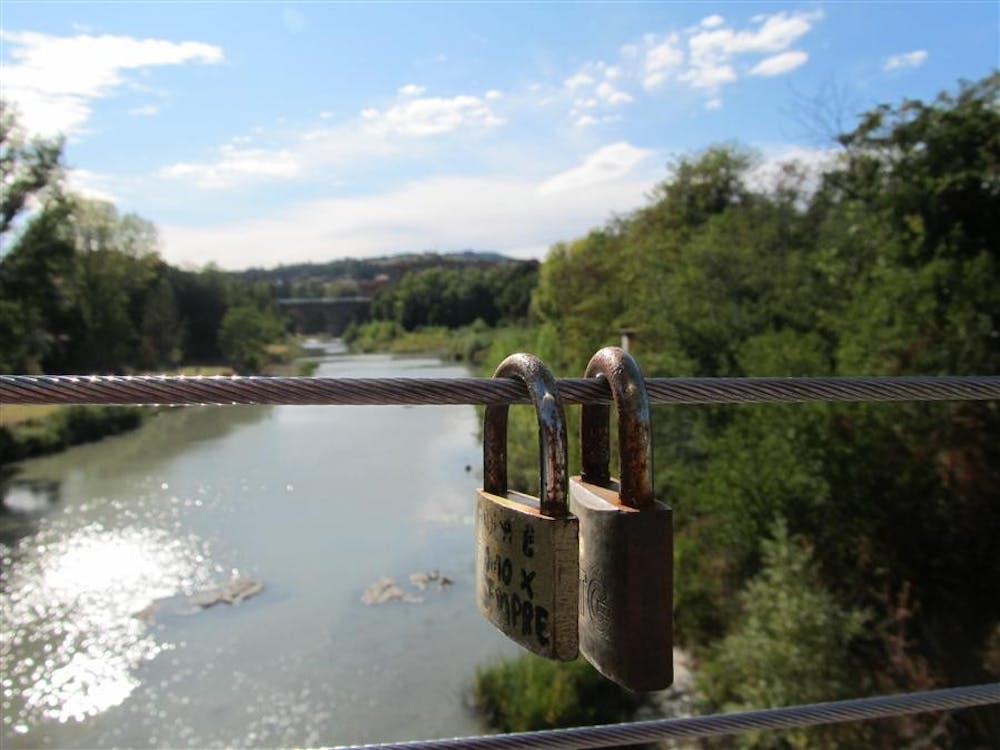
To protect their relationships and to prevent themselves from going down the route of the infamous Serbian schoolteacher, local girls began writing the names of their beloved soldiers on padlocks on the day of their loved ones’ departures. Once the soldiers left, the locks were affixed to a bridge until their return.
Since then, the padlock phenomenon has spread out of Serbia and become popular most recently in France, Italy and Germany.
In these three countries, public bridges have been taken over by a multitude of shiny silver padlocks. Many of these locks are from visiting tourists who want to leave their mark on the country.
More recently, it has become tradition for local couples to write their names on a padlock and secure it to a bridge. On their wedding day, the couple travels back to the bridge to release their key together into the water, signifying the security of their love.
While the history and traditions surrounding this European custom are rich, governments see the locks as a nuisance. Many countries have had to use desperately needed tax dollars to remove the locks that cause both infrastructure and aesthetic problems.
Regardless of the government’s view, locals and tourists alike continue to partake in this unique form of expressing their love.
While many European trends travel west across the Atlantic to the States, the lack of bridges in many American communities might cause a barrier to the possibility that this trend will become popular here.
But, let’s be honest, does anyone really think the precarious wooden bridges near Ballantine Hall should be burdened with the weight of both students and their love? I didn’t think so.
— johnsbrl@indiana.edu
Bologna by Bre
Locks of Love
Get stories like this in your inbox
Subscribe