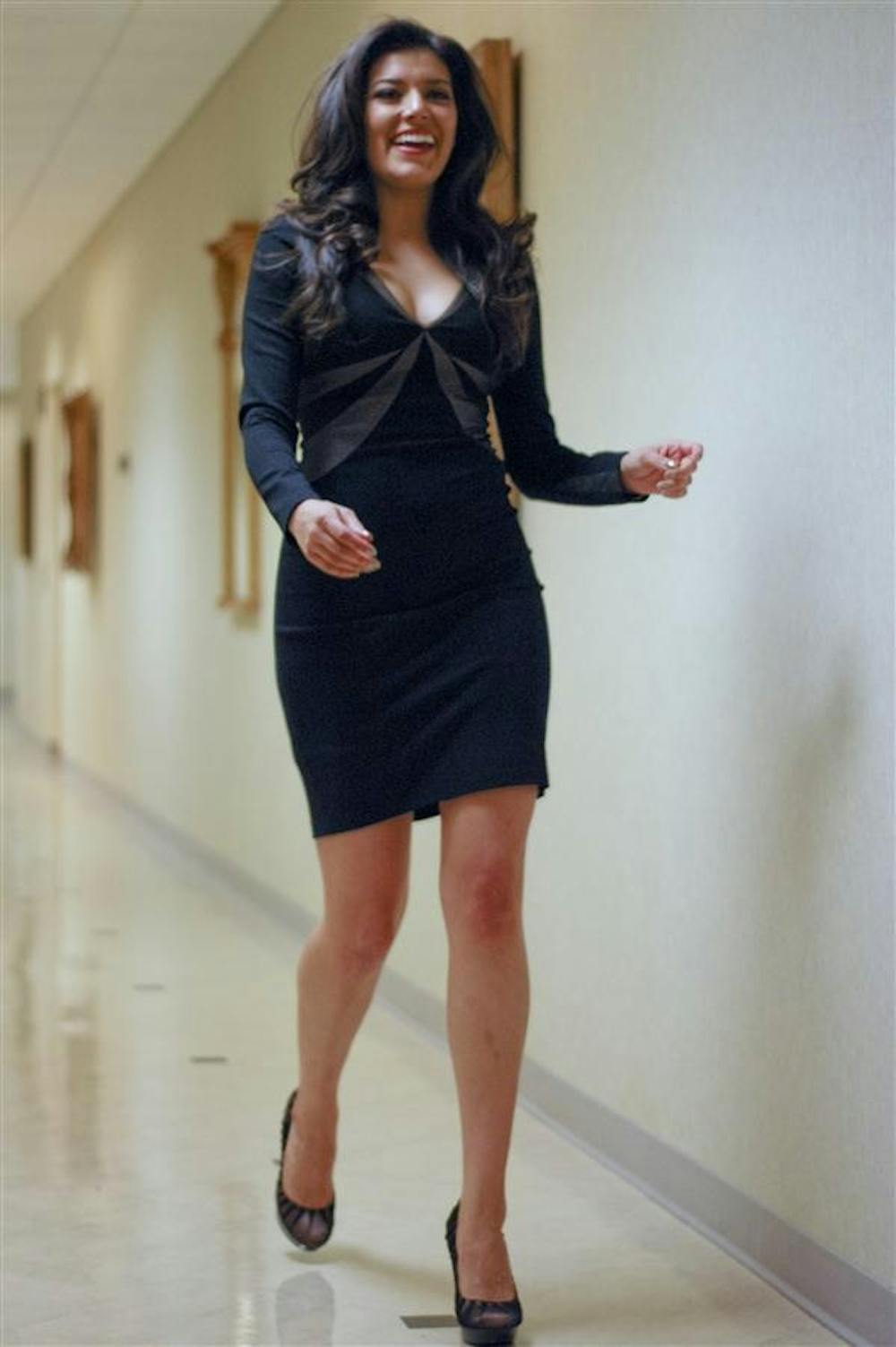
Gabrielle Reed is not a typical beauty queen.
Reed, a 23-year-old Jacobs School of Music student, is also Miss Indiana, a title that hundreds of women strive to call their own.
Originally from Los Angeles, Reed who has long dark hair and a gleaming smile, started participating in pageants when she was 19 for one reason: to earn enough scholarship money to pay for school.
This past weekend, Jan. 15, Reed and 52 other women competed for the title of Miss America, in Las Vegas, Nev.
Reed has a desire for promoting domestic violence awareness, and a passion for opera singing. She got involved in pageants for scholarship money, but soon found that she gained much more than money for school.
“I found more than just scholarship. I found an avenue to cultivate my voice as a classical singer, and as a domestic violence advocate,” Reed said in a video about her experiences,
She studies opera with The Jacobs School of Music, Senior Lecturer in Music, Alice Hopper, and currently is taking this year off of school because she travels 3 to 4 days a week doing appearances around Indiana.
Before winning the honorable title of Miss Indiana, Reed said, “You first have to win a local competition, and my first year in the system, I competed three times at different locals across the state. I won the Miss IU title in 2008 and that was my first ticket to Miss Indiana.”
She went from winning Miss Southern Heartland, to Miss IU, and at last, the title of Miss Indiana. As Reed looks back at the experience of making it to Miss America, it was quite different than what she was used to at the state level.
At this stage it became more about pleasing the sponsors whose products had to be televised.
“You’re shooting commercials and as much as it is about promoting the organization, it’s very much about promoting the sponsors.” Reed said. “Kind of everything that you did, it was an appearance, and they wanted it to be fun for you, but really it was about selling the sponsor’s product, so that was a different focus for me.”
When viewers watch Miss America, they see the glitz and the glamour in a feature segment. For Reed, and all of the other contestants, there were 10 full days of work that built up to the televised event.
“We had rehearsal all day long for the 10 days, literally up and camera-ready by 7 a.m. and then get back to your room by 10 or 11 o clock at night and then wake up and do it all over again. You go non-stop the entire day, you don’t get a break. So it’s an exciting week,” Reed said.
Aren Straiger, Co Executive Director of Miss Indiana, has known Reed since she entered the competition of Miss Indiana.
“She is very talented without a doubt,” Straiger said. “She is one of those people who is beautiful starting from the inside and it comes all the way to the outside. And I know that sounds cheesy, but it’s true.”
Straiger also agrees that Reed might not be the typical beauty pageant queen.
“What she really hated to do was go shopping, so we kind of got a kick out of that as we prepared for Miss America,” Straiger said. “That’s not normal. Most pageant contestants think that’s kind of fun, but for Gabrielle it was more of something she wanted to check off of her list very quickly.”
During the 10 days of competition, there are three nights of competition.
The first night Reed competed in an evening wear competition, where she wore a Juan Carlos, red strapless silk dress, with no beading. The second night was the talent competition, which Reed won for her opera performance, which counted for 35 percent of her total score. Her hands moved from her side, further up into the air as she sang, while wearing a white strapless gown. Third night was an on-stage question.
It was the 10-minute interview, that is not televised, that contributed to Reed’s reasoning of why she thinks she didn’t make it to the top 10.
“At the state levels our interviews are very much based around our community service platform but also very much based around current events, both pop culture related and political. Interviews really are difficult. You have to know your stuff, you have to know what’s going on in the world around you and you have to have an opinion on it.”
Compared to the national level, Reed felt it was quite different.
“My Miss America interview was far less intense. So much so, that it kind of threw me off. I was asked questions like what is your favorite gossip magazine and I was disappointed by that because I kind of felt like, give me a real interview because I can handle it, so that was disappointing.”
Reed also made the point that out of 53 women, she was the second-to-last girl to be interviewed.
“I think by the time I got to my interview, they knew who they wanted. And I feel like because of that, I wasn’t given maybe as an intense interview as I would have if I had gone maybe, 20th.”
Because Reed didn’t make it to the top 11, she was not shown on national television. In the past, they normally televise the top 15, but this year it was done differently. They made room for people’s choice, which was done with online voting beforehand.
“Who knows if I even made it to the top 15. We won’t ever know,” Reed said.
What sounds most daunting of all is that even though she didn’t make it to the top 11, she still had to stay onstage and watch the other girls advance.
“It’s kind of like you get to hang out and be a part of the show, and watch the competition even though you’re not actually competing anymore,” Reed said. “We really were just there, not really part of the show anymore, but it kind of made it fun because we kind of just got to relax for a little bit. Where if we had still been on camera, and part of the show there would have been the need to be on constantly.”
After 10 days of being “on” non-stop, Reed was able to breathe. Her attitude towards the whole experience was positive, relaxed, and quite realistic.
“I didn’t really go with the focus of, okay, I’m going to come here with tunnel-vision and I’m here to win because really it’s such a subjective process. I mean you never know what they’re looking for. It changes from year to year. I think what they were looking for this year was very different than what they were looking for last year,” Reed said. She thought the type of girl they were looking for this year, was “someone who was just positive and would be a Miss America and a real role model that would just be a representative of the organization.”
Reed was also aware of the wide variety of girls who competed.
“Every girl here is very different. If you want to have a truly positive experience you almost can’t go with that attitude, that okay I’m going to win, because it changes. And you know there are seven opinions and who knows what their perception of you is.”
“Of course, I won’t lie. I won’t say I’m not disappointed. My goal was to make it into the top 10 so I could perform my talent on national television and I am disappointed that that didn’t happen, and I was disappointed that I feel like I didn’t get a fair shot at my interview, but I feel like I knew they wouldn’t want me.”
Every girl submits two pages of paperwork that basically summarizes their lives in the shortest nutshell of all.
“Mine was filled with very strong opinions,” Reed said. “A strong opinion to the left, politically and socially. I would have been a Miss America with a strong opinion and I would have been a Miss America for the wrong reason.”
In these two pages Reed stated she was involved with Hoosiers for Hillary, was a producer for The Vagina Monologues, and is also very involved with feminist groups on campus. Possibly, a little too radical for Miss America.
At the end of the experience, Reed might not have won the title of Miss America, but she did win enough money to pay for her undergraduate education, basically debt-free.
She has five and a half months left with the Miss Indiana organization, where she will continue to work with different shelters around the state, promoting domestic violence prevention.
“I have at least another one or two years at IU, and I plan on then getting my master’s.”
IU is on her list of programs to check out, but she is also going to keep her other options open.
“I have explored many other majors and I can’t imagine myself doing anything else. That’s really the kind of position you need to take if you’re going into something like music because it is hard and it really has to be the only thing you can see yourself doing.”
Miss Indiana returns home
Get stories like this in your inbox
Subscribe