
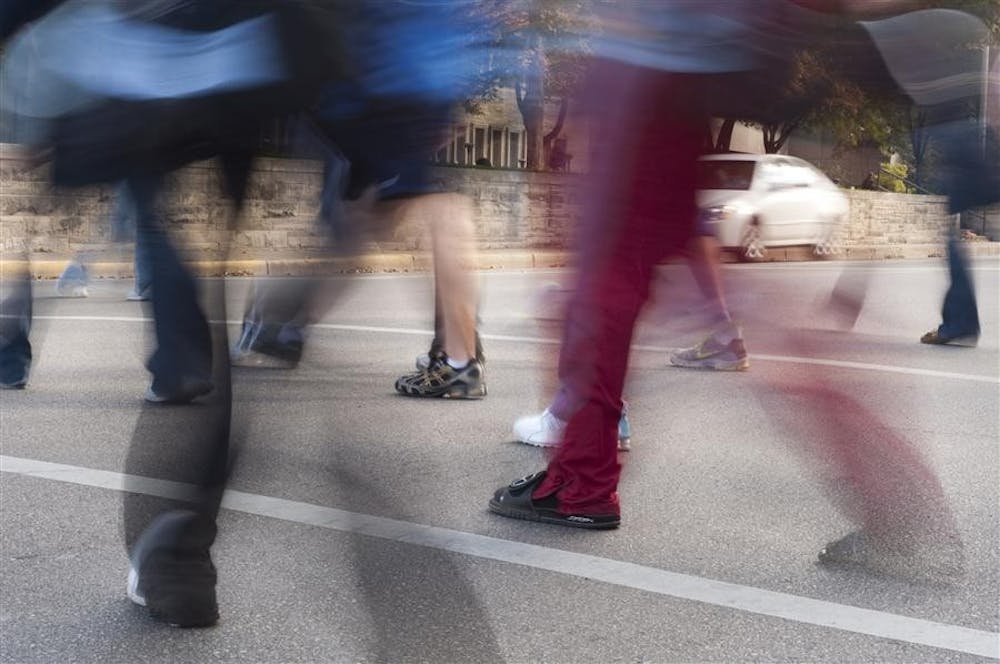
There’s a crosswalk about 30 feet ahead, but there’s enough time to cross the street now, so the student runs to the other side of the street with seconds to spare.
It’s a dangerous game, but it’s a game about 60 to 70 percent of students on campus play everyday for various reasons. No knowledge about crosswalks, too lazy to walk the extra few feet, simply not caring or maybe thinking the cars will stop.
Sophomore Peter Duong died exactly one year ago on Fee Lane while crossing the street. His death was a wake-up call for IU and its street safety issues, and while improvements have been made, the University still has a long way to go.
It’s going to get worse before it gets better
After Duong’s death, some pedestrians and drivers became more alert, but some didn’t, leading to at least another 16 accidents involving pedestrians and cyclists on campus within the past year.
The first was on the same day as Duong’s accident, on the corner of East 13th Street and Fee Lane. However, the female student suffered minor injuries. Three more accidents occurred in September — one by Herman B Wells Library, one by Third and Mitchell streets and the third by Fess and Atwater avenues.
Senior Kexin Xiang was involved in the accident on 10th Street the morning of Sept. 11. Xiang said she was in a hurry to get to class and couldn’t see the cars because of the buses outside of the library.
“I got hit by a car when I was crossing 10th Street from the library to the business school,” she said. “There were many bruises on my neck, but nothing with my bones or muscles.”
Xiang also suffered a concussion.
There were five other accidents before the University installed any extra safety precautions.
Stepping in the right direction
Taking note of all the accidents, Provost and Executive Vice President Karen Hanson assembled the Bloomington Campus Safety Task Force in September 2009 to identify problem areas on campus and make suggestions for improvements.
In November, the task force recommended creating a safety education program, installing pedestrian crosswalks, making changes to the bus system to reduce confusion between IU
Campus Bus and Bloomington Transit stops and forming a standing committee to oversee additional traffic safety issues.
Following the recommendations, three crosswalks have been placed on campus in high traffic areas. The first two crosswalks were installed by March 22 on Fee Lane, and in August, the third was placed on 10th Street between Herman B Wells Library and the School of Public and Environmental Affairs.
“It took this death to let the city put these crosswalks in,” said Mitch Rice, member of the Bicycle and Pedestrian Safety Commission for Bloomington. “In my opinion, it’s an improvement, but I have no data.”
To go along with another recommendation to educate pedestrians, the “Get Street Smart” campaign was launched this fall. As part of this plan, IU Police Department officers were on the streets to make sure students were using the crosswalks correctly and to hand out pamphlets providing students with more information about traffic and pedestrian safety.
“If they’re not using them properly, we’re educating them,” IUPD interim chief Keith Cash said. “What officers tended to see more than anything was a lack of attention on the pedestrian’s part.”
Officers were also watching drivers to make sure they were obeying traffic laws.
The problem continues
The extra safety precautions and education for pedestrians might be helping, but there are still issues on campus.
Hanson said the task force estimates only 30 to 40 percent of the students are using the crosswalks, but there is no exact data.
“It’s not 100 percent, but there’s no way you’re going to get 100 percent of students to use those,” Kurt Zorn, co-chairman of the task force, said.
Cash explained even with proper education, not all students will follow the rules.
“Some people are just going to cross where they want to cross,” Cash said.
But Zorn said he doesn’t think it’s completely students’ fault.
“Traffic itself is a dangerous encounter,” he said. “Drivers are just as guilty as bicyclists and pedestrians.”
Hanson said one day while she was out on campus, she noticed a couple of drivers who failed to stop at a stop sign. She said drivers need to slow down, and pedestrians need to pay more attention.
“The safety issue remains for us on both sides, with educating motorists and pedestrians,” she said.
Xiang said the crosswalks have helped, but it’s not all about location. She said a big factor is the time of day, because if students are rushing to class, they’ll run out on the road and drivers could be going fast as well as trying to get to class.
“Be very careful when crossing the street,” she said.
What’s next?
Cash said IUPD will continue to enforce the crosswalk laws and try to educate more drivers and pedestrians. He said it’s too soon to tell how effective the crosswalks will be.
“The new one is very new,” Hanson said. “Our observations seem to suggest students are using them more and more.”
The University also took action to prevent these accidents and created a safety committee last spring because the task force was temporary.
“As a committee, our purpose is to serve as a body that reviews and assesses safety on campus,” Zorn, who is on the committee, said.
The committee met for the first time in May and will meet once every semester or as needed.
But Rice pointed out that there still needs to be actual action before any problems will be solved.
“I think there’s a lot of places we can improve pedestrian safety,” Rice said. “The problem isn’t identifying those places, it’s getting it done.”
He suggested the city lower the speed limit throughout campus streets to 20 or 25 miles per hour instead of 30 miles per hour and also said he thought crossing guards could help.
Purdue University recently placed crossing guards throughout campus to help students cross streets safely, and Rice said while this is a great idea, it is not likely to happen at IU.
“Truth is, IU has a lot more money than the city,” he said. “So if there were crossing guards, it would probably have to come from the University.”
Other ideas Rice had were to install crossing lights at the mid-block crosswalks and add more crosswalks in general, specifically near Memorial Stadium and near Sixth Street and Indiana Avenue, where an accident occurred last week.
He said he has seen students walking along Dunn Street by the stadium, but there is no sidewalk on the stadium side of the street and no crossways to get to the other side.
“It just makes no sense. There should be a crossing block there,” Rice said. “I think we have to accept where students are already crossing and make those places safer.”
IU still works to solve pedestrian issues
Get stories like this in your inbox
Subscribe



