1. Drink coffee at the Union
900 E. Seventh St.
In 1909 John Whittenberger created the Indiana Memorial Union, a men’s union designed to bring the campus together. At the time, rivalries between classes and between fraternity members and independents were common. Originally in the Student Building, the Union was a place for meetings, social functions and other activities that would bring the male students together. In 1952, after much debate, women were officially admitted to the Union Board. Today, at 500,000 square feet, the Indiana Memorial Union is one of the largest student unions in the world.
2. Read rare literature at the Lilly Library
1200 E. Seventh St.
The Lilly Library is home to many rare and unusual publications. The library’s collection contains about 400,000 books, 130,000 pieces of sheet music and 7 million manuscripts. The library is home to Thomas Jefferson’s original draft of the Declaration of Independence, a large collection of miniature books and the New Testament of the Gutenberg Bible, among other rare books and manuscripts.
3. Watch a game at Memorial Stadium
Northeast corner of 17th Street and North Dunn Street
Memorial Stadium stands tall to welcome IU football fans and Bloomington visitors entering campus from the north side. With the new north end zone addition, which was completed in 2009, the stadium has more than 52,000 seats. The stadium’s most recent renovation also added a new weight and training facility for the student athletes. In 2003 the press box and the locker room were revamped and updated.
4. Catch a show at the IU Auditorium
1211 E. Seventh St.
Since March 22, 1941, an array of performers have graced the IU Auditorium stage. The theater, which seats 3,200, is equipped for theatrical performances, conferences, concerts and more. In 1997 the theater closed for a $13 million renovation and then reopened two years later. The Auditorium houses 16 Thomas Hart Benton murals, the Dailey Family Memorial Collection of Hoosier Art and two Robert Laurent sculptures. It also contains an organ that William H. Barnes donated to IU in 1942. During his annual Halloween appearance, renowned organist Dennis James uses the organ. The Auditorium’s 2009-2010 season includes performances by Frankie Valli & the Four Seasons, Yo-Yo Ma and a production of “The Wizard of Oz.”
5. Experience the ‘Creaniacs’ at Assembly Hall
Northwest corner of 17th Street and Fee Lane
On the north end of campus, Assembly Hall is the heart of Hoosier basketball. With 17,456 seats, the arena is famous for its enthusiastic fans. Assembly Hall opened during the 1971-72 basketball season and has been host to many sold-out games ever since. Men’s basketball coach Tom Crean, hired to replace Kelvin Sampson in 2008, has already inspired a name for a new generation of basketball fans: the “Creaniacs.”
6. Explore Indiana’s history through the Benton Murals
Thomas Hart Benton was commissioned to paint murals depicting the state of Indiana for the 1933 Century of Progress Exposition in Chicago. To do this, Benton studied the history of Indiana and traveled around the state to understand the people and geography of the area. Benton’s notoriety in the wake of the murals landed him on the cover of Time magazine in 1934. His most famous mural — mainly for the controversy it caused — is titled “Parks, the Circus, the Klan, the Press” and depicts robed Ku Klux Klansmen burning a cross. Today 16 panels of the murals are in the IU Auditorium; two, including “Parks, the Circus, the Klan, the Press” are in Woodburn Hall; and four are in the old University Theatre.
7. Step inside Beck Chapel
Beck Chapel is a nondenominational chapel in the center of campus. It sits near the Indiana Memorial Union, across from the Chemistry Building. The chapel, built out of Indiana limestone and wood from the forests of south-central Indiana, was completed in 1956. It is open to the public and is available for weddings and special occasions. In 2009, John Mellencamp shot his music video for “A Ride Back Home” in the chapel.
8. See the Old Cresent & the Rose Well House
The Rose Well House was a gift from Theodore F. Rose. It was built in 1908 on top of IU’s first water well, near what is now Wylie and Maxwell halls. The Rose Well House is situated in the oldest part of campus, known as the Old Crescent. The structure was created in the shape of Rose’s fraternity pin. IU lore claims that a female IU student from the Beta Theta Pi sorority is not officially a co-ed until she has been kissed beneath its dome at midnight.
9. Relax in the Arboretum
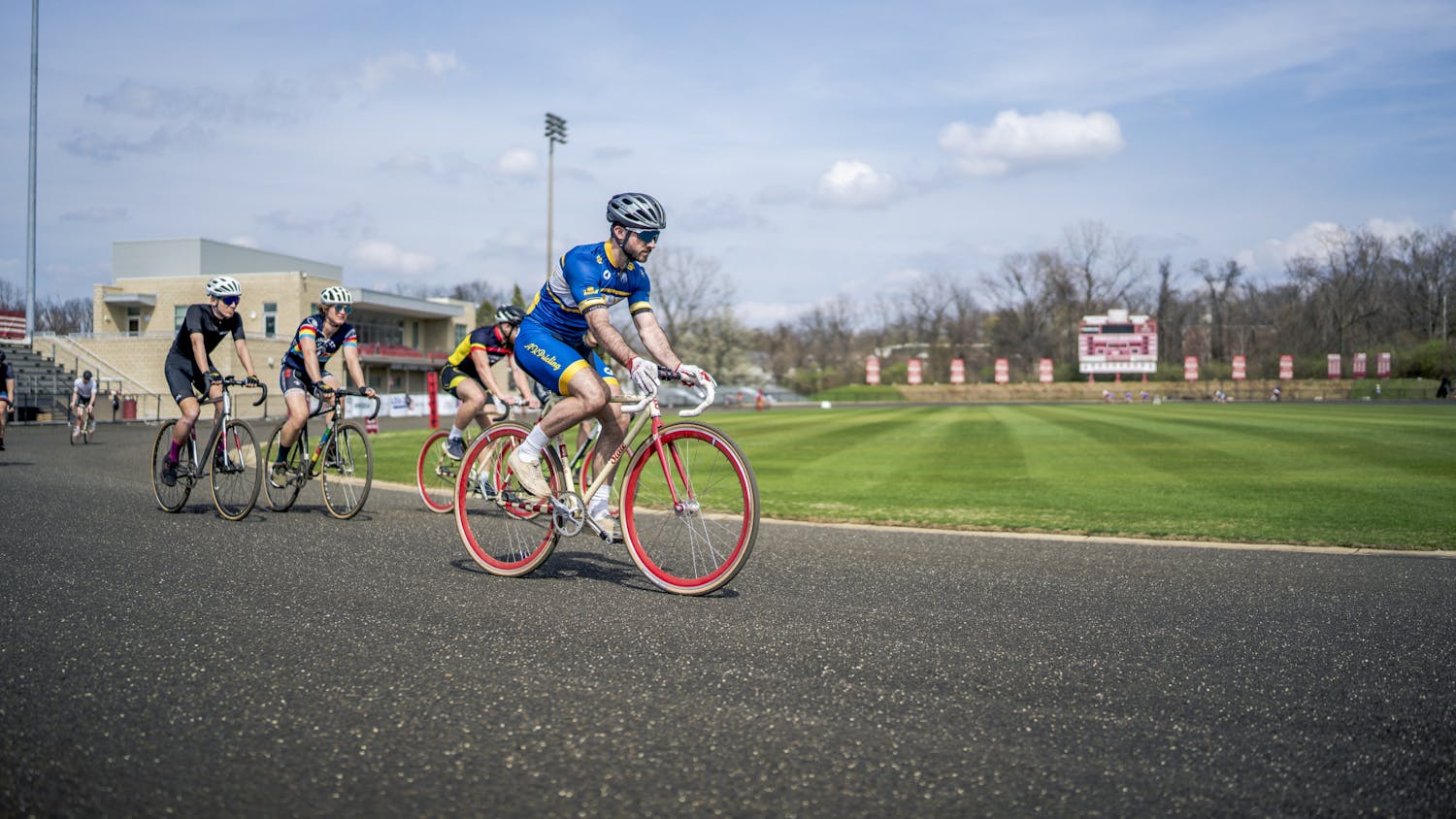
The Indiana University Arboretum is a popular place for students and visitors to sit back and relax. It sits between 10th and Seventh streets on the west side of the Herman B Wells Library. The area is landscaped with trees and shrubbery and includes a stream that flows into a small pond. The Arboretum contains a variety of plants, many of which are representative of specific individuals and events. Prior to becoming the IU Arboretum, the area was first the Memorial Stadium football field and then became the Little 500 racetrack, as featured in the Academy Award-winning film about the race, “Breaking Away.”
10. Stargaze at Kirkwood Observatory
The observatory opened in 1900 and is named in honor of Daniel Kirkwood, a former mathematics professor at IU. It is used for teaching and research purposes. In 1866 Kirkwood announced that gaps, caused by Jupiter’s gravitational forces and asteroids, exist in outer space. Modern astronomers still refer to these phenomena as Kirkwood gaps. The observatory is at Indiana Avenue and Fourth Street behind Bryan Hall.
11. See what Alfred Kinsey started at the Kinsey Institute
Morrison Hall 313, 1165 E. Third St.
Alfred C. Kinsey is the man who started it all. After students at IU petitioned for a class about marriage, professor Kinsey, an acclaimed zoologist, accepted the challenge. While preparing for the class, he realized there was very little research on human sexuality. He took it upon himself and his staff to acquire research on the subject. They started by interviewing more than 18,000 people about their sexual histories. This study was the beginning of the Kinsey Institute, which is currently located on campus in Morrison Hall. Now the institute’s library contains films, videos, fine art, photography, artifacts and various print materials concerning human sexual behavior spanning from over 2,000 years ago to the present day.
12. Step through the Sample Gates
The Sample Gates at the east end of Kirkwood Avenue between Franklin and Bryan halls serve as an iconic gateway to campus. The Gates were a gift to the University from Edson Sample in 1986 and lead walkers into the Old Crescent — the original hub of IU.
13. Stick your feet in Showalter Fountain
Directly in front of the IU Auditorium is the Showalter Fountain, which contains the sculpture “The Birth of Venus.” Former IU faculty member Robert Laurent created the two-ton work of art, which depicts Venus being born out of a clamshell, surrounded by fish. After the IU men’s basketball team won the NCAA championship in 1987, one of the fish mysteriously disappeared. Protesters also carried one of the fish, weighing 200 pounds, to Assembly Hall the night then-President Myles Brand fired men’s basketball coach Bob Knight.
14. Have lunch with Herman at the Herman B Wells Statue
As the 11th president of IU, Herman B Wells (1902-2000) worked tirelessly to promote academic freedom. He is also credited with advancing desegregation at IU and supporting the preservation of green space and trees on campus. A sculpture of Wells sits near the Rose Well House in the Old Crescent area of campus near Wylie Hall. The sculpture depicts Wells sitting on a bench with his hat in one hand and a handkerchief in his jacket pocket.
15. See the angles of the IU Art Museum
1133 E. Seventh St.
Established in 1941, the IU Art Museum has a collection that is continuously changing and growing. Currently, the museum has art pieces from around the world, including famous works from both Claude Monet and Pablo Picasso. The museum has more than 30,000 pieces from various art-producing cultures in history. However, the art is also outside the museum; in front of the building, which was created by I.M. Pei, sits a red loop-like structure called the Indiana Arc and a light totem that projects jewel-like tones onto the wall of the Art Museum and into the sky.
15 things you should do on campus
Get stories like this in your inbox
Subscribe