
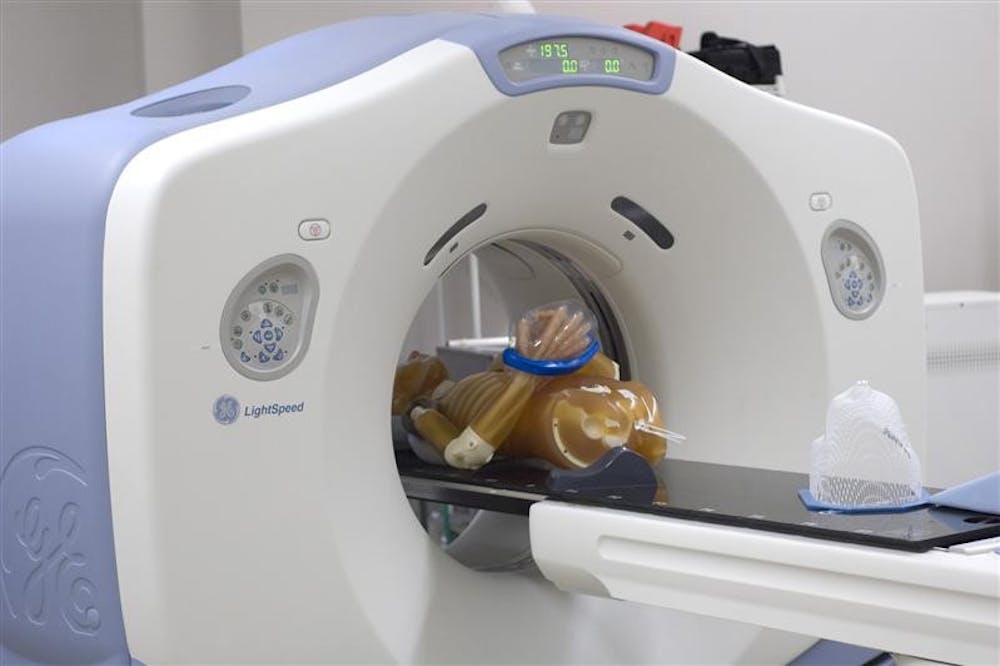
A beam shoots invisible, highly energized protons into a cancer patient’s body. The protons, traveling near the speed of light, find the tumor and release their energy into it, destroying the tissue with radiation.
The patient feels nothing, and the tumor is systematically killed cell by cell.
Right now this is a simulation, but by July it will be a reality.
Bloomington is home to the world’s first and only training facility for medical personnel who will use proton therapy to kill cancerous tumors. Tom Doyle, vice president of training and education at the ProCure Training and Development Center, affectionately called the facility “the proton school.”
Professors at the proton school are now hard at work teaching their first group of doctors, medical physicists and radiation technologists how to use the equipment. They will complete training this summer, so they will be ready when the ProCure Proton Therapy Treatment Center opens in Oklahoma City in July.
When it opens, the Oklahoma facility will be the sixth proton therapy center in the country. ProCure will open another in Warrenville, Ill., in 2010.
The technology behind proton therapy has been around for decades, but it is now rapidly changing from an experimental to a mainstream treatment, said Dr. John Cameron, physicist and founder of the ProCure Treatment Centers. Cameron said proton therapy is very promising, treating cancer as effectively as traditional treatment methods – with fewer side effects.
Standard radiation therapy uses X-ray photons to interfere with the DNA of cancer cells and prevent them from dividing and growing.
Proton therapy works the same way, except doctors can manipulate the protons so they deposit almost all their energy directly into the tumor cells, causing less damage to nearby healthy tissue and organs and resulting in more effective treatment.
Cameron said proton therapy also reduces the risks of future complications and the recurrence of cancerous tumors.
Although the proton therapy facilities are expensive up front, costing about $125 million to $150 million each, Cameron and the rest of the ProCure team said they believe the facilities are a worthy investment because of the reduced likelihood of future complications. Proton therapy poses less risk to the patient than surgery, he said.
“It’s sort of like taking the rifle and shooting the rat,” Cameron said. “Chemotherapy would be more like taking rat poison, setting it down, waiting for the rat to eat it and then waiting for the rat to die.”
Doyle said ProCure offers a new approach to proton therapy training by creating a structured curriculum so doctors can practice before they treat patients instead of learning on the job.
The Training and Development Center also combines Web-based learning techniques with hands-on training, said Mark Rocque, e-learning manager at ProCure. Medical personnel complete some aspects of their training in a virtual classroom and then fly to Bloomington to practice at ProCure.
“A lot of it could and will be done online, but when you get to the technical aspects, you really need the hands-on training,” Rocque said. “The goal is to have the staff walk onto the floor like they’ve been treating patients for three years.”
This technique allows the trainees to make mistakes in a controlled environment without disastrous, real-world consequences.
“We don’t send airplane pilots out in the beginning and allow them to crash,” Cameron said. “They have simulators that are exactly the same as being in the cockpit of a plane, and they simulate the takeoffs and landings. We do exactly the same thing. We have rooms that are identical to the workspaces in our facilities so they can practice.”
Proton therapy center begins training program
Doctors to open sixth facility of its kind in Oklahoma City
Get stories like this in your inbox
Subscribe



