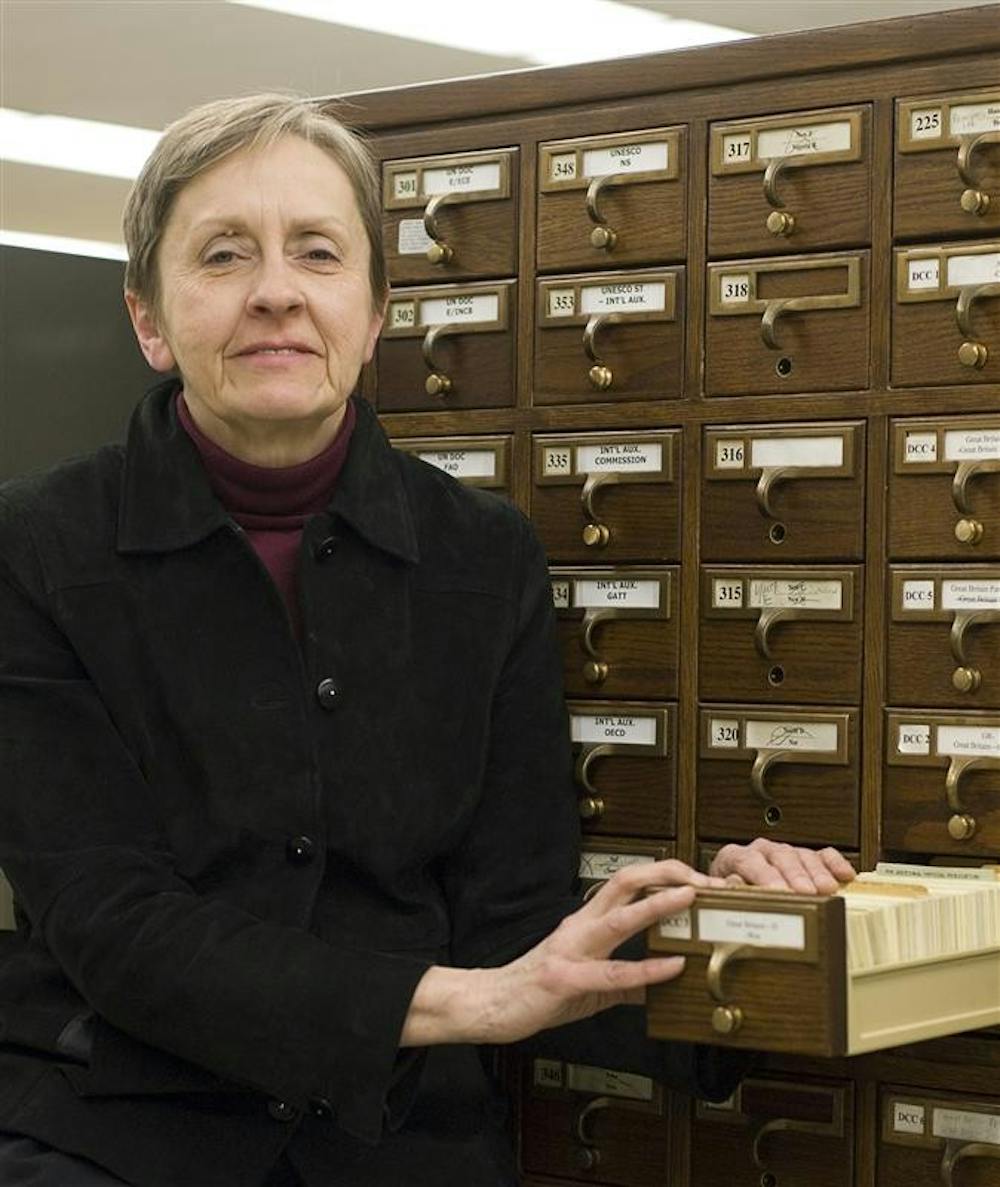
Librarian Lou Malcomb still keeps an old card catalogue in her office. It is stored away inside a filing cabinet on the floor by her desk, brought out rarely to show how libraries used to function.
Her nearby computer now connects her to the world, helping Malcomb find answers instantaneously through the Internet.
Since she joined the IU Libraries in 1968, radical developments in technology have caused her job to evolve. As Head of Government Information, Microforms and Statistical Services for the IU Libraries, Malcomb said her responsibility as a librarian remains the same: maintaining access to current and old information for users.
“People have always said I should be a detective,” Malcomb said. “I like the challenge of finding information.”
Changing user expectations, however, have altered the way Malcomb performs her job. She uses technology to provide answers to a greater number of people in record time through collaboration with other campus resources.
Patricia Steele, Ruth Lilly Dean of University Libraries, said partnerships allow the library to make changes it couldn’t afford on its own. By working with University Information Technology Services, the library can aid faculty research through technology, expand its digital library and share information with students through e-mail and instant messaging.
Eric Bartheld, director of communications for the IU Libraries, described another project called the Hathi Trust that brings libraries from all over the world together online to create a digital repository of research materials. The Internet allows the libraries to get information to the public more quickly. The library is also currently working with Google to digitize many of its volumes to create easier access for users, Bartheld said.
Malcomb estimates that more than 50 percent of her reference inquiries today occur electronically.
She said she has been able to get an article abroad in less than 24 hours when it would have taken about 30 days to have the book shipped overseas.
“You never know when an idea might be lost because we didn’t get information there fast enough,” Malcomb said.
Though she appreciates the ease technology brings to her job, Malcomb doesn’t like the loss of communication between library staff and students.
“I love walking through the main library lobby and being open to a student asking where something is,” she said. “I miss it.”
Malcomb and Steele agree technology has also changed the library’s function. Steele said students are now looking toward the library as a comfortable place that is not home or work.
The library administration listens when making changes and updates. In recent years, these have included small group work areas for collaboration, docking stations and security for laptops and increased food services.
Malcomb said she considers the library an environment for students to think about the work they’re doing and a place to come together for thinking, instead of just a physical storehouse. She said her favorite part of her job is the power to turn students on to thought.
Malcomb started working for the libraries as an IU sophomore in 1968, retrieving information in the closed stacks as a page.
“I loved it and still do, because you get to see everything we have,” Malcomb said.
Steele said Malcomb’s dedication and ability to follow the library’s changes make her an example of what library employees must be today to be successful.
“She is extremely hardworking, versatile, creates a welcoming physical presence for the library and fights very hard for what her users need to have,” Steele said. “Lou has 30 years experience. She proves that if you are the right kind of person, age doesn’t matter.”
Librarian sees technology change over 4 decades
Get stories like this in your inbox
Subscribe