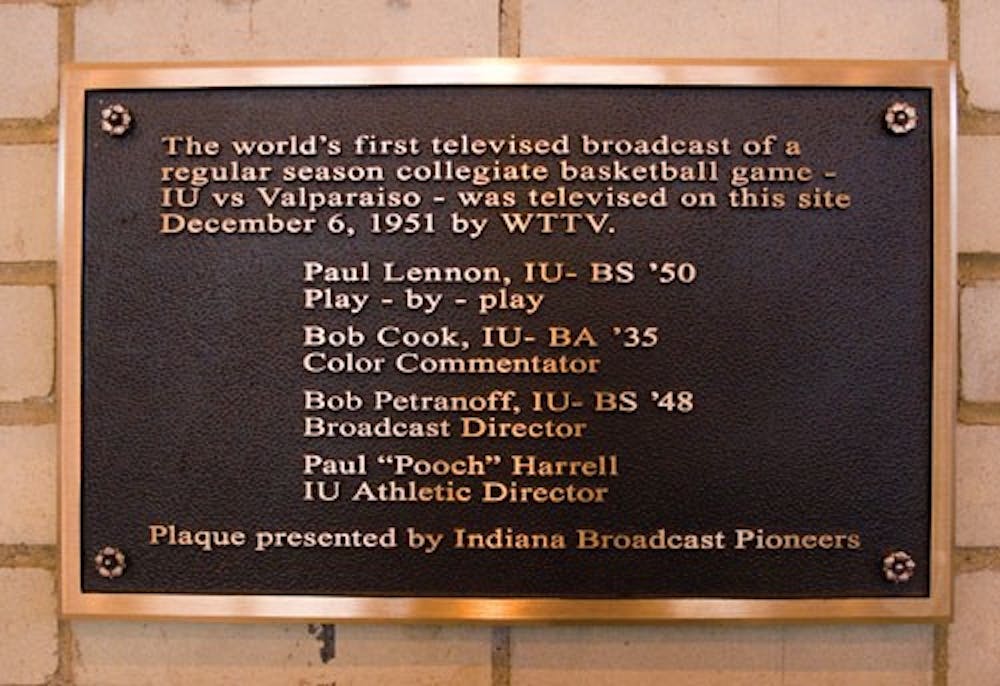
Five national championships. A 32-0 season record in 1976. Bob Knight and Branch McCracken.\nThe Hoosiers have a timeless reputation in the basketball world. Recently, the Hoosiers publicly revealed the little-known but quietly celebrated fact that a plaque has been added to the west wall of the Wildermuth gym to mark the location of the first-ever televised regular season collegiate basketball game: IU vs. Valparaiso, played Dec. 6, 1951.
History of the game\nThe game took place at the Seventh Street Field House, now known as Wildermuth Gym. Paul Lennon, a local radio broadcaster who did play-by-play for IU games on the radio, was approached by the station manager of then-named WTTV-Channel 4 in Bloomington. The manager was in search of a good program to entice advertisers to sponsor his station when Lennon suggested the basketball games as a possible venue. After some consideration, Chesty Potato Chips was selected as the primary sponsor. \nChesty helped to cover the $750 fee the athletic department charged WTTV to compensate for the potential loss of ticket sales, and on that December night, history was made. Not only was it the first occasion a regular season basketball game was shown on the air, but it was also the night Lennon coined what became a successful phrase in the advertising world.\n“I remember looking into that lens, and when that little red light went on, I just said it,” Lennon said. “I said, ‘I’ve got my ticket. Have you got yours?’ while holding up the bag of (Chesty Potato) chips.”\nWithin days, markets sold out of the chips. Within three weeks, the manufacturer was forced to buy more potatoes from other companies when his warehouse was emptied by the high demand. And faithful Hoosier fans wanted to keep the game sponsorship coming. After only one game, IU basketball had proven how successful advertising at sporting events, which is now a multi-billion dollar industry, could be.\nHal Fryar, currently a member of the Broadcast Pioneers of Indiana, was a longtime broadcaster in Indiana. He recalls the early days of basketball broadcasting, which were handled much differently than today’s games.\n“The really interesting part of the story is that the field house wasn’t illuminated at all for TV,” Fryar said. “Engineers had to bring in floodlights.”\nIn addition to the floodlights, cumbersome stationary cameras from the studios were also brought into Wildermuth. After the game was over, they had to be dismantled and brought back to the studios in time for the nightly newscast.\n“You could actually see the camera being wrecked on the air,” said Fryar. “It was very primitive.” \nBecause on-location filming had never been done before, Bob Petranoff, the broadcast director during the game, knew at the time that what they were doing was revolutionary.\n“We were aware we were breaking some ground,” Petranoff said.
Initiating the plaque\nFryar knew of the historical importance of that night and wanted to make sure history was preserved and the field house was properly recognized for its historical importance. He brought the idea of the plaque up to members of the Indiana Broadcasters Association as well as the IU Alumni Association. He sought donations from the IBA, IUAA, Lou Gerig of Sease and Gerig and Associates, a PR firm based out of Indianapolis.\nAfter enough funds were raised, a plaque was installed, and Lennon and Petranoff were honored during halftime of the Hoosier basketball game against Western Michigan on Dec. 20, 2006. The color commentator for the 1951 game, Bob Cook, was also honored. Cook had already passed on, but his name is featured on the plaque for his contributions to the game. Former IUAA president and current Broadcasting Pioneers of Indiana Vice President Ken Beckley was there to present the honor to them.\n“It was a quick ceremony – under three minutes, but it was great to finally have those men honored,” Beckley said. “We (IUAA) were pleased to be asked to be involved with the honoring.”\n“It was a surprise (to be honored),” said Lennon. “But a pleasant one.”\nThe plaque was hung about two months ago, above one of the water fountains overlooking the basketball courts. Beckley looks forward to having the two surviving forces behind that infamous night’s broadcast on campus soon to pose for a photo with the plaque that bears their names.\n“We hope to get them down on campus for a picture,” said Beckley. “For \nhistorical purposes.”