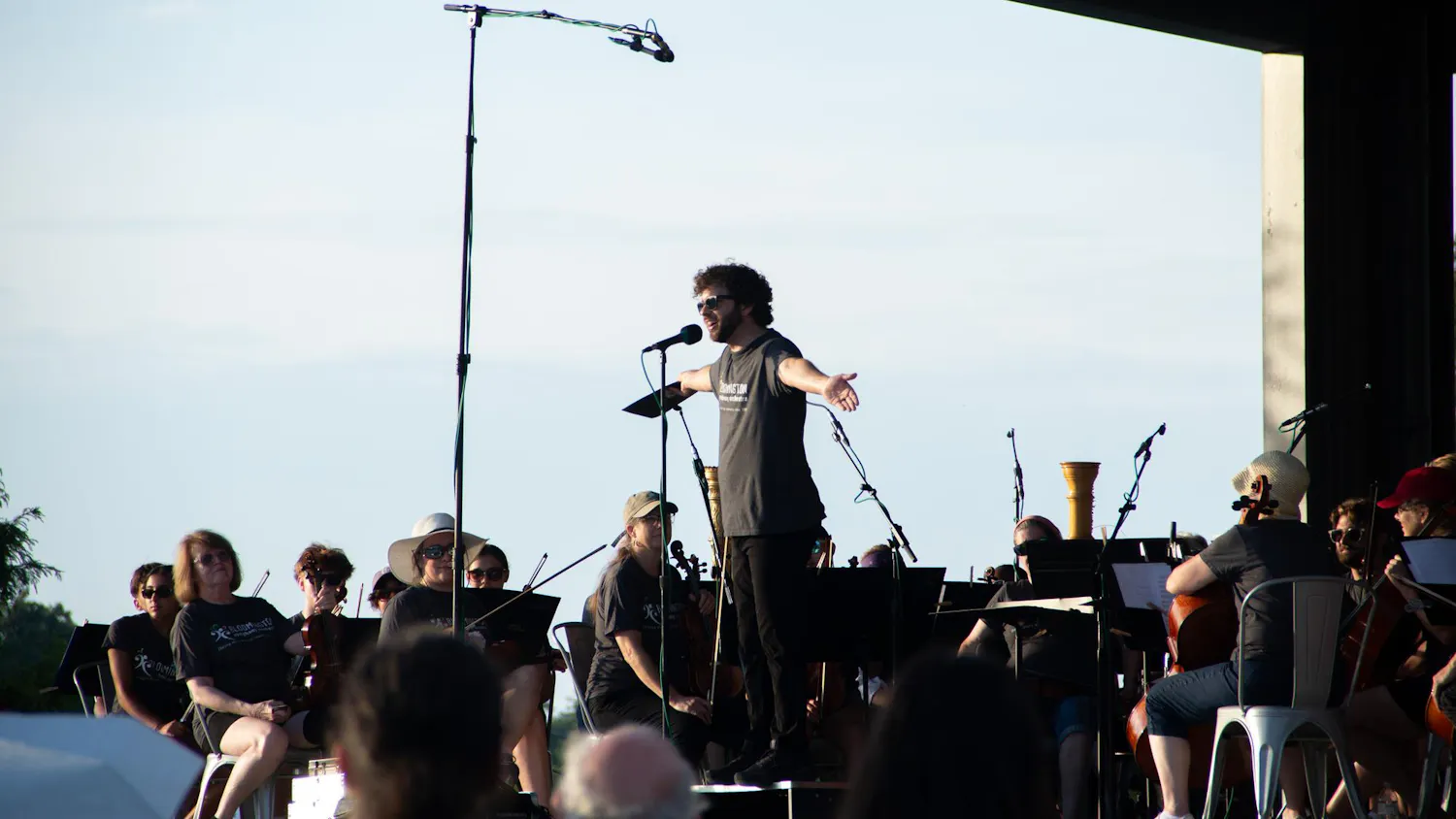
The Silk Road Ensemble took its audience on a musical and cultural journey transcending many national and geographical borders on Saturday night. The group used the music and dance of Central Eurasian countries to show a broader image of a part of the world many people know little about.\nThe performance of the Silk Road Ensemble was part of the Central Eurasian Studies Society conference that took place this weekend at IU. The Silk Road Ensemble attempted to undertake the tremendous task of performing the dances and music of all the Central Asian countries. \n"I really enjoyed the Azerbaijani folklore songs that unwrapped the wealth of the Azeri nationality," said Nurlanbek Masylbaev, a visiting scholar from Kyrgyzstan. "The music was so sensitive that it even reminded me of the national music of my own country." \nFor almost 30 years, the Silk Road Ensemble has tried to erase cultural differences by performing the arts and music of different countries. \n"We want to demonstrate that we can use Azeri instruments to play not only old traditional Azerbarjani melodies, but also music of Turkey, Israel, Tajikistan, India or Russia," said ensemble member Arif Bagirov. \nAll of the members are professional musicians who graduated from state musical colleges in Baku, Azerbaijan. Bagirov said musical education is only a tool for becoming a better skilled musician. \n"At the musical college you can study the techniques of how to play Azeri instruments, but you need long experience and a soul of the musician to feel the instrument and to make the instrument sing in your hands," Bagirov said. \nAll the members of the ensemble come from different parts of the world including Azerbadjan, Uzbekistan and Turkey. Most of them have maintained an international reputation by traveling to a variety of countries and marrying women from different stops along the way. \nBagirov, who considers himself Muslim, was born in Azerbaijan and married a Jewish woman from Israel. \n"Love, as well as music doesn't have any borders or national identities," Bagirov said. \nOne of the richest of the Silk Road musical traditions is folk music, which varies widely with the religious, linguistic and cultural background of the musicians.\nThe Silk Road artists demonstrated several genres of folklore music. One of the main genres was a mugham (or makam) performance. Mugham, the music of the sedentary cultures of the Silk Road, is a complex form that requires years to master. It is like improvisational jazz -- the greater the master, the more complex the music. Mugham is also similar in concept to Indian ragas and, in the past, marathon performances would last well into the early morning. \nSilk Road vocalist Novruz Mamedov used a technique called melisma, in which the singer sings one syllable of taxing several notes, much like a Gregorian chant. Unlike the western approach that utilizes the diaphragm for breath support, Central Asians often rely more on their throats to sing. Throat techniques vary over different regions. The Iranian and Azerbaijani mugham singers, for instance, call their technique chah chah or jahjah. \n"The singing was unbelievable. You can see the feelings of the singer, because through his songs he lets you touch his heart, and there are a lot of emotions," said visiting scholar Asan Saipov. "Although, it is hard to decide which performance was the best because all of them were so different and unique in their own way. Both the wedding dance and the accordion performance just made me speechless."\nThe members of Silk Road Ensemble said they believe if by the end of the concert the artists feel the audience understood the feelings of the musicians and saw what is in the hearts of the Central Asian people, then the concert was successful. They said it is successful because the mission of erasing national differences has been completed. The members of Silk Road Ensemble said all musicians of the world should try to do the same. \n"We musicians have only one nation," said ensemble member Avner Shakov. "And when we get together, nobody asks the nationality of each other, because music is our international identity." \n-- Contact staff writer Fatima Morrisroe at fmorrisr@indiana.edu.
Silk Road Ensemble blurs international borders in music
Get stories like this in your inbox
Subscribe