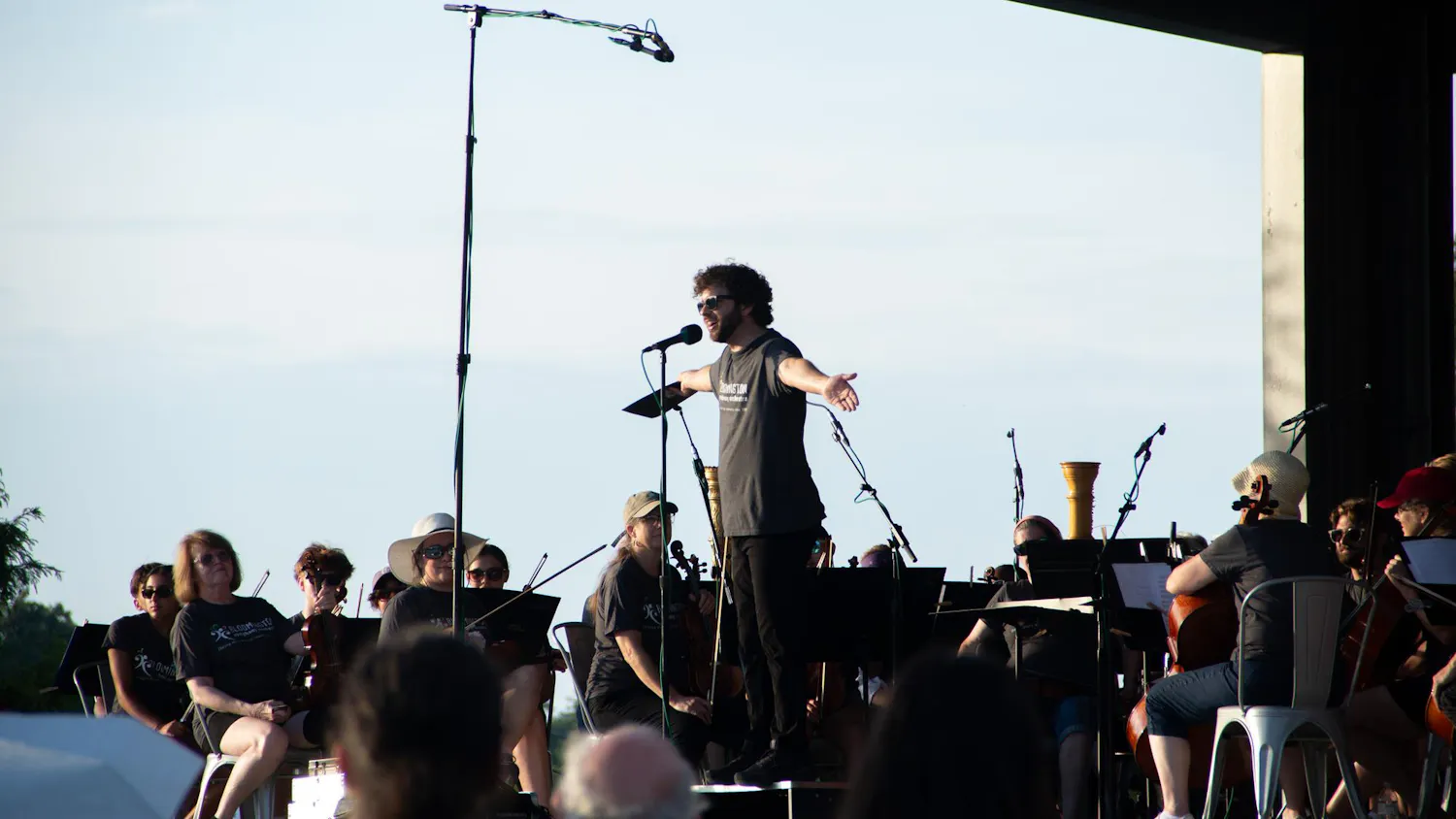
An ensemble of nine international artists will use the music and dance of Central Eurasia to promote a positive image of their culture this weekend. The Silk Road Ensemble will perform at Buskirk-Chumley Theater as part of the Central Eurasian Studies Society conference which is expected to attract hundreds of international scholars and artists to IU.\nThe fifth-annual event is the largest conference of its type in the world. This year's conference will focus mostly on Central Asia, but also includes places like Mongolia, Tibet and the western part of China and Caucuses regions. This weekend's annual conferences for the Mongolia Society and the American Institute of Afghan Studies are part of the Central Eurasian conference. The cultural music featured by the Silk Road Ensemble is representative of the countries along the path travelled by Marco Polo from Europe to Asia.\nAfter the discovery of the route to China by Marco Polo, Central Asia became a significant place for the exchange of cultures. Historical impacts of the route changed the modern situation of the region. \n"It's now not just the place that people pass through like Marco Polo," Inner Asian and Uralic National Resource Center Associate Director Edward J. Lazzerini said. "He didn't really care about Central Asia, but now Central Asia, by itself, is an important place to stop, look around, see what's going there and pay attention to." \nProfessor Shahyar Daneshgar, who researches Silk Road culture, is a member of the Silk Road Ensemble.\n"Nothing is as strong as performing arts -- particularly music -- to reach the souls and hearts of people," Daneshgar said. "I think they're nothing like culture and music, which can really help people to understand the other cultures and get rid of differences. Once you get rid of differences, then there will be less trouble." \nThe conference this weekend, sponsored by the Inner Asian and Uralic National Resource Center, includes about 50 to 60 panels about Central Eurasian topics, workshops, films, books, artifact exhibits, cultural events and food of Central Eurasia. \nThe conference represents the growth of the Central Eurasian Studies Society and public interest in the cultures it studies.\n"We had events like this in previous years, but they tended to be very much smaller," Lazzerini said. "They were open mostly to American and Canadian scholars who were interested in that region. But in the last two years, it has grown enormously, about 40 percent of people participating this year are from abroad -- from Central Asia, Russia, China, Mongolia, plus places in Western Europe." \nTo contribute the cultural impact firsthand, many foreign participants will expand the event.\n"I'm very excited to meet all those new people, scholars coming from far away countries," Daneshgar said. "For some of them, it's going to be the first time trip to the USA, so we want to make sure they're going to have good times here."\nDaneshgar said a global institution like IU requires a lot of knowledge about the rest of the world. \n"We live in a global village, but we as Americans are involved right now in this region," Daneshgar said. "Our children, our boys and daughters, right now are in Afghanistan, Iraq and Uzbekistan. So, it would be good for us to know where our children are, whom they're seeing, where they're staying, what they're eating or what kind of music they hear there." \n-- Contact staff writer Fatima Morrisroe at fmorrisr@indiana.edu.
Musical performance explores Silk Road culture
Ensemble plays tunes from Central Eurasian countries
Get stories like this in your inbox
Subscribe