
Editor’s Note: All opinions, columns and letters reflect the views of the individual writer and not necessarily those of the IDS or its staffers.
If the president speaks, but there is no one around to hear it, does he make a sound?
President Donald Trump is preoccupied with remaining in the spotlight. It’s easy to forget given his current role, but at his core, he is an actor. If it means capturing media attention, Trump is willing to spew his stream of consciousness to the media on a near-daily basis. Whether he’s proclaiming that a “whole civilization will die tonight,” telling a reporter “quiet piggy” or renaming AI to “SUPER INTELLIGENCE,” stand near Trump, and you will likely hear several headline-worthy quotes.
The media is happy to give Trump his attention fix, because he benefits their bottom line. In his first term, mainstream news outlets experienced a “Trump bump” — a dramatic increase in share prices and viewership. This bump was largely driven by coverage of inflammatory, misogynistic and white supremacist rhetoric used by the president. Outrage drives clicks; clicks drive revenue.
Constant media coverage was a large factor in Trump’s initial political rise. During the 2016 elections, news outlets gave him approximately $5.2 billion in free coverage. Those mentions were not all positive, but they went a long way towards boosting his national profile. In 2015, most political commentators viewed Trump as a joke, long-shot candidate. He was never going to win, so what was the point of debunking or investigating him?
We all know how that ended.
Throughout both of Trump’s terms, mainstream news organizations have prioritized administrative access over long term consequences. Look no further than the rescheduled White House Correspondents’ Dinner this July, when the Wall Street Journal’s team received the Katharine Graham Award for Courage and Accountability.
The award recognized their reporting on Trump’s birthday letter to Jeffrey Epstein, a story he denied and answered with a lawsuit. Khadeeja Safdar, one of the WSJ reporters who broke the story, had her home address exposed in the suit. Her family was forced to relocate. When the winners left the stage, Trump stood and shook their hands. Apart from Safdar, the team was all smiles.
It would have been easy to refuse Trump’s hand; he sent a flowery birthday card to a sex offender and tried to cover it up with a lawsuit. But even knowing his past, the WSJ reporters were willing to share the spotlight with him. If the press wants the public to take their reporting seriously, it needs to take itself seriously. That requires burning bridges with powerful people when they do wrong.
The president has always depended on the media to get his attention fix, but he is now getting high on his own supply. On Sept.18, Trump announced MS NOW, CNN and Politico would be banned from covering the White House. Shortly after, several other news organizations, including Fox News, ABC, CBS and NBC, announced they would suspend press pool operations until access was restored. In response, Trump launched TRUMP TV, a state-run channel which broadcasts 24/7 reruns of speeches and live events.
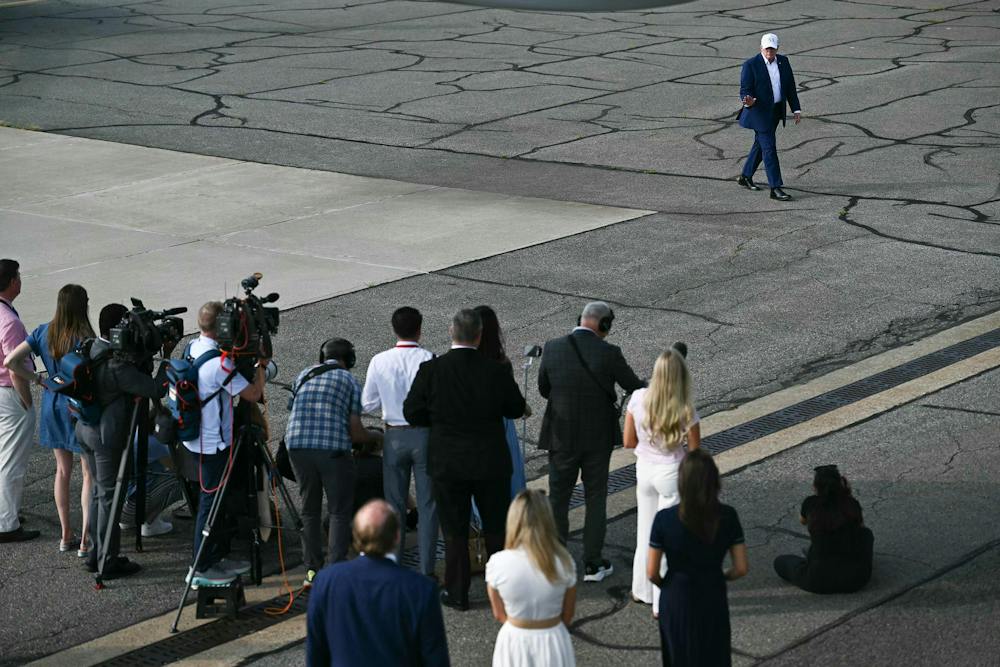
The first test of this arrangement was a flop. At a Sept. 21 ceremony to open a new White House helipad, the pool’s cameras and microphones were absent, and the president’s remarks were barely audible on the footage that aired. With no replacement pool, the White House must supply its own equipment and its own audience.
TRUMP TV gives the president full control over his media presence, but there’s no guarantee anyone will give him the attention he craves. Established news outlets have dedicated viewership and decades of institutional credibility, appeal that extends beyond the Trump brand. TRUMP TV, on the other hand, only has appeal to a narrow segment of the electorate. The president is speaking in an empty room; it’s time for the press corps not to hear him.
As courts overturn Trump’s media crackdown, it may be time to reevaluate the role the press plays in giving him the spotlight. Mainstream news organizations have spent the better part of the last decade chasing the “Trump bump,” but the utility of White House access is lost on much of the American public. A poll from April found 62% of respondents actively avoided news about the president. At one point, Trump commanded the spotlight because of his brash and unapologetic attitude, but his act has gone stale.
The press needs access to the White House, but that reporting is not a replacement for investigative journalism. Focusing on Trump’s rhetoric, even if to condemn it, keeps him in the spotlight — instead of those impacted by his decisions. It’s possible to be too close to a story, and healing the public’s trust in media requires a break from Trump.
Increasingly, this looks like a decentralized network of internet-native publications. More Perfect Union, a nonprofit news site, won an Emmy in 2026 for reporting on the Haitian immigrant community in Springfield, Ohio. The Intercept, another nonprofit, identified the U.S. Immigration and Customs Enforcement officer who fatally shot Renee Good. A third nonprofit, ProPublica, exposed Supreme Court Justice Clarence Thomas’ hidden ties to billionaire Harlan Crow.
The existence of these nonprofit organizations demonstrates that there is still demand for high-impact independent reporting. Important people often say the least important things, while the voices of those with little power can be the most profound. Mainstream news organizations claim to speak truth to power, but the best journalism is often done outside of the spotlight.
So, if the president speaks and no one is around to hear it, does he make a sound? He does. It just doesn’t always have to be news.
Spencer Robinson (he/him) is a junior studying public policy analysis and law and public policy. His commentary can also be found on his Substack.



