
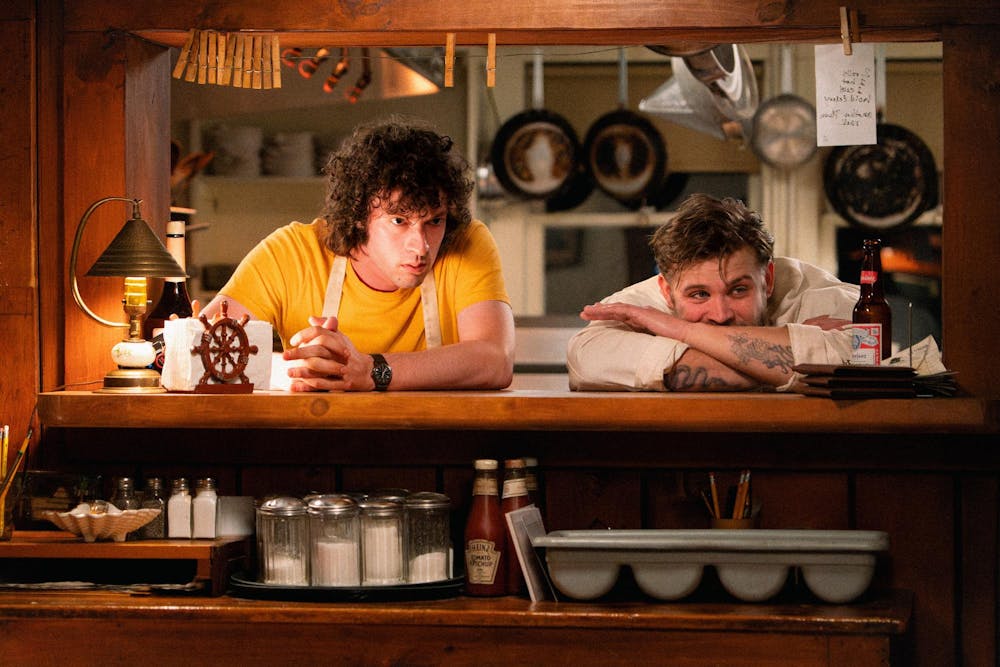
A24’s new film “Tony,” released nationwide Aug. 21, is a thoughtful coming-of-age biopic about a man who used food to teach us about the world, ourselves and the people around us.
The film takes snippets from Anthony Bourdain’s life, exploring his early experiences, relationships and the person he was before becoming a world-renowned chef, writer and TV personality. Inspired by just a few pages of his 2000 memoir, “Kitchen Confidential,” the film centers on one summer 19-year-old Bourdain spent in Provincetown, Massachusetts.
This film has been on my radar for a while. As a fan of Bourdain’s writing, I was intrigued as soon as the trailer dropped in May 2025. Bourdain has been a central figure in pop culture for years, and even after his death in 2018, I’ve found many of us are still captivated by him and his work. He taught us to be open to new experiences, to move and live without judgment and to be honest with ourselves and others.
The movie is a fictional biopic, drawing on just a few of Bourdain’s real-life experiences. Despite this, it does an excellent job of capturing Bourdain’s essence while giving viewers a new way to look at him. We know him through his writing and shows like “Anthony Bourdain: No Reservations,” but seeing this undeveloped and awkward version of him highlights what made him so alluring: the fact that he never shied away from his flaws but embraced them.
The film starts out with a Bourdain quote from "Kitchen Confidential” that reads, “I was— to be frank—a spoiled, miserable, narcissistic, self-destructive and thoughtless young lout, badly in need of a good ass-kicking.” It’s a line that sums up the entire film and gives viewers a preview of what’s to come.
From the very beginning, the movie makes it clear this story is not just about his journey to becoming a chef but also about him figuring out who he is.
The plot depicts a young and cocky Bourdain, played by Dominic Sessa, as he follows his crush, Nancy (Emilia Jones), from Vassar College to Provincetown after losing out on a writing fellowship for the summer. Once in Provincetown, he discovers Nancy dating another man. Determined to stay and win her back, he reluctantly takes a job as a dishwasher at the restaurantThe Flagship, the real restaurant where Bourdain began his career.
One performance I was especially anticipating was Leo Woodall’s who played Sal, a sous chef who befriends Tony and shows him all the bad habits within the kitchen. After seeing his performance in the Netflix limited series “One Day,” I was interested to see him take on another “bad boy” persona, and I was not disappointed. He plays the devil on Tony’s shoulder, encouraging his reckless behavior and poor decisions. Sal’s character is certainly unenjoyable, but Woodall gave a stellar performance.
That character becomes even more interesting when you look at Tony’s relationships with the people who work at The Flagship. Another relationship that stood out was between Tony and a character referred to as “Chef” (Antonio Banderas). I interpreted Sal and Chef as a representation of Tony's two conflicting sides.
Sal represents his irresponsible and chaotic nature, highlighting the beginning of his drug abuse that would follow him throughout his life.
While Chef is his mentor and showcases the patience and respect it takes to work in a kitchen. Although Bourdain’s real-life mentor was a man he called “Bigfoot,” who he met while working in New York City, the film uses Chef to represent many of the qualities Bourdain would one day develop. Throughout the film, he challenges Tony to become a better version of himself, even telling him, “You can be anything you want to be, and yet, you are nothing.”
At first, I thought it was an interesting choice to create a movie about Bourdain’s early life, as it was the least represented in his body of work. But after watching the film, I can see why the writers chose to highlight this portion. Instead of trying to explain the person we already know, it introduces us to a scrawny, uncertain kid that still has a lot to learn. Since he is such an iconic figure, breaking down one specific time in his life made his story more digestible and ultimately more relatable.
So, whether you’ve been a Bourdain fan for years or are just discovering his work now, “Tony” offers a unique look at a part of his life we rarely get to see while reminding us of the legacy he left behind. More than anything, the film reminds us it takes time to become successful and that making mistakes is part of the journey.



