
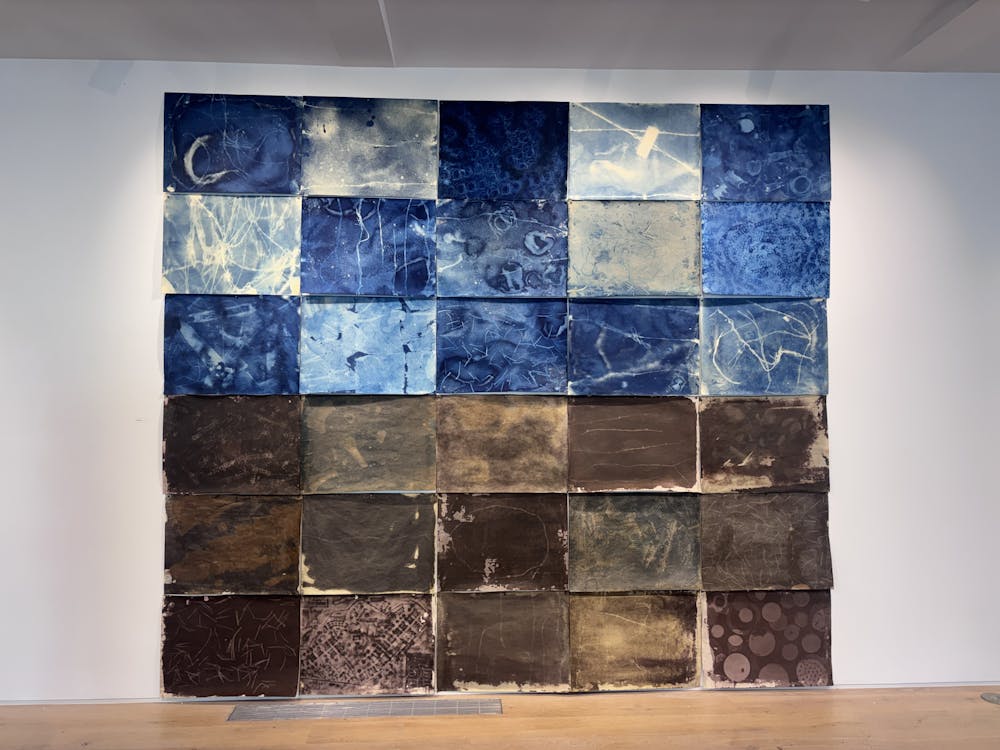
Bloomington’s Pictura Gallery debuted “Trace,” the latest exhibit by artist Osamu James Nakagawa, on Friday.
Nakagawa, who was born in New York City but raised in Tokyo, drew on Japanese American history and his own experiences in the U.S. to create the pieces in the exhibit.
“Trace” uses landscape photography to comment on the experiences of Japanese Americans incarcerated in camps during World War II. After the bombing of Pearl Harbor by Japan in 1941, President Franklin Roosevelt issued an executive order forcing about 120,000 people of Japanese descent, mostly U.S. citizens, into camps.
Most of the photos in the exhibit were taken at the sites of these former camps, with each photo depicting the sky and the ground below using the diptych technique. A diptych photo uses two matching flat plates or panels that form a pair. Essentially, two photographs are placed side by side or one above the other to tell a combined story.
In the artist's curatorial note, Nakagawa states that the split line between the sky and the ground represents the psyche of going in and out of consciousness, a feeling common among Japanese Americans who were confined for three years in these camps. Nakagawa also used imagery of the moon, clouds and constellations in the sky as a contrast to the shower drains, nails and sharp wires of the inside of each internment camp. His imagery is meant to offer disorienting perspectives and large framing.
Each artwork and photograph encourages viewers to try to imagine the events of World War II from the perspective of Japanese Americans. During the creative process, Nakagawa traveled all over the United States and Japan to capture these images.
“I went there and then I felt something,” Nakagawa said. “How can I visualize that?”
Additionally, Nakagawa is a professor of photography at IU and many of his students attended Friday’s event. One of these students was Alex Leon, a junior studying creative advertising and photography, who was able to view some of the pieces in Nakagawa’s class before the exhibit debuted.
“He showed us a few works, and I originally thought it was a really cool concept,” Leon said. “This one for him really felt like the epitome of his identity, and I really feel that strongly through this exhibit.”
Recent IU graduate Darby Williams works as Nakagawa’s personal assistant. While Williams also saw the pieces before they were displayed, she said they took on a different significance once up on the gallery wall.
“Seeing it up really emphasizes its impact and its importance, especially historically,” Williams said.
Williams learned about incorporating research into the creative process through watching Nakagawa create his work. Both Williams and Nakagawa specialize in printing their images to capture meaning. Working with Nakagawa aided Williams’ thesis work this past spring. Key rules that align with Nakagawa’s creative method include taking time when creating and researching the subject beforehand.
“For my thesis, I followed those same exact principles that he used,” Williams said.
As a professor, Nakagawa is able to combine his professional work with his teachings. He said his work as a photographer makes him a better professor. During his classes, he sometimes uses his own work as examples for students.
With “Trace,” Nakagawa invites his audience to find parallels between the camps and modern-day immigration detention centers. Today, Fort Bliss, a site that held Japanese Americans and nationals located in El Paso, Texas, has been repurposed as a detention center for immigration detention. Fort Bliss was one of the camps Nakagawa took photos of for the exhibit.
“I want everybody to keep questioning, see what is going on in this world and then reflect,” Nakagawa said.
Nakagawa said he hopes that his students see his work and learn to create their own art that transcends personal differences to move audiences.
“There is not only one thing that you take away,” Nakagawa said. “Yes, the work is political. I just want the viewer to feel instead of just understanding what happened and then move on.”
CLARIFICATION: This story has been updated to include a paragraph mistakenly omitted during publication.


