
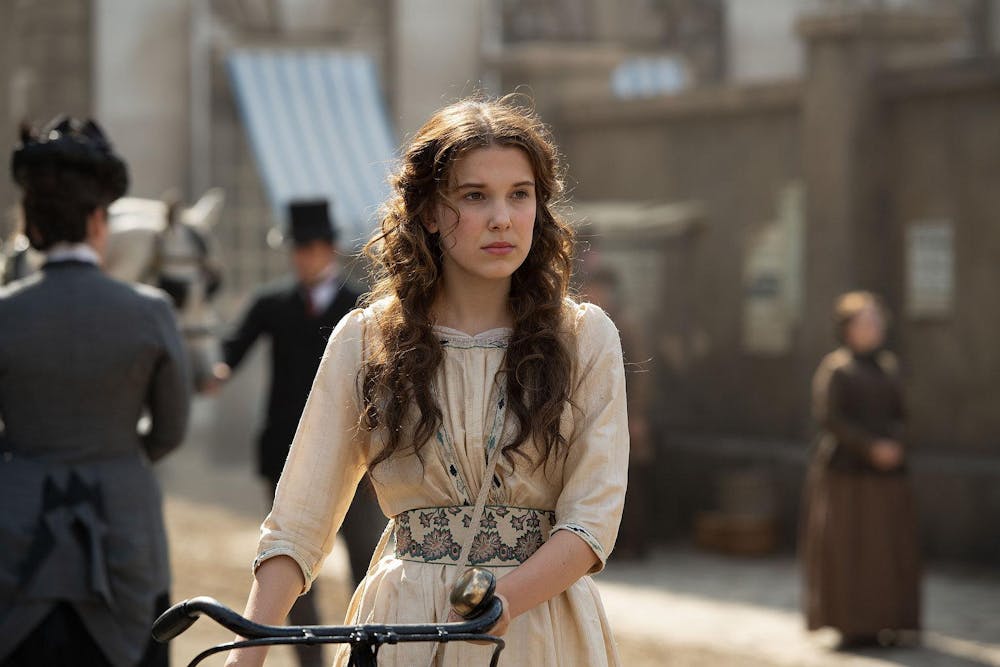
SPOILER: This column contains potential spoilers for “Enola Holmes 3.”
“Enola Holmes 3,” released July 1 on Netflix, took a major genre shift from the franchise’s previous installment, “Enola Holmes 2.”
In this newest installment, I feel like the franchise's once prevalent feminist themes have died down to focus on Enola (Millie Bobby Brown) and Lord Tewkesbury’s (Louis Partridge) marriage, resulting in a movie that is more focused on love than lighthearted mystery.
The film starts off with Tewkesbury waiting at his wedding for Enola, who is nowhere to be seen. Finding out that her brother Sherlock (Henry Cavill) has been mysteriously kidnapped, Enola abandons the ceremony in attempts to find her lost brother. Thus commences the film’s exploration of Enola choosing between her personal life with Tewkesbury and her detective code.
And after “Enola Holmes 2,” I was left disappointed as for what this new film could have been: another interestingly intertwined mystery filled with feminist themes. As arguably my favorite out of the three, this previous film’s character, Sarah Chapman, is directly inspired by the story of one of the real leaders in the 1888 Bryant & May matchgirls’ strike, even sharing the exact same name.
This presence of an impactful historical figure in establishing women’s rights was quite fitting to the franchise. As throughout the previous films, the feminist themes are front and center. For example, Enola’s mother, Eudoria (Helena Bonham Carter), is actively involved in the suffrage movement, forcing her to leave Enola as a teenager in the first movie.
However, this new installment also creates more of an emotional background for characters who have been previously underdeveloped. I felt like Tewkesbury and Enola’s chemistry in other films had felt lackluster. I entirely thought they were only friends with a slight crush on each other thus far due to Enola’s steadfast emphasis on her work and being independent from her well-known brothers.
I also felt that not only was this relationship allowed to grow in this newest installment, but also that of Sherlock and Enola. Although Sherlock is absent for the majority of the film due to being kidnapped, the two siblings share an emotional moment at the end.
Enola saves her brother and Lady Tewkesbury (Hattie Morahan) from Moriarty (Sharon Duncan-Brewster), who planned these kidnappings to uncover a stolen Afghan gold cache and to enact revenge on the Holmes family. And the two connect much deeper over their future and sibling bonds than they have ever before.
Sherlock has chosen to rarely show his emotion towards Enola, reasoning that placing one’s emotions onto situations is entirely irrational and remaining calm despite their often troubles. So, when I saw him cry and tell Enola that she can embrace both lives she has chosen, I was moved by the strong connection they have. It feels like this connection only grew stronger during Enola’s journey to save Sherlock.
But with this overreliance on character development, I felt the plot suffered immensely. Instead of a fast-paced and playful nature, the plot progressed slowly in its attempt to be more mature, introducing both Enola’s personal dilemma and the onset of war. I felt the wedding arc was underdeveloped in comparison to the mystery of Sherlock’s kidnapping, making each wedding scene feel less enjoyable than the film’s standard adventure.
Also, the wedding scenes took chunks out of the main adventure, leading it to also suffer from a lack of investigative depth the previous two films had. I think lengthening the film’s one hour and 45-minute runtime, the shortest out of the three films, could have allowed the writers to better flesh out this mystery and create a better bridge between the wedding arc and kidnapping arc.
Although Sherlock was saved and Enola was able to go through her own journey of self-discovery, I felt the story hadn’t been developed in a way that I cared much for its resolution. Nor am I much interested in a potential fourth movie, which is hinted at by the wedding having yet to fully occur and Enola’s discovery of one key clue she missed.
Despite this detail, my hopes for an upcoming film are quite low, feeling that the franchise has passed its peak potential. While I love this series’ exploration of feminism and gaining women’s rights within 19th century England, something I feel many old-timey detective movies fail to account for, I couldn’t say “Enola Holmes 3” offers much of the charm present in its first two films.


