Editor's note: All opinions, columns and letters reflect the views of the individual writer and not necessarily those of the IDS or its staffers.
Yuck! It’s stringy, it’s chewy, it tastes of dirt and death. I’m not eating that.
At 14, I vehemently shook my head and pushed that plate of fungi as far from my fork as possible. At 22, I’m still shaking my head. But, having been a vegetarian for just shy of a decade now, my parents, cookbooks and the veggie section of restaurant menus alike continually try to shove bites of that famous decomposer into my face:
Mushrooms.
Am I mad about it? Not really. While mushrooms have never suited my picky palate, they provide many nutritional benefits to humans, important ecological services to plants and trees and applications for the global strive toward sustainability.
Everyone wants to talk about quinoa and kale when superfoods are mentioned, but this fungus, the mushroom, is the unsung hero, ahem, magician, of the kitchen table. Incorporating mushrooms into your diet lowers your risk of cancer and mild cognitive impairment, a condition that makes memory and language difficult and often precedes Alzheimer’s. Mushrooms are also a prebiotic — their most abundant carbohydrate stimulates healthy bacteria to grow in your gut — and an immune system booster.
Mushrooms are the only source of vitamin D in the produce section and are also low in sodium, which helps manage high blood pressure. Research also suggests shiitake mushrooms can reduce or block the production and absorption of cholesterol, and mushrooms are already a low-sodium protein alternative.
While our bodies require some level and types of cholesterol for functions like making hormones and building cells, too much “bad” LDL cholesterol can amass in your blood vessel walls, leading to constricted blood vessels and thus blood flow. Over time, this blockage can cause chest pain or a heart attack. Mushrooms? A literal lifesaver if I ever saw one.
On a somewhat less self-centered level, mushrooms are vitally important as the facilitator of nature’s biggest group chat. WhatsApp is hocus pocus compared to their subterranean networks. Frolicking in the forest, as I’m sure you do, you’ll notice mushroom caps dotted here and there along the forest floor. But underneath, there’s something more.
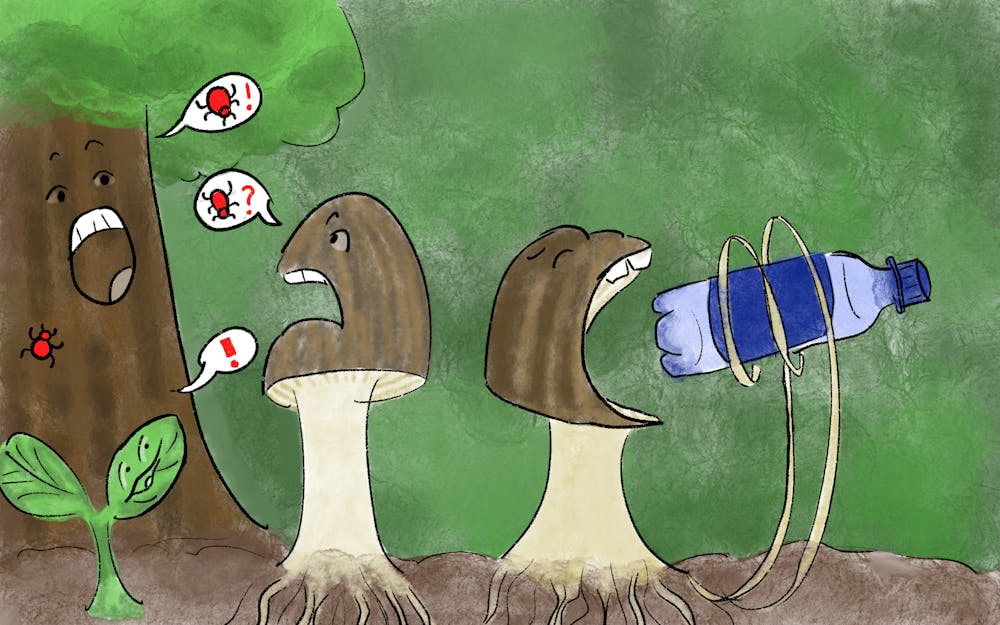
Those caps just account for the tip of the iceberg. They keep their junk in the trunk under the soil, where tiny “threads” called mycelium make up most of the fungal body and put in all the work. This almost 500 million year-old network — coined by Dr. Simard, the researcher who discovered it, as the “Wood Wide Web” — of mycorrhizal fungi, or mushrooms that form symbiotic, mutualistic relationships with bacteria and plant and tree roots. These underground internet trolls allow trees to send warning messages to each other: pests, drought, disease, watch out! Meanwhile, there’s a constant exchange between tree roots and mycelium of water, nitrogen, carbon and other minerals.
But it’s not the only clandestine job mushrooms are toiling away at. Along with microscopic organisms like protozoa and bacteria and fellow macroscopic organisms like earthworms, termites and millipedes, fungi are decomposers. Where we make a pitiful attempt at recycling, decomposers have it down pat. They eat up dead organic matter and waste — leaf litter, wood, animal carcasses, feces — and break it down into simpler substances like water, carbon dioxide and compounds providing nitrogen, phosphorus and calcium necessary for plant growth.
They’re basically the ultimate stay-at-home parent, sweeping up detritus on the forest floor and serving fixin’s for photosynthetic producers like plants, algae and cyanobacteria to make their breakfasts. They sit at the bottom of the food chain, taking up the rest of the forests’ refuse and recycling it into usable energy for everyone else. It’s the most efficient closed loop economy around.
In fact, nature’s recycling system is so superior to humans’ that researchers are working toward adopting it.
Only 9% of plastics can actually be recycled the way we’ve been doing it, but in 2021, the recycling rate looked more like 5-6% in the United States. At this rate, the amount of plastic in the ocean could outweigh the fish by 2050, and even if you threw a plastic container away today, it might still be floating out there, fully intact, until the 2500s. In 2024, a team at Sporadicate, led by Gavin Pechey, set out to look for a sustainable solution to bridge this gap in recycling.
They found that mushrooms possess the ability to chow down on plastics, or better.
“We could create a hybrid mushroom that would do well breaking down several types of plastics,” Pechey said to Presley Arrowood for Idaho State University Magazine.
While this technology is in the works, scientists are finding more, and wackier, ways to use these magical organisms in search of a more sustainable world. We’ve seen promising applications of mushrooms for replacing leather or filtering heavy metals and toxins from abandoned homes, contaminants from water and microplastics from humans. What’s more, it takes a fraction of the water and growing space to produce mushrooms as it does many other foods, all while limiting carbon dioxide emissions.
Mushrooms really are the ultimate magic of the earth, especially when they capture the eye of the field of sustainability. If we take more notice of these magicians, they can keep doing their spectacular tricks. I may not want them on my plate, but, by Jove, do we need them on our planet.
Odessa Lyon (she/her) is a senior studying biology and English, pursuing a minor in European studies.