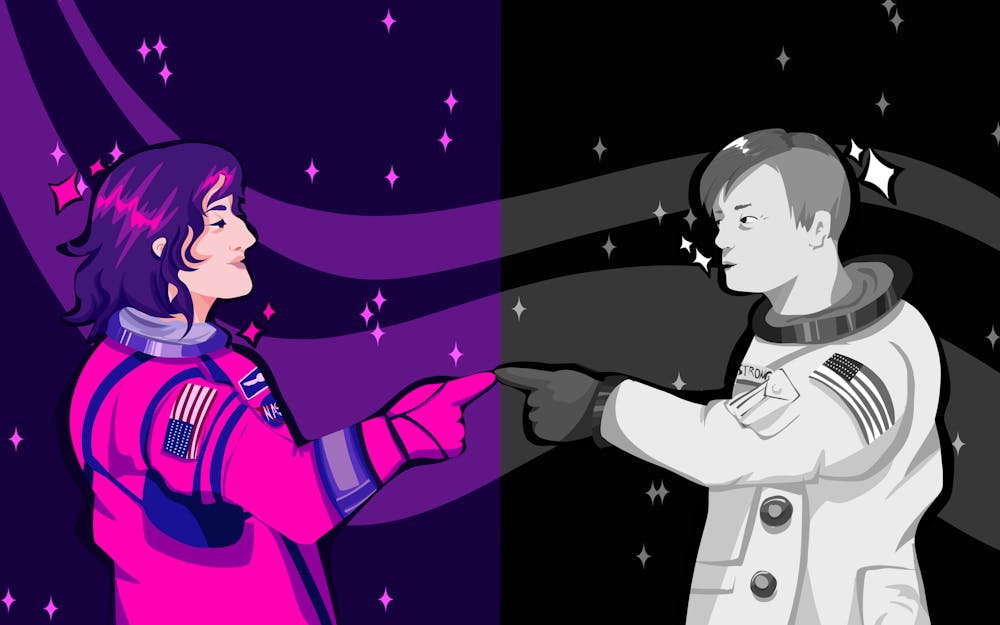
The similarities between the present day and President John F. Kennedy’s are plain.
NASA’s Artemis II mission, which completed a 10-day round trip to the moon this month, had much in common with Apollo 8. The 1968 crew traveled around the moon — orbiting it for 20 hours, in fact — and took pictures, like the photos we saw from Artemis II.
The social media buzz surrounding Artemis II reminded me of a famous speech I once read for class: Kennedy’s 1962 address at Rice University, in which he proclaimed the words “we choose to go to the moon.”
Why, then, was Artemis II necessary? After all, Apollo 11, completed nearly 57 years ago, actually touched down on the moon. Why did we choose to go to the moon again?
In his speech, Kennedy spoke about progress and about the United States being a world leader in scientific advancement. About going to the moon simply because there is “new knowledge to be gained.” About the enrichment that all people will gain from that knowledge.
The speech is as relevant now as it was then. Now more than ever, Americans need something unifying to believe in — a shared excitement about the new knowledge still to gain. That knowledge exists out there, in space, and it’s important we continue pursuing it.
In the last 57 years, deep space travel has been nonexistent. The last Apollo mission took place in the 1970s, leaving behind a sudden public disinterest in space exploration. Apollo 11 was extraordinary. The first lunar landing was an event watched closely by the entire country. Subsequent space travel seemed to pale in comparison.
Even the U.S. government, under President Richard Nixon, seemed to begin deprioritizing space travel, as NASA’s budget in 1970 was greatly reduced. It seemed that, since the moon was the goal, and it had been reached during Apollo 11, that no further space travel was necessary. Considering this context, Artemis II was a crucial first step in getting human pilots back into deep space.
The Artemis crew conducted many tests and evaluations of equipment to see how new technology would perform in deep space. They evaluated how well life support, propulsion and power, to name just a few, functioned while in space, which represented important preparation for future deep space missions. With the Artemis crew’s findings, NASA is even looking ahead to creating a “Moon Base.”
If our leading space experts think there’s more to explore up there, shouldn’t we trust them? Shouldn’t we believe in them? When we stop exploring, we will lose something essentially human. Thinking, knowing and learning are noble pursuits toward which we should naturally gravitate.
Kennedy gave his speech in 1962, eight years before Apollo 11 made it to the moon. The 1960s were a time of massive political and social turmoil. The U.S. was engaged in the controversial Vietnam War. The Civil Rights Movement was in full swing. The Cold War spanned the globe, the U.S. and Soviet Union’s mutually assured destruction an ever-looming threat.
Americans needed something to hope for. So the president promised them a man on the moon. He encouraged national pride, telling his people the U.S. would lead the world’s scientific advancement.
Our time is one of extreme political polarization. Republicans and Democrats are pitted against each other instead of working toward a common goal, as evidenced by the government shutdown of October 2025, and the ongoing Department of Homeland Security shutdown. We once again have little hope for the future of the country. And once again, anxiety over another country’s own efforts to go to space have risen, this time China.
Once again, we needed something to hope for. And once again, we looked to the moon.
Watching these brave and hopeful astronauts, we felt a connection, even through our TV screens and phones. Certainly, the astronauts themselves felt an outpouring of love and support from down below. These were people who believed in what they were doing. And they were our gateway into the wonder-filled expanse of space.
Space inspires curiosity in all of us. It represents the next mystery to solve, the next great unknown to conquer. This new era of space travel appeals to all of those senses, capturing our imaginations and giving us hope for future advancement at a time when hope is in short supply.
Both during the Apollo missions and again now, some have raised concerns about the cost of space travel. Admittedly, the price tag is hefty. The Artemis II mission alone cost an estimated $4.1 billion, paid out of the U.S. federal budget. Is that worth it, when so many Americans are worried about rising costs of gas and healthcare?
Well, how much are we willing to pay for hope?
The sense of unity that we experienced watching astronauts explore deep space again gave us something to look forward to. It could mean returning to learning for the sake of learning, for the sake of examining our curiosity. In a moment of heavy focus on education as simply job training, high profile missions like these could change how we continue to view learning.
Deep space travel must continue, and it needs our support. Keep following future missions. Keep looking up. Most importantly, this country must learn from the past. Over 50 years is a long time to halt the pursuit of knowledge. We need to create new goals to strive for, so we always have something to look forward to.
Choosing to go to the moon is just that: a choice. We must keep making it.
Sasha Burton (she/her) is a sophomore studying elementary education with minors in Spanish and English