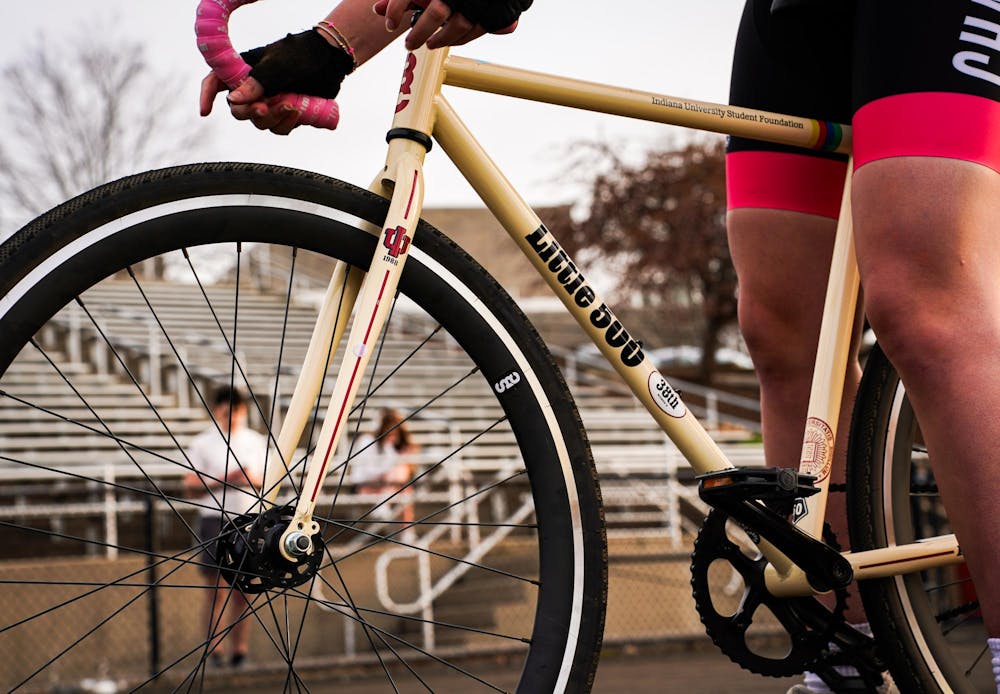
Anticipation mounts as Indiana University marches closer to April 24, the start of the 2026 Little 500. Students have been thinking about how to celebrate the weekend, and athletes have been preparing their bodies for racing.
But before the big day, much of the race is won in the months leading up to the wave of the green flag.
While riders look superhuman speeding around the track on race day, they’ve been building their strength and fitness for months. Early morning rides, high intensity workouts and mental battles of comparison all make up a base of strength unseen by the spectators in the stands of Bill Armstrong Stadium.
Every one of these aspects and more are kept track of in meticulous fashion by the athletes using recording software like Strava. Teams use these apps to keep track of everything from milage to heart rate to power.
Through weeks of relentless training, the numbers help give athletes clarity and guidance about how their training is progressing.
“It allows me to keep tabs on [my fitness] and make sure that I’m continuing to grow,” sophomore rider Judah Nickoll said.
During his time with 3PH Cycling, Nickoll has been a part of a culture that uses apps like Strava, Trainer Road and Zwift for tracking activities and analyzing statistics after their rides end.
The team uses an in-app club on Strava to keep track of each other’s training and to make sure everyone’s on the same page during the week.
“It works really well with seeing where your teammates are at in the week in terms of their training and how much volume they have,” Nickoll said.
These softwares give Nickoll access to an array of different metrics surrounding his performance; measuring heart rate, power and cadence is crucial in his training program. When his coaches put together workouts for his team, different statistics will be more or less important depending on the time of year or target workout his coaches want the team to achieve.
“If it’s December, we’re doing much more long threshold work where we’re just trying to build fitness,” Nickoll starts. “Whenever we get into like February, March and April, it’s much more so sprinting, working in pace lines, a lot more of the quick, fast twitch muscle fiber type of workouts.”
If these programs were to disappear tomorrow, Nickoll thinks his activity tracking and connection to the team would suffer. He said he would switch to using Garmin as his primary tracker, but said the metrics and social aspect of Garmin pale in comparison to Strava.
“I get to see my stuff, but I’m not necessarily seeing my team’s,” he said. “I would be completely out of the loop on where everybody else was.”
While Strava gives Nickoll an opportunity to keep up with teammates’ training, the aspect of comparison also makes athletes focus more on what others are doing rather than their own improvement.
“It’s a social media,” Nickoll said. “You have to be careful about how you compare [yourself].”
Despite this, Nickoll says Strava and the digitalization of Little 500 training has revolutionized how riders train and prepare for race day. Even though comparison can be a negative, being able to check in on teammates and being aware of metrics while training has made athletes more aware of how to recover and improve.
Junior Jolie Eichorst of the women’s Chi Alpha team has had a similar experience to Nickoll, using training softwares when preparing to compete.
Chi Alpha also uses Strava to track their activities, but they use Garmin bike computers to track their activities and biometrics. For them, heart rate zones are crucial for making sure they’re within the zones their coaches want. Athletes of all sports use this to train at different intensities.
The team also pays attention to how long they can hold paces when doing workouts.
Eichorst and her team use Strava to follow each other and keep up with their training and see how they’re riding compared to fellow teammates and other riders. She and her team also use the app to keep each other accountable and keep up a standard of effort. This adds a level of mental stress to her training.
“I feel like there is an expected average miles per hour that you should go whenever you go on rides,” Eichorst said. “But even when you're doing a chill recovery ride, it feels like you shouldn't… upload that for other people to see, because it's just not a hard enough effort to be respected in the community.”
Without Strava, Eichorst said a lot of the pressure to perform would disappear, resulting in an overall less stressful training experience.
“I don't think that I would feel as pressured by other riders in order to, like, uphold a standard of effort,” Eichorst said.
Even though training without the app would help alleviate the stress she feels, knowing people are watching helps keep her accountable. In the end, that helps her ride every day and improve by being consistent.
As race day approaches, both Nickoll and Eichorst represent a larger shift in cycling culture toward a newfound focus on statistics and biometrics to train smarter. With Eichorst and Chi Alpha competing April 24, and Nickoll and 3PH Cycling set to race April 25, all their months of training will be put to the test.
This story was originally published in the Indiana Daily Student's spring 2026 Little 500 Guide.