When I first arrived in Bloomington, I thought the city felt a little flat. There were no high-rises, no dramatic skyline. Instead of a city that constantly reflects me back to myself, there was a green landscape that seemed to hold me quietly. But as I began walking more slowly through this small college town, I realized the city had accumulated its architectural eras quietly.
Here are four buildings in Bloomington that I think best represent different architectural eras.
Buskirk-Chumley Theater — 1920s Cinema
As you walk down Kirkwood Avenue, a bright red neon sign reading “Indiana” welcomes pedestrians to the Buskirk-Chumley Theater. Listed on the National Register of Historic Places, the theater first opened in 1922 as the Indiana Theatre, contributing to the nationwide boom of movie palaces.
Even as the film industry declined and the theater faced financial hardship, the building endured. After being renovated intoc a performing arts venue in 1999, it focused on multiple concerts and events like Lotus Festival and only plays films periodically. But still preserves the defining features of a 1920s theater with its glowing marquee and changeable letter board.
Musical Arts Center — Brutalism
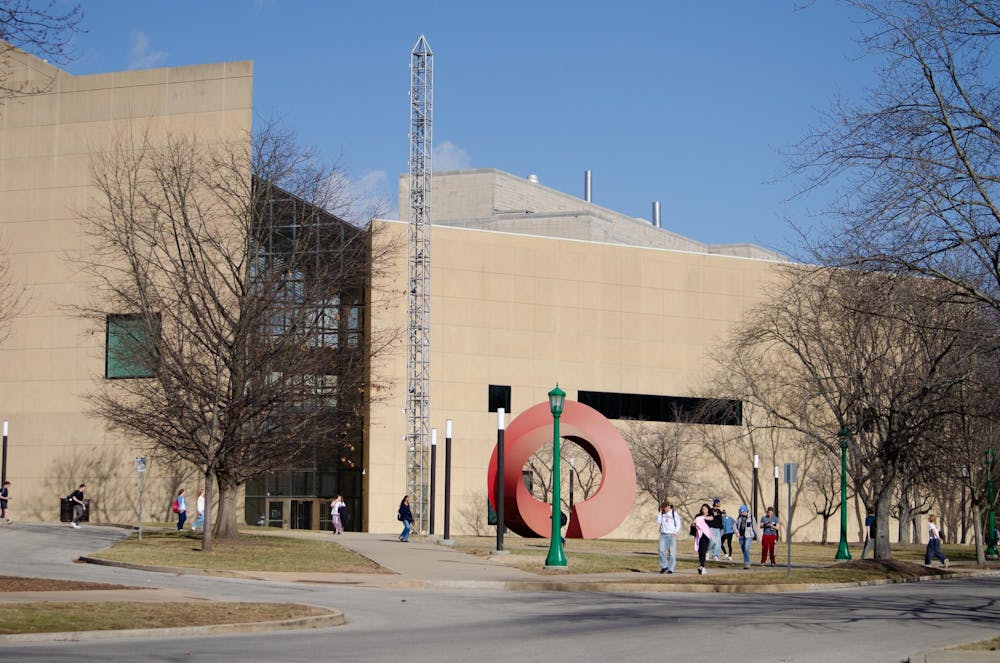
The Musical Arts Center on IU’s campus, standing as a mass of exposed concrete, has often made me feel unsure of whether I was in Berlin or Indiana, as this brutalist style is common in postwar European countries. Designed by Evans Woollen III and completed in 1972, it has hosted many concerts presented by the Jacobs School of Music.
Woollen is regarded as the architect who introduced modernism and brutalism to his hometown of Indianapolis. The MAC’s exposed concrete and heavy mass make its brutalist roots unmistakable.
Those who appreciate art should not overlook Peau Rouge, the sculpture in front of the MAC. Designed by artist Alexander Calder, the 40-foot-high red sheet metal sculpture forms a visual pair with the MAC, with its exposed welded seams clearly visible beneath layers of red paint.
Eskenazi Museum of Art — Late Modernism
When I first researched Bloomington before moving here, I was surprised to learn that the Eskenazi Museum of Art on IU’s campus was designed by I. M. Pei, the architect behind the Louvre Pyramid and the East Building of the National Gallery of Art in Washington, D.C. The knowledge that a globally recognized architect had left his imprint here made the city feel less distant.
Completed in 1982 after then-director Thomas T. Solley commissioned Pei to design a permanent home for the museum, the building reveals its strength inside. Skylights draw natural light through the glass ceiling, distributing it throughout the atrium. The effect reflects Pei’s long-standing emphasis on geometry and light and turns the museum’s café into one of the campus’s most popular study spots.
Mies van der Rohe Building — Mid-Century International Style
Near the Herman B Wells Library on campus stands a building by Ludwig Mies van der Rohe, glowing with a quiet, mysterious white light. Its form projects outward, as if suspended in midair. It stands out immediately yet feels strangely familiar.
Learning that the structure was designed by van der Rohe, widely considered to be one of the most influential modernist architects of the 20th century, made that familiarity make sense to me. His Seagram Building in New York became a prototype for the glass corporate tower, while the Farnsworth House is known for its glass structure that fully exposes its facade within a forested landscape.
The Bloomington building was originally designed as the dormitory for the IU Alpha Theta chapter of fraternity Pi Lambda Phi but was never completed. In 2013, the original drawings for the building were rediscovered by Sidney Eskenazi. A renewed design plan was announced in 2019, and the building was finally completed in 2022.
Bloomington is not a large metropolis. Yet within a short walk you encounter a 1920s theater, 1970s concrete brutalism, mid-century international modernism and late-modernist geometry. The city did not grow upward; it accumulated layers. In a city that seems calm on the surface, architecture reveals its depth.
This story was originally published in the Indiana Daily Student's spring 2026 Source Campus Visitor's Guide.