Editor's note: All opinions, columns and letters reflect the views of the individual writer and not necessarily those of the IDS or its staffers.
So, you bought her roses, knocked on her door and are now parked outside Osteria Rago.
“Table for two,” you tell the hostess. She scans the reservations and leads you to your table.
The hostess sets down two menus. Then a third.
She won’t meet your eyes.
“I hope you don’t mind,” she says. “We were a bit overbooked, and—”
Behind you, an old man steps up, dragging a heavy crozier along the wooden floor. He has a tall green mitre, an unkempt white beard and deep-set, wrinkled eyes.
“This is… a tough week for him,” the hostess tells you under her breath before she hurries off.
The old man’s eyes settle on yours.
Your date elbows you. You pull out a seat for your new supper-mate.
But really, this is no meet-cute. That old man staring back at you shouldn’t be a stranger — it’s St. Valentine. The founder of your feast.
Unfortunately, you might not remember him. Since Geoffrey Chaucer retired his quill — five centuries ago — Valentine has been suffering a rough patch.
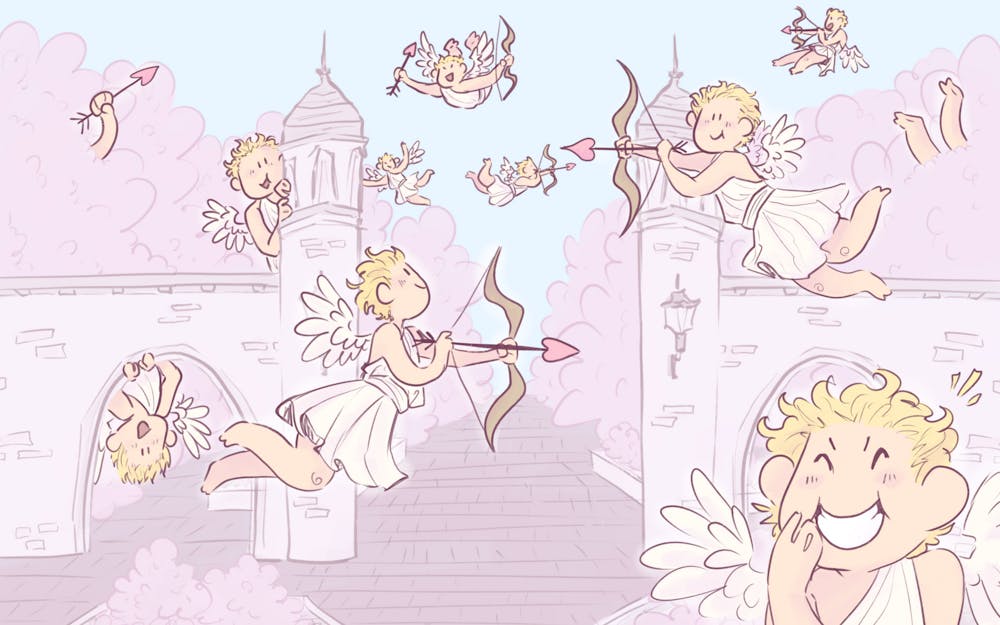
Working in an industry where mythical creatures dominate is a tried-and-true way of slipping from cultural relevance. Myths endure because every age refashions them. Cupid, shaped by one culture, has shifted time and again to meet subsequent generations’ demands. We’ve cast him as a cute, chubby and harmless baby on greeting cards — far from the lord over desire and revulsion the Romans imagined him to be.
Valentine, on the other hand, gathered a culture around himself: Christendom. In doing so, he wed his fortune to its survival. So, when Christian society gave way to the secular moment that has replaced it, Valentine, too, exited the stage. And the day celebrating him was emptied of all prior substance. After all, do you know the seventh-century Gelasian Sacramentary’s prayer to St. Valentine? Neither do I.
The result is a holiday that resembles a shipwreck’s shore-ridden plank. After being torn from the whole vessel, it risked sinking into the deep before the tide beached it on foreign soil. Now, exposure slowly degrades it, which is to say, Americans celebrate it less than ever.
Can we save Valentine’s Day?
Look again at your old dining partner. Valentine’s Day’s earliest celebration is difficult to date, but undoubtedly, it began as a commemoration of your new companion’s martyrdom, whoever he was. Early modern scholars combing through ancient sources counted at least seven Valentines.
Two of these figures, from around Rome, were both purportedly beheaded by Roman authorities on Feb. 14. It’s not unlikely these accounts preserve just one early martyr claimed by two cities, however. A third possible Valentine was a bishop of Genoa, a city northwest of Rome, executed on May 2.
So, how did one of these saints shrouded in historical uncertainty enter the business of love?
It’s fashionable to trace St. Valentine’s romantic association to older pagan holidays, but this is historically untenable. Medieval lovebirds — and real birds — are likelier the true culprits.
To commemorate English King Richard II’s engagement on May 3, 1381, Chaucer composed his poem “The Parliament of Fowls,” in which he likened Richard and his soon-to-be wife to the birds who “come to choose their mate” on Valentine’s Day. Valentine of Genoa’s Day. May 2. In the spring, when birds ascend on the newly warm skies.
Yet then, as now, Feb. 14 was better known for saints named Valentine. And the poem, which filled royal courts across Europe with romantic ideas, was thought instead to refer to that February day, Henry Ansgar Kelly, a research professor in UCLA’s English department, has argued.
Poetry paired Valentine’s Day with love. Perhaps the wrong Valentine’s Day. But that error doesn’t render our celebrating love on this day invalid. Whether or not the Valentines of Rome and Terni commemorated on Feb. 14 were one saint, a Valentine gave up his life for the one he loved on this day. He even made this sacrifice without expecting anything in return — for example, being remembered in any substantial way. Rather than nullify his gift, this surrender of ego perfected it.
If Valentine’s Day can be saved, it is because it still gestures toward someone who gifted all they had and were while asking for nothing. The lack of verifiable content about St. Valentine lets all of us become a Valentine. With roses. With dinners. Most of all, with just ourselves.
Eric Cannon (he/him) is a sophomore studying philosophy and political science and currently serves as a member of IU Student Government.