
Editor's note: All opinions, columns and letters reflect the views of the individual writer and not necessarily those of the IDS or its staffers.
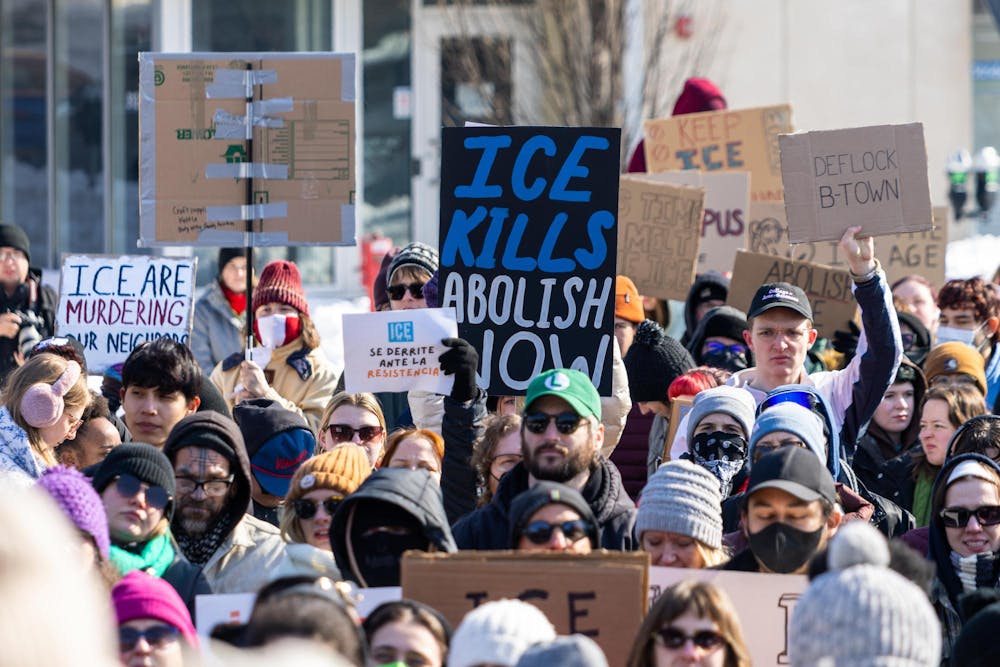
“ICE out!” rang in unison among hundreds of people gathered Jan. 30 outside Bloomington City Hall. Never before in my three years at Indiana University had I seen such a protest. Public anger toward the Trump administration’s deployment of U.S. Immigration and Customs Enforcement in Minneapolis and across the country echoed in Bloomington. Given recent events like the death of Alex Pretti and Renée Good it’s unsurprising that such a protest would happen in Bloomington. What is surprising, though, is how the protest unfolded and what it advocated.
I have had a little over two weeks to reflect on my personal experience of the protest, largely as an observer. Even the most charitable interpretations of the ideas expressed at the protest leave me deeply uncomfortable associating with the event.
I arrived at City Hall around 12:30 p.m., by which point hundreds of people who had marched through Bloomington to this ending point had already gathered. I found myself near the back of the crowd, barely able to hear the speeches. After a while, I grew frustrated and navigated through clusters of people until I spotted a friend near the front. I wove my way through a crowd of attendees until I was able to join him and finally hear the speeches.
One of the speakers caught my attention after deriding ideas of reformation and constitutionalism. His ideas then took an internationalist turn.
“Terrorism is not real,” he proclaimed in reference to the administration’s stance on domestic terrorists. This includes labeling Alex Pretti as an “assassin” and “domestic terrorist.” This extremely radical statement was met with applause.
The horrors of the 26/11 attacks, where about 10 members of an Islamic fundamentalist group from Pakistan killed and injured hundreds in my home city of Mumbai, flashed before my eyes amid the loud cheering approval of the crowd. Even though I was with friends, that one moment made me extremely uneasy. The speaker later doubled down on his argument by criticizing the American War on Terror, saying it was illegitimate and completely unwarranted.
My best guess is that the speaker meant the word “terrorism” was linguistically constructed by Western powers to label any and everybody who opposes their interests as such. This interpretation would justify the statement “terrorism is not real” as rejecting American imperialism, rather than downplaying atrocities like the 2008 Mumbai attacks, in which I and thousands of others lost friends and family members.
I am not accusing the protest or the speaker of supporting terrorism. However, the speaker did something very dangerous here: he combined moral absolutism with radical rhetoric.
Such radical rhetoric, even though it was met with applause, threatens our ability to find common ground in an already-polarized political climate. Even if we assume that the rhetoric was a product of the event itself, I think it would be foolish to suggest the content was also a product of the event. The leap from criticizing ICE and its actions to American imperialism seems far-fetched and unnecessary. It is this unnecessity which is a symptom of populism.
Through the protest, it was clear to me that some participants aimed to construct a classic “us versus them” narrative. That “us” was presented as the completely virtuous majority, while the “them” was the irredeemably malign elite and oppressive governing class acting against the majority’s interest.
Alongside chants such as “ICE out everywhere” and “no more surveillance state” which were focused and topical some participants described the United States as a “fascist empire,” through chants like “ICE, KKK, IDF they are all the same,” some equated ICE to the Ku Klux Klan and the Israel Defense Forces. In these moments, the focus shifted from a critique of specific policies to broad sweeping condemnation of governance itself.
This meant not working within institutions but rejecting them on an absolutist moral ground. It seemed to me that the speeches and chants made at the protest bred resentment not against an administration but a system of governance. That system being liberal democracy.
The absence of talk about reformation and political action through procedure further solidified my intuition. A primary assumption that plagues most populist rhetoric is that of homogeneity. It tends to homogenize the moral virtuosity of those they consider “the people” and lay the entire burden of society’s problems on “the elite.”
To justify this stark divide, they appeal to claims like equating ICE to the KKK and calling the United States a “fascist empire.” These arguments flatten complex political and legal realities into absolutes that appeal to a crowd.
Nuance does not create movements; an acknowledgement of a shared injustice does. A three-hour literature review on world wealth inequality would be unlikely to mobilize collective action as effectively as the Occupy Wall Street Movement did. The problem isn’t acknowledging the injustice; the problem occurs when this acknowledgement turns illiberal.
History teaches us that societies that abandon procedural constraints in favor of absolutist righteousness risk repeating cycles of violence and oppression. Nothing is better evidence of this than the current transgression of liberal institutions and the response to these transgressions being one of revolutions rather than reform.
Liberal democracy is important because it privileges pluralism over absolutism. It creates avenues for addressing grievances while respecting constraints like individual rights, which tend to protect the most marginalized in a society.
If we want meaningful change, we must move away from promoting fringe political philosophies at protests and move toward exploring avenues of reform. We must attempt at relegitimizing the very institutions that now seem to have lost public favor. This can be done first by respecting constitutional constraints and second by demanding administrators do the same.
Advait Save (he/him) is a junior studying economics and sociology.



