
Editor's note: All opinions, columns and letters reflect the views of the individual writer and not necessarily those of the IDS or its staffers.
Tucker Carlson will visit IU on Tuesday for Turning Point USA’s event honoring Charlie Kirk’s legacy after his tragic assassination at Utah Valley University last month. This event carries emotional weight for many Hoosiers. It’s of particular importance given the controversy surrounding some of Carlson’s remarks.
Due to the political and contested nature of this event, we must deeply reflect on what a university is, and how we must conduct ourselves when confronted with ideas that we may agree or disagree with.
Universities are, at their core, sites of knowledge production. Knowledge production is the entire process through which ideas are generated, challenged and refined within a community, making it both an intellectual and social process.
This definition is naturally permissible as we consider universities to be democratic institutions where everyone has the right to speak. So, in this broader sense, knowledge is not only produced in laboratories or within published academic papers. It is a living process of claims and counterclaims open to everyone.
Philosophers since Plato have argued knowledge is justified true belief. Basically, a belief that aspires toward the truth and is backed by justification. But in a university setting, that definition is unsettled, as we must first assume that no one owns the truth in its entirety.
We must then view the truth as something to be pursued and not owned. The pursuit of truth happens through open discussion and free expression, which helps people reach closer to pursuing the truth collectively.
If no one holds the truth, our universities must become spaces where even conflicting or unpopular ideas find refuge, so they get a chance to play a role in refining our understanding of the world. In effect, those at universities should view knowledge, and the pursuit of it, with humility.
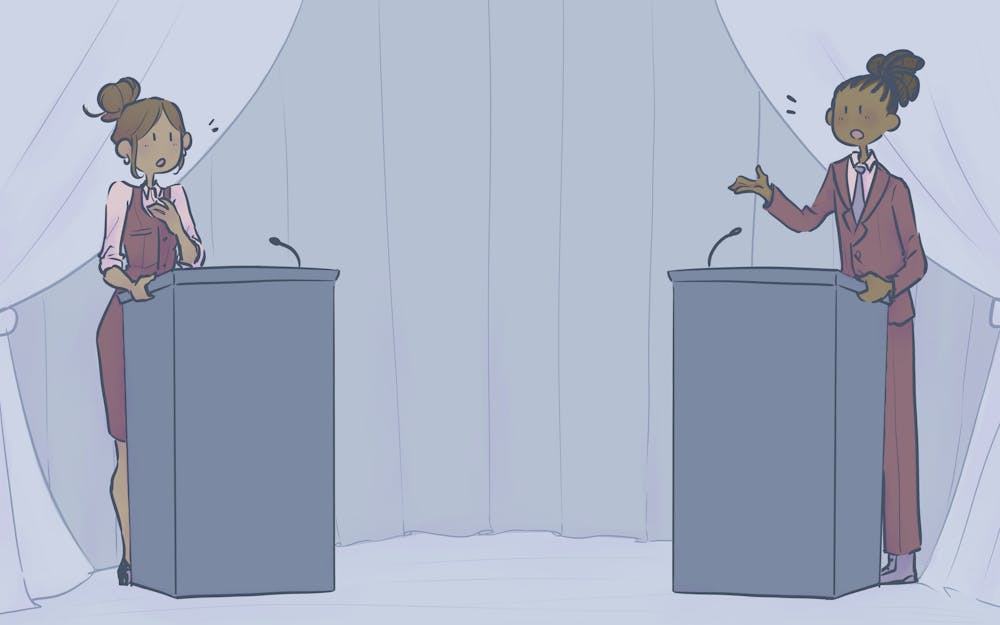
We, as students, must adopt this humble ethic. When speakers like Tucker Carlson visit our campus, they can hold a mirror to our own integrity in fostering a campus that allows all speakers to contribute to the process of knowledge.
To engage humbly does not mean to suspend critique but instead means to critique without having the arrogance of certainty over knowledge. It means recognizing that even when we challenge claims, our own might be flawed. To subscribe to humility is to accept that our knowledge is fallible. We must remain humble enough to revise our beliefs.
In classrooms, debates or even speaker events, our act of engaging must presuppose respect for everyone. Respect does not mean one agrees with a particular claim but acknowledges that their own claim may be wrong.
Humility, then, is not a passive act. It is active in its practice of having the willingness to listen, question and respond proportionately. It is what keeps a university from turning into a theater of self-righteous voices. For if such a thing were to happen, that would mean the rejection of the very process through which understanding grows.
To protect knowledge production at universities, certain practical steps in engagement should be adopted. This includes preparing by reading primary sources and credible reports so that one’s responses are grounded in evidence and not ad hominem. It requires one to be an attentive listener to keep track of empirical claims, resisting responses to potential snark comments and preparing counter speech rooted in deliberation.
It’s essential to show respect for all, as it serves two functions of granting people the same rational agency we claim for ourselves and committing to the process of discourse through which an understanding can be reached. When we adhere to this principle, we move toward extending a speaker's event into a pedagogical event of educational value.
Conversely, when engaging with speakers devolves into personal attacks or aims to silence people, it claims arrogance over knowledge, and whatever potential educational value people could derive is lost.
I, therefore, wish to frame humility as a civic virtue for engaging in expression within the context of the university. It is the duty of the university and ours as students to structure our common life to become a laboratory of fallibility; an institution where beliefs are freely expressed, contested and improved.
Inviting contest is the way to keep this laboratory functioning. If we are to maintain our university’s nature of producing knowledge, inviting speakers like Carlson is a welcome step in this direction. Our responsibility in that case is to meet such an event with humility and respect to build a university that values openness.
Advait Save (he/him) is a junior studying economics and sociology.



