Editor's note: All opinions, columns and letters reflect the views of the individual writer and not necessarily those of the IDS or its staffers.
On Dec. 18, 2025, President Donald Trump issued an executive order to reclassify marijuana from a Schedule I drug with no accepted medical use to Schedule III — transferring it from the company of drugs like heroin or LSD to the likes of Tylenol with codeine or testosterone.
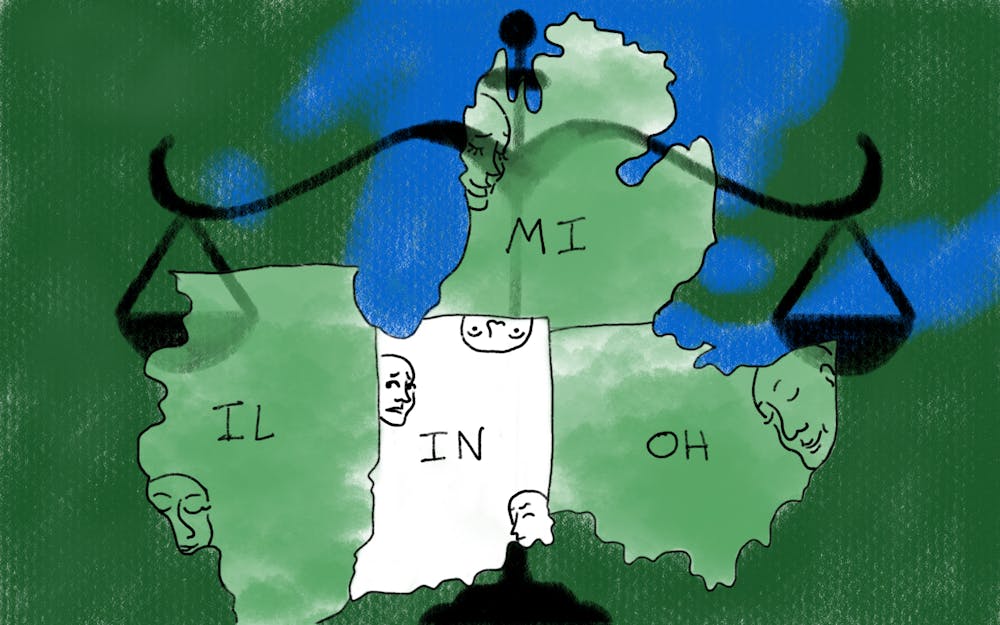
Accordingly, it’s well past time for Indiana to join our Michigander, Illinoisan and Ohioan neighbors in the fruits of legal marijuana: expanded medical research, symptom management for psychological disorders and chronic pain and plain ol’ recreation.
Indiana’s House of Representatives and Senate are now reading multiple bills that propose changes to state laws regarding cannabis (the plant), marijuana (high-THC cannabis), THC (tetrahydrocannabinol, the high-inducing psychoactive compound) and hemp (little-to-no-THC cannabis).
It’s worth noting, however, that other countries eschew the term marijuana, which is essentially derogatory North American slang used negatively toward people of color. The term originally comes from Mexico, but by 1920s and 30s United States, “anti-drug activists often used the word marijuana in a negative way, and the media and government officials also turned it against people of color, including Mexican immigrants and jazz musicians,” writes David Hyde in 2022 for KUOW.
Simply put, “marijuana” is historically fraught while “cannabis” is scientific. Because of these roots, lawmakers in Washington, Maine and Virginia have introduced bills to make the vocab swap in their state laws.
Striking while the iron is hot, Indiana Rep. Jim Lucas, R-Seymour, for example, proposed House Bill 1298 to reflect this pending federal reclassification of marijuana and THC at the state level. Similarly, Rep. Mitch Gore, D-Indianapolis, is fighting for a less restrictive possession policy with House Bill 1191, decriminalizing “two ounces or less of marijuana.”
The Senate is also reading bills concerning testing, packaging and distribution rules like Senate Bill 286 for cannabis — to establish an Indiana Cannabis Commission — and Senate Bill 250 for hemp — to define THC products.
But before any jokers, smokers or midnight tokers rejoice, as with much that leaves Trump’s mouth, there’s more to his announcement than meets the eye; some question if the new federal marijuana rhetoric is too good to be true.
This process of rescheduling marijuana has been underway since October 2022, when former President Joe Biden asked the U.S. Department of Health and Human Services and the Drug Enforcement Administration to review scheduling. In August 2023, HHS recommended the move from Schedule I to III to the DEA, and by May 2024, the DEA proposed a rule to do just that.
A few months later, in July, a period for public comment was opened. In August the DEA announced a hearing on the proposal, October saw participants selected by the DEA for the hearing and by December the hearing was finally scheduled to take place Jan. 21, 2025.
However, mirroring the Democratic Party’s half-baked efforts to codify abortion into federal law, Biden’s plan failed at the finish line.
By the time he left office Jan. 20 2025, the DEA hearing was halted from further legal progress, and the participants were ordered to “provide ongoing status updates,” which is like that friend who says they’ll “lyk” and doesn’t text back for a week.
Biden was able, though, to pardon thousands of Americans convicted on possession charges in October 2022 and December 2023. He also signed the Medical Marijuana and Cannabidiol Research Expansion Act , increasing the approved research entities to study medical marijuana.
If Biden’s efforts to move the needle on marijuana already seem like small pennies, Trump’s executive order to the attorney general — to hurry up and reschedule the drug already — is worth even less than chump change.
Because courts have interpreted the Constitution’s “vesting” and “take care” clauses concerning executive power to merely “permit the president a vehicle/voice to ensure that federal law or policy is implemented (executed) properly,” Trump’s big pronouncement might not amount to more than a “pretty please.” Either way, executive orders cannot overrule federal laws.
But thankfully, states’ rights are still worth something, and the horizon looks tentatively positive: Indiana could finally be following in the happy footsteps of the greater Midwest. If the general assembly bills pass, they would provide invaluable support to medical marijuana research and, more importantly, for the people who would benefit from it.
For decades, innovative research has suggested CBD-dominant cannabis — the secondary, non-intoxicating cannabinoid — can reduce symptoms of post-traumatic stress disorder, trauma-related stress and anxiety; various cannabinoids can reduce inflammation at the cellular level; and cannabis can provide cancer symptom relief, as well as possibly fight neurodegenerative diseases like Alzheimer’s and Parkinson’s.
The evidence is so overwhelming as to prompt The American Legion, the nation’s largest veteran’s service organization, and Jeff Staker, head of Hoosier Veterans for Medical Cannabis, to endorse the reclassification. The potential benefits of rescheduling marijuana abound, though the current federal Schedule I classification — rooted in the racist doctrines of President Richard Nixon's War on Drugs — hinders further findings by limiting access and availability.
To stymie the marijuana reclassification movement is to keep Americans behind bars on injudicious and racist terms and hold back extremely promising scientific progress. When cannabis use rates are generally equal across races, yet Black Americans are arrested on marijuana charges at a far higher rate, and when medical marijuana advancements promise relief to many suffering, we must stop to ask ourselves how the current federal classification of marijuana as a Schedule I drug serves the country.
Hint? It doesn’t.
Odessa Lyon (she/her) is a senior studying biology and English, pursuing a minor in European studies.