Editor's note: All opinions, columns and letters reflect the views of the individual writer and not necessarily those of the IDS or its staffers.
Valentine’s Day’s origin remains debated, but most historians agree its roots lie in celebrating the beginning of spring.
“The Parliament of Fowls,” a medieval poem written by the English author Geoffrey Chaucer, is one of the earliest poems we know that mentions the holiday in a romantic context. In it, Chaucer describes birds of all kinds searching for their mates when the warm half of the year returns.
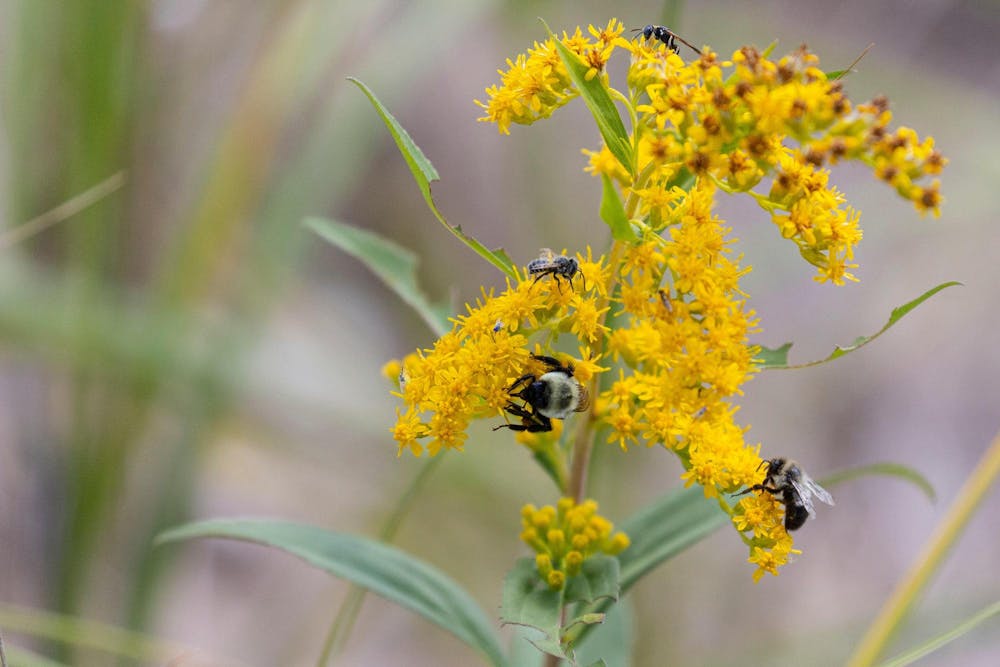
With this history, it should come as no surprise the holiday’s namesake, St. Valentine, is also connected to another springtime species as the patron saint of beekeeping.
For St. Valentine’s honeybees, finding love is as easy as sweating a chemical. Bees, like most insects, rely on pheromones to find their “perfect match.”
A pheromone is a chemical compound an animal produces to cause certain behaviors in other members of its species. Among other things, bees use pheromones to mate with their queen, recruit fellow workers to forage pollen, mark their hive’s entrance, recognize each other, alert other bees to danger and even urge other bees to sting.
But insects aren’t the sole wielders of these external chemical messengers: Our evolutionary branch-mates, mammals, also use them.
Chemicals in male mouse urine have been found to accelerate puberty in female mice. A steroid produced in boar saliva is known to induce mating in female sows. Mother rabbits release a pheromone to help their offspring find a nipple to latch onto for feeding. And if your cat or dog pees to mark its territory, you’re already more familiar than you think with the role pheromones play in the social lives of animals.
If you’re wondering whether you, too, might possess the wonderful power of pheromonal communication, you’re not alone. For decades, scientists have studied the existence of human pheromones, with mixed conclusions.
To produce such instant, reflexive behavioral changes when smelling a chemical, mammals rely on the vomeronasal organ, a part of the nasal cavity dedicated to sensing pheromones and producing an immediate response in the brain. In humans, however, a great deal of evidence exists to show our VNO is vestigial and no longer connected to our brain.
While lacking a functional VNO isn’t good news for the possibility for human pheromones, it doesn’t entirely rule them out, either. In fact, some recent studies have unearthed surprising results about the smells we can detect — and produce.
A study published in the 2020 issue of Metabolites, for example, demonstrated we produce different chemical signatures in our sweat depending on our emotional state. Another study, published in PLOS Biology in 2023, found smelling female tears reduced aggressive behavior in male participants by over 40%.
These results sound promising, but they aren’t enough to prove human pheromones’ existence. And the key reason why is that they just might not be necessary. Humans are simply more complicated than mice and honeybees.
We aren’t mindless drones, compelled to sacrifice ourselves for our hive from the mere whiff of a chemical. We can learn, remember and have emotional responses to the smells that surround us without the help of pheromones. We constantly rationalize the world around us, minding through vast seas of both chemical and mental data. In the end, the evolutionary path humans tread left little room for airborne scents to shape our lives.
So, unfortunately, if you, like the birds and the bees, hoped to find your match on Valentine’s Day — or at least celebrate the match you’ve already made — with pheromones, take a shower. Your advanced brainpower threw that plan for a loop. As humans, we analyze our compatibility with others and have an urge to understand a person’s personality before we ask them to be our valentine.
And if you’re struggling to find your match this Valentine’s Day, remember: It’s supposed to be difficult and confusing. While it might be easier to select your soulmate based on their musk, it would not form the most human relationship.
Spencer Schaberg (he/him) is a sophomore studying microbiology.