
Editor's note: All opinions, columns and letters reflect the views of the individual writer and not necessarily those of the IDS or its staffers.
Feeling unlucky in love? Chances are, if you’re a member of Generation Z, you’ll turn to ChatGPT, Microsoft Copilot or Meta for help.
According to the most recent study on singles from Match.com and Indiana University’s own Kinsey Institute, nearly half of Gen Z has started to use AI for dating. This trend is a concerning shift toward inauthenticity when it comes to relationships of any kind.
With AI use on the rise in education, art and even Super Bowl commercials, it was only a matter of time before the dating world suffered the technology’s effects as well. Dating apps are jumping on the trend, introducing services like AI matchmakers and AI feedback on profiles. AI could even give you advice on what to say next in a direct-message conversation with a match.
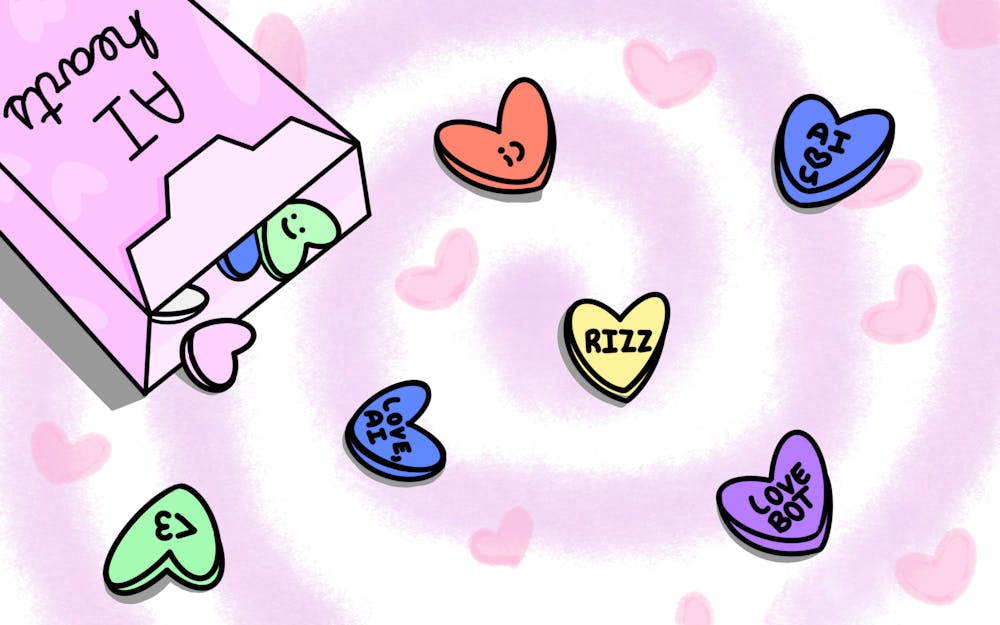
These messaging assistants, like the app Rizz, analyze screenshots of text conversations and suggest what to say next. The AI is supposed to help you seem funnier, smarter or more charming to a prospective date.
Let’s assume the goal of hopping on dating apps is to start a potential long-term relationship— that is, to find love. Starting such a personal commitment with AI assistance doesn’t bode well. Technology as a substitute for authenticity simply isn’t conducive to making a real connection.
Roman Khaves, founder of Rizz, calls the service “around-the-clock, objective advice.”
Objective advice, however, may not be the right way to approach dating. The “best” response may not be a singular answer, but instead the one that accurately reflects who you are. Although the app continues to train itself to create responses best-suited to your tendencies, those responses are still poor imitations of the real thing.
Among singles from the Kinsey study, 83% say dishonesty is a romance dealbreaker. Wouldn’t using AI to come up with snappy responses to texts be dishonest? This technology is a means of using words that are not your own, of portraying yourself as something you are not.
Envision the conflict you could feel finding out that someone you had connected with was using AI to generate their responses. Were you connecting with another human being or just with a machine? Such doubt is incompatible with a lasting relationship.
Kicking off a relationship with AI’s help is a slippery slope to over-reliance on the technology. AI is a way to avoid the awkward parts of early romance, the getting-to-know-you stage. Those initial stages of a relationship are important for gauging whether a new connection is really a match. AI undermines our role in this process, erodes our skills to make those determinations.
Turning to AI also devalues other connections in our lives. Consulting AI about courting would eliminate the need to turn to a trusted friend for dating advice. In this change, we lose the intimacy of discussing our life’s details with those we trust. That intimacy and trust is what strengthens bonds and creates true connections.
This is what AI offers: avoidance of vulnerability.
We often think of vulnerability through a lens of fear. Psychologist Yesel Yoon writes that the fears of rejection, judgement and relinquishing control are all reasons we could be resistant to vulnerability.
However, vulnerability is honesty — and it is crucial for forming deeper, more authentic connections. Vulnerability is opening yourself up to someone and letting them know they can feel comfortable doing the same. Vulnerability can also lead to a more empathetic understanding of others’ experiences.
It is a lot easier to let AI formulate the perfect response than to let someone, especially a stranger on a dating app, see who we really are, flaws and all. But this exposure is crucial.
According to the Centers for Disease Control and Prevention, social connection helps reduce the risk of heart disease and stroke. It can even improve quality of sleep and help manage stress. Social connections also provide necessary support when going through challenges.
Authentic connections show us we aren’t alone in the world. Using AI in dating endangers that authenticity. After all, dating is one way to seek those connections that remind us we mean something to other people. Using AI to supplement your dating app persona isn’t putting your best, or even your own, foot forward.
Gen Z, it is time to think critically about AI use. Soon, our ability to make real human connections, and to reap their benefits, could disappear.
It is difficult to truly commit to vulnerability. But we have to try. Change doesn’t have to happen all at once, or even quickly, but AI is not the answer to finding love. Being a more open, more genuine version of yourself is.
Sasha Burton (she/her) is a sophomore studying elementary education with minors in Spanish and English



