“Five! Four! Three! Two! One! Release!”
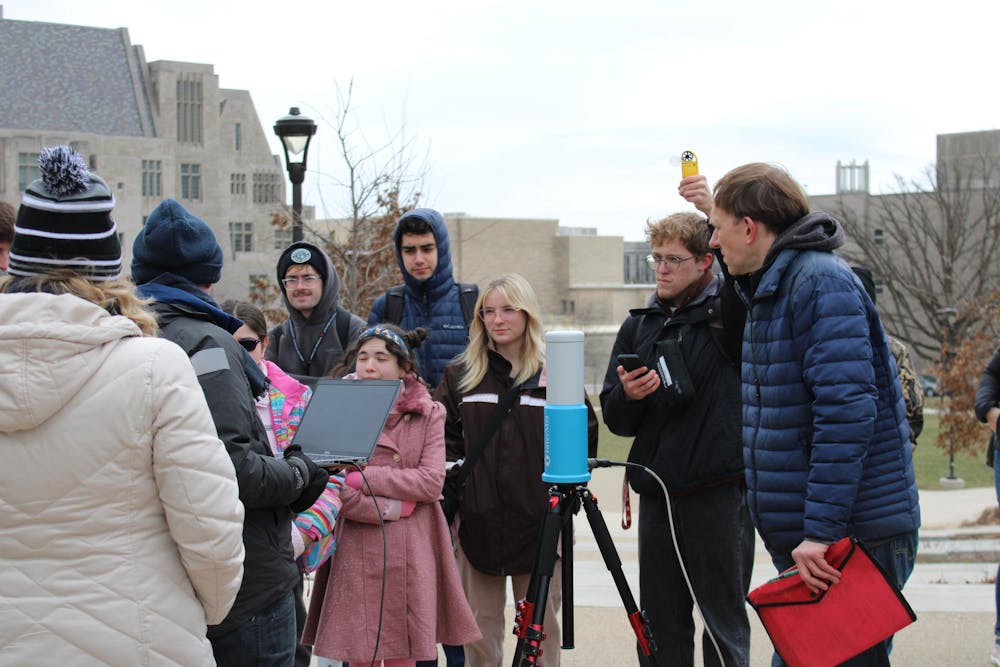
Cheering and claps erupted on a grassy field near the northern edge of campus when students and faculty from the Department of Earth and Atmospheric Sciences let go of the first weather balloon released by Indiana University researchers.
The department is starting a new program launching weather balloons to give students field experience and contribute to weather forecasting in and around Indiana.
“It’s exciting to have, we don’t have any weather balloon data in the state,” first-year graduate student in earth and atmospheric sciences Ethan Choo said.
Saturday was the first of about 100 balloon launches planned at IU over the next half year, associate professor of earth and atmospheric sciences Travis O’Brien said.
“We don't have a regular weather balloon launching station within a couple states of us,” O’Brien said. “And it's really critical for forecasters, like in Thursday's severe weather, for them to know how, for example, temperature and winds and stuff change with height in the atmosphere.”
Weather balloons, which can reach an altitude of over 100,000 feet, have an instrument package that transmits data back to scientists on the ground every few seconds with information about temperature, wind and humidity, senior lecturer in the Department of Earth and Atmospheric Sciences Cody Kirkpatrick said.
The department bought equipment for the launch from International MET Systems, a company which sells atmospheric sensors and related technologies.
Alana Dachtler, the vice president of sales and marketing for InterMet, assisted IU students and faculty in the launch.
On the ground, the set up included a receiver with an antenna that picks up the signal from the weather balloon, a computer and a large helium tank. Students helped prepare for the launch by using handheld tools that measure wind speed, dew point and temperature.
Once collected, the data from the weather balloons will be accessible to the National Weather Service and other weather services from around the world and will contribute to making more accurate weather forecasts, Kirkpatrick said.
“The expectation will be that if you add more of this kind of data, your predictions can be more accurate,” Kirkpatrick said. “And so after we do this a few dozen times and we try, we run a few dozen tests, we can see if that's true or not.”
Making this launch happen wasn’t as much of a breeze as Saturday’s wind, O’Brien said. It took over a year to secure funding for materials like helium, get approval for the project, acquire insurance and deal with other logistics like reserving the launch site.
Safety measures included checking with air traffic control at the Monroe County Airport to ensure it’s safe to release the balloon.
“I just gave a quick call,” O’Brien said. “I told them we're prepared to launch about 2 miles northeast of the airport.”
Securing funding and complying with safety protocols hasn’t been the department’s only challenge. Changes to the NWS have made it difficult for those working on the weather balloon project to contact the government agency.
In 2025, DOGE cut around 550 NWS jobs, CNN reported. While around 450 of these positions may be returning due to concerns from lawmakers and the public over public safety, O’Brien said the impact is still felt.
O’Brien said that it’s been difficult for him and his colleagues to figure out who to get in touch with at the NWS to inform them of the balloon launches.
“We'd had contacts for a long time, and there's been so much turnover there for the last six months that we don't know who's there anymore,” he said.
As a result of these cuts, NWS offices are only launching weather balloons once a day, if it all, instead of their previous standard of twice daily, according to CNN. Meteorologists say that the reductions have limited the amount of data they can collect, reducing the quality and speed of forecasts during extreme weather events like tornadoes.
O’Brien said the cuts have also affected his students because the NWS used to send someone to IU once a year to talk with students about career trajectories and how to apply to government jobs.
“That relationship's now kind of up in the air, and we're having to re-establish that relationship with the new folks up there,” he said.
In spite of these challenges, the Department of Earth and Atmospheric Sciences will launch two more balloons at 10 a.m. and 2 p.m. Sunday on campus near East 11th Street and East Cottage Grove Avenue, another preview of what Kirkpatrick said will give students career-relevant experience.
“If folks see us around launching, come up and talk to us, we’re really excited to have this be something that engages the IU community and gets them excited,” O’Brien said. “I mean, how fun is it to launch a weather balloon?”