10 p.m.
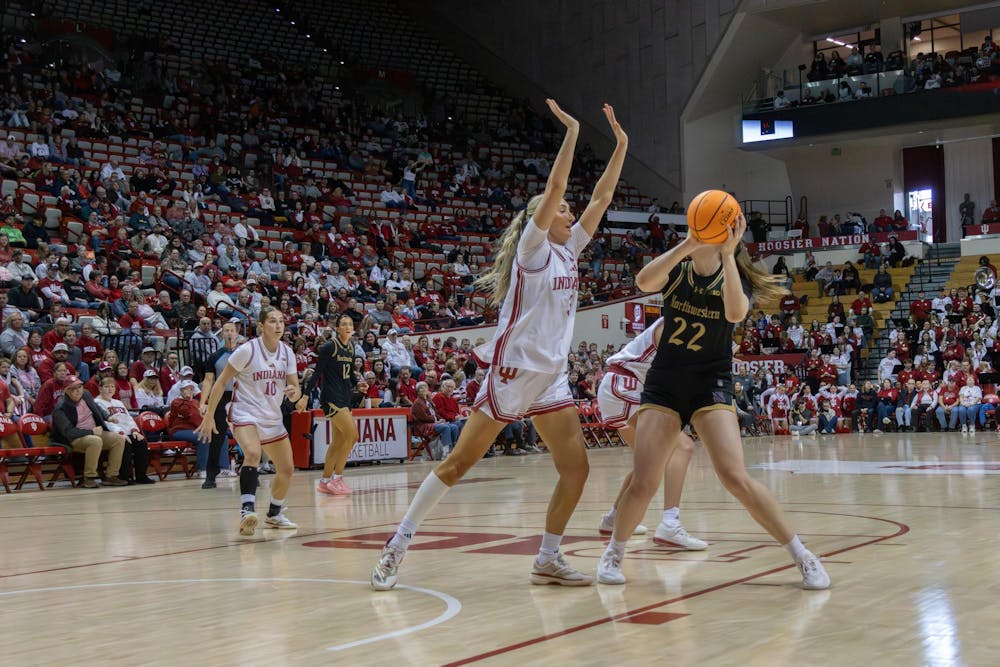
That’s what time Indiana women’s basketball tipped off against USC on Thursday night.
It was a late start time for a game projected to be a snooze-fest. The Trojans came into the matchup as 14.5-point favorites and 7-6 in the Big Ten this season. Indiana’s leading scorer, senior guard Shay Ciezki, was out after rolling her ankle during the morning shootaround.
The Hoosiers fought throughout the contest and only lost 79-73, a result that in December and January would’ve felt like a victory. Yet, after three consecutive wins, the 6-point loss left a bitter taste in Indiana’s mouth.
“They’ve tried to do some of the things we’ve asked them to do, and we’ve seen some of that pay off,” Indiana head coach Teri Moren said postgame. “So, this is why tonight kind of stings ... we came in here tonight with a lot of confidence.”
However, I can’t help but remind myself that these expanded conferences — such as the 18-team Big Ten — and cross-country matchups have come at a cost for student-athletes. Last season, the Oregon men’s basketball team traveled 26,700 miles, up from 7,327 miles in the 2023-24 season.
But conference expansion isn’t a new idea in college athletics. Sit down — if you weren’t already — for a history lesson.
Let’s start in 1959. The days of Branch McCracken and Walt Bellamy, Indiana football against Ohio State ending in a 0-0 tie, plus women’s basketball not even being recognized as a Division I sport.
But the powers in college athletics were already flirting with the idea of a “superconference.” A framework for what is now known as the “Airplane Conference” was hatched.
The proposed conference would have seen members from 12 schools join forces: the floundering Pacific Coastal Conference (Washington, University of California, Berkeley, USC, UCLA, Stanford University), three of the largest military academies (United States Military Academy, United States Naval Academy, United States Air Force Academy) and four of the most prestigious athletic programs toward the eastern United States (University of Notre Dame, University of Pittsburgh, Penn State, Syracuse University).
Just like the Big Ten now, the “Airplane Conference” would have stretched coast to coast. It also had prestige compared to similar conferences at the time, as by 1960, nine of the 12 participating schools had at least one claimed national title.
The conference wouldn’t come to be, as internal differences between the schools — and maybe involvement from the U.S. government — killed the idea.
And the mentality of creating a large conference hasn’t bypassed the Big Ten. I mean, it is called the Big Ten even though there are 18 teams in the conference.
1993 saw the Big Ten move toward the East Coast with the addition of Penn State, a school that might have been more synonymous with the term “Independent” as Notre Dame is now.
Then, the Big Ten went west and lured Nebraska from the Big 12 in 2011 after the Cornhuskers spent 15 years in the conference. By 2014, Maryland was added from the Atlantic Coast Conference, and Rutgers joined after the dissolution of the Big East.
And — as we all know — the Big Ten added USC, UCLA, Oregon and Washington in 2024 after the PAC-12 broke apart.
From a fan’s perspective, the matchups have been interesting to watch. No. 2 UCLA and No. 8 Michigan played a thriller on Sunday, a contest that would have been reserved for the NCAA Tournament two seasons ago. On the same day, No. 25 Washington and Wisconsin went to overtime, and the Huskies came out on top 91-86.
With immense revenues and budgets, football and men’s basketball teams have been better equipped to handle the travel load. But lower revenue sports — such as women’s basketball, baseball, softball, volleyball and soccer — that play multiple times each week have incurred most of the challenges.
Indiana baseball now must travel to Eugene, Oregon, to play the Ducks in March. Softball travels to UCLA in April. The men’s tennis team will jump from Oregon on March 13 to Seattle, Washington just two days later.
The new reality of college athletics is just that — a reality. But teams can’t be affected by travel or late start times.
“We’ve tried like crazy to keep them up so they can get used to local time,” Moren said postgame. “The thing I talked to them about when we first got here was just watching some other teams that are on the East Coast that came out here to the West Coast ... I felt like they kind of were sleepwalking.”
Yet Thursday felt like a different story, one where USC was the team “sleepwalking.” Indiana, on the other hand, was the team with confidence to start the game.
In the first quarter, the Hoosiers jumped out to a 24-13 lead. It came together because every Indiana player knew they needed to help each other with Ciezki being out of the lineup. Freshman guard Nevaeh Caffey, freshman forward Maya Makalusky, redshirt sophomore guard Lenée Beaumont and senior guard Jerni Kiaku all finished the first quarter with five points.
“I thought our kids were ready from the beginning,” Moren said postgame. “We never had to try to jump-start them at all. I thought they were ready from the start.”
Even though the result ended in the 11th Big Ten loss for Indiana this season, the Hoosiers have looked like an improved team since the 0-10 start in conference play, an improvement that will be put to the test against No. 2 UCLA on Sunday.
Follow reporters Savannah Slone (@savrivers06 and srslone@iu.edu) and Max Schneider (maxschn@iu.edu) and columnist Sean McAvoy (@sean_mc07 and semcavoy@iu.edu) for updates throughout the Indiana women’s basketball season.