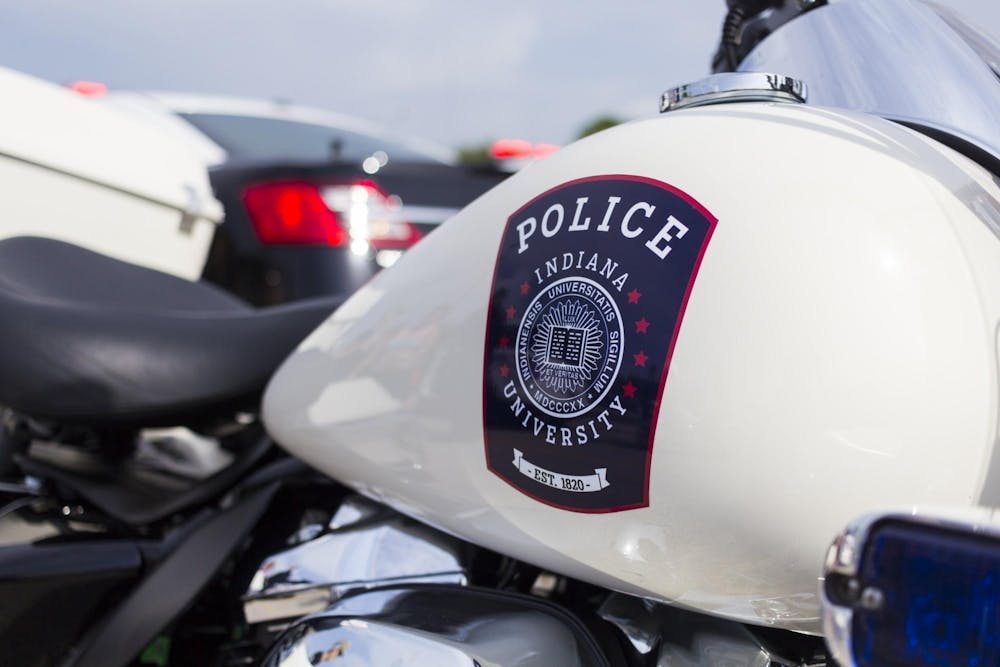
Indiana University Public Safety has consolidated previously separate training programs into a new education center.
Launched in January, the IU Public Safety Education Center brings together training that had been developed independently across the IU Police Department, the Office of Emergency Management and Continuity and the Office of Environmental Health and Safety. 
The consolidation shifts instruction away from strictly lecture-based formats. Major Stephen Luce, director of the IU Public Safety Education Center, said it’ll now be structured toward hands-on, scenario-driven learning.
“If we use scenario-based, interactive models, it helps people think, decide and act under pressure,” Luce said. “We want to develop those critical thinking skills for everyone who goes through our courses.”
IU Public Safety created the center after receiving increasing requests for training from agencies outside of IU, Luce said. Before the center’s launch, most training was internally focused.
“We realized we were in a strong position to help others receive high-quality safety education and training, not just at IU, but across higher education,” Luce said.
The center’s first year, Luce said, will focus on organizing existing IU Public Safety courses under a single education center and coordinated catalog.
The first course scheduled under the new education center is the Indiana Law Enforcement Academy Instructor Development, a five-day February training held at IU’s Indianapolis campus that prepares law enforcement officers to become certified instructors within Indiana law enforcement agencies.
Other early offerings include Crime Prevention Through Environmental Design in March, which examines how physical space design and management can reduce risk, and Mental Health First Aid, a one-day certification course beginning in March that trains participants to recognize signs of mental health or substance use challenges and connect people to support.
Additional trainings address more specialized public safety needs, including Autism for First Responders, which focuses on interactions with individuals on the autism spectrum, and International Police Mountain Bike Association Basic Training, a four-day June course for public safety professionals seeking bicycle patrol skills.
Courses open to the public emphasize awareness, prevention and risk reduction through education rather than enforcement tactics, Luce said.
Several courses are structured around hands-on application rather than exclusively classroom instruction. In the Mental Health First Aid course, participants move from instructional material into scripted scenarios that mirror real-world situations, with instructors observing how participants apply what they have learned, Luce said.
“We’re going to have a slide deck on how to give CPR and perform first aid functions, but then we’ll pause and actually do those in the classroom,” Luce said. “It’s not just information in your head — you’ve done it with your hands.”
IUPD Public Information Officer Hannah Cornett said in an email that the center is designed to build on existing police training while expanding and coordinating access to safety education.
“The IU Public Safety Education Center builds on the strong training our police officers already receive by offering advanced, specialized education led by public safety experts,” Cornett said over email. “By empowering both professionals and the community with practical knowledge, the center helps create a safer environment for everyone.”
Julia Nowak, also an IUPD public information officer, said in an email that the center focuses on prevention in order to reduce risks before incidents occur.
“Courses emphasize situational awareness, early intervention and practical decision-making,” Nowak said over email. “By sharing these resources with both safety professionals and community members, the center supports a proactive approach to preventing incidents.”
Because the center has only recently launched and courses have yet to begin, IU Public Safety will measure success through participant feedback and course evaluations rather than enrollment figures alone, Luce said.
“We want to make sure participants leave feeling confident and prepared,” Luce said. “We won’t know if we’re successful unless we collect the data and continuously evaluate it.”
Looking ahead, Luce said he hopes the IU Public Safety Education Center will serve as a national model for public safety courses.
“We want to continue delivering high-quality, relevant training that’s accessible, science-based and developed in partnership with faculty,” Luce said. “Ultimately, our goal is to have a lasting impact on safety culture and community trust, especially within higher education.”