“Continuum: Eskenazi Faculty Exhibition 2026,” currently on view at the Grunwald Gallery of Art, brings together more than 50 artists, designers and architects from across the Eskenazi School of Art, Architecture and Design. The exhibit, which opened Jan. 16, offers a cross-section of faculty work that reflects both ongoing experimentation and fully realized artistic research.
It features a range of materials, processes and perspectives, from sculptural forms and experimental fashion to collaborative digital installations and traditional printmaking.
Rather than centering on a single theme, the exhibition presents multiple creative approaches — painting, sculpture, design, architecture and more — across the school’s programs and allows faculty artists to present their work, in some cases for the very first time.
“I think some artists are still digesting what these projects fully mean and what they’re working through,” Linda Tien, director of the Grunwald Gallery, said. “For some people, this probably hasn’t been exhibited elsewhere yet. For others, it’s a fully realized series.”
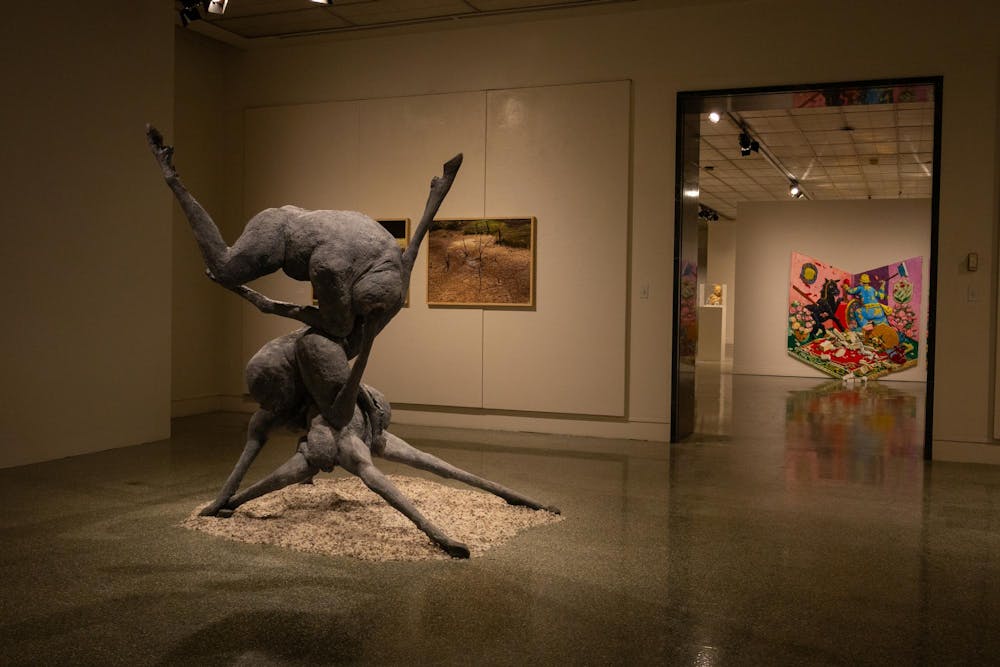
One of the first pieces visitors can find when entering the three-room gallery is a sculpture by Melanie Cooper Pennington, a senior lecturer in sculpture at IU.
Tien described Pennington as coming from “a figurative sculpting background in ceramics” before developing her work to focus more on abstracted beast-like forms. The detailed sculpture of two animal-like creatures intimately interacting invites interpretation, an open starting point for the exhibition.
In the other room of the gallery, graphic designer and IU lecturer in graphic design Alexander Landerman’s posters of events featuring notable performing artists demonstrate the continued use of tactile production methods, such as traditional print and letterpress.
The gallery showcases a diverse collection of different types of artwork, demonstrated by a nearby lamp by designer Justin Bailey. His use of aluminum and light as both a material and medium highlights how functional design coexists with conceptual artwork.
Works continue to move between disciplines deeper into the gallery. A pair of dressed mannequins in IU assistant professor of fashion design Jooyoung Shin’s series “Alterity” explores identity through clothing, positioning garments as both wearable objects and sculptural forms.
“She uses the centuries-old question: what is a woman?” Tien said. “Through clothing, she’s exploring how you embody and express identity because clothing has, for so long, been able to define or restrict identities.”
While grounded in fashion design, Shin’s work also operates within contemporary art contexts, using concepts of identity and a diverse palette of material to create it. Her work illustrates how the exhibition collapses traditional boundaries between fields.
A nearby digital installation presents an active Google Doc file accompanied by layered audio recordings of conversation and ambient sounds. The work documents students collaborating simultaneously, each represented by a moving cursor.
Tien said the experience is designed to be immersive with headphones for listeners to hear the overlapping voices of the participants interacting in real time.
She said the project draws from collaborative experiences shaped by COVID-19 learning environments, emphasizing how “individual marksmanship kind of turns into a collective progress.”
IU associate professor Jiangmei Wu’s work is also featured in the exhibit. Constructed from a single piece of fabric, the installation converts flat material into a complex three-dimensional structure through detailed stitching and emphasizes the idea of transformation being a process.
“She’s always been very mathematically minded in terms of design,” Tien said. “Her work is always about how to take flat material and turn it into 3D forms.”
Other works highlight themes of memory and lived experience.
Daniel Martinez, associate professor and director of the J. Irwin Miller Architecture Program, presented cyanotype prints — a process that produces an image onto paper or fabric by exposing it to UV light — inspired by his experience playing dominoes with family and friends in South Florida.
“This body of work is really about connecting to the cultural traditions that I grew up with,” Martinez said.
Using domino tiles as mark-making tools in the cyanotype process, he allows time and light exposure to shape the imagery, creating layered impressions that reflect movement and scale.
“Our memories are not stored in our minds as perfect reproductions,” Martinez said. “We actively construct memories in the present moment.”
Martinez also said the faculty exhibition provides opportunities to observe connections across disciplines that are not always visible in day-to-day academic settings.
“We’re all so busy that it makes it difficult to slow down and learn about the amazing work that everyone at the Eskenazi School is doing,” Martinez said. “So many disciplines are represented in this school, and it’s rare to have a chance to observe that in a single setting.”
Painting lecturer Amanda Smith’s work, “Cissy’s Garden,” also originated from a personal exchange. The painting was inspired by a student’s story about transforming protective backyard netting into a trellis for plants to grow on.
Developed after the pandemic, the painting forms part of a larger body of paintings by Smith examining backyard spaces as a “microcosm of the relationship between nature and culture,” she said.
Smith said faculty exhibitions also allow artists who teach, as well as their students, to reflect on their works. She said exhibitions like this show how critiques can be a collaborative way to help artists exchange perspectives and more effectively express their message.
Collaboration is a central subject in “Implement Archive,” an ongoing project by Tien and visiting professor of art Ellen Kleckner. The work explores tools, materials and shared authorship. It features a table structure with many different objects, encouraging gallery-goers to touch and interact with them and engage with memories and associations.
“There’s this practice of letting go of autonomy and ego,” Tien said. “The practice itself is a very deep investigation into ‘What does true collaboration actually mean?’”
She described the project as evolving through trust built over time, combining play, improvisation and mindfulness while reconfiguring familiar everyday objects into unfamiliar forms. These unfamiliar forms can bring up different memories for someone physically exploring the work.
The exhibition at Grunwald is a broad umbrella of ideas and artistic questions from faculty artists, bringing IU’s artistic community closer together.
“Continuum” will be open through March 7 at the Grunwald Gallery, located in the Eskenazi School of Art, Architecture and Design.