
I first became aware of how inaccessible and non-compliant Indiana University’s campus was with the Americans with Disabilities Act when the history department moved to “Siberia” — a dorm that had no ramps but plenty of mold, making staff and some faculty sick. We remained there for two years. I had to apologize to students every semester for this and assured them I would hold office hours in accessible places to them. The solution to that problem was to tear the building down.
Later on, I observed other disparities between IU’s commitment to accessibility and reality. In the former Admissions Office on Eagleson Avenue, the front door of the university for many students and parents, there was no ramp. Subsequently, this building became the Diversity, Equity and Multicultural Affairs offices.
A few years back, a student with a wheelchair in one of my classes gave me an earful about the lack of care they experienced from administrators, staff, faculty and peers. They were intent on suing the university but, fortunately for IU, were successful in getting into grad school away from here. There, they focused on improving things for people with limited mobility by becoming an expert in that area.
That student further opened my eyes to what it means to live with disability on this campus and I never forgot that lesson. Private acts of solidarity are nice, but public acts of holding our administration accountable are a more powerful way to have an impact on the institution moving forward.
On Sunday evening, I was getting messages from students with their concerns about the heavy snow and their ability to get to campus safely the next day, when we were meeting at 9:35 a.m. Then, around 7:00 p.m., Provost and Executive Vice Chancellor Rahul Shrivastav sent an email moving all non-essential activities to remote. I don’t know how this decision was reached or who was consulted. I also don’t know how he then decided to open campus fully Tuesday. I remember former Provost Lauren Robel had a pretty awesome method: she would get in her car and drive on the county roads all the way to the Monroe County Airport.
It was impressive. Decisions were made based on personal observation and a common-sense approach to accessibility in private vehicles to campus from rural areas. I’d like to recommend we return to at least that, because this decision affects the safety of more than 55,000 people.
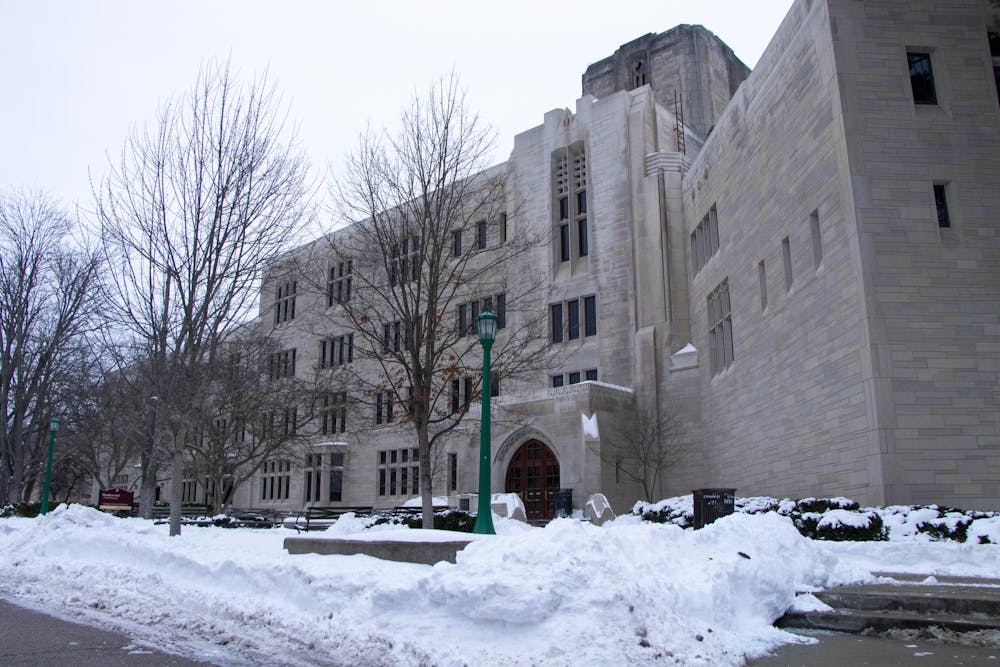
By Tuesday, everything on campus was apparently fully operational so we could go back to business. Not. I arrived on campus at 7:30 a.m. Wednesday, a whole 24 hours after all was declared open and accessible, with plenty of time before my morning classes. I wanted to make sure I could park and that, even driving slowly and walking even more slowly — I have bad knees — I could make it to my Woodburn Hall classroom in time to recover and reach the proper headspace to teach.
As I inched toward the IU Auditorium, I observed one parking space for people with disabilities next to Woodburn — the closest one to the ramp to enter the building — lay under 15 feet of snow. A veritable fort. Then, next to the auditorium, another space for people with disabilities had become the drive to the rest of the spaces for able-bodied people because, across from it, there was another enormous pile in the middle of what was supposed to be the road.
Besides this, the sidewalks were poorly cleaned. I walked in the middle of the street, where it was safer at that hour. To reach Woodburn, people had to use a pathway barely wide enough for one small person — definitely not the 32 inches necessary for wheelchair access. And the ramp was nicely blocked off by a bunch of snow nobody found necessary to remove.
I wrote the Provost within 30 minutes, and by the time I left my second class, at 12:30 p.m., a crew had started to deal with the mountains of snow that blocked off parking for people with limited mobility. In the one spot that had already been freed, a car was parked. This is not just an abstract issue; it is about the ability of someone to go to work.
From the Provost, I received this response: “I am sorry to hear of the challenges. The sheer amount of snow continues to create challenges for all. I have shared your email with the right individuals and hope this will be addressed soon.”
From Susie Johnson, the Associate Vice President of Facility Operations, came another expression of reassurance that by Thursday morning the Woodburn ramp was accessible. Chancellor David Reingold initiated that action. And the University ADA Coordinator encouraged me to let them know about such issues in the future.
This is better than the usual radio silence I hear when I raise other issues with the higher administration. But it is not good enough. Because this is not about one entrance and one parking spot.
I did not have the bandwidth to walk every inch of campus to make sure it was accessible — because it is not my job. On the other hand, the Provost has the responsibility to determine when we are ready to be fully operational. And fully operational doesn’t mean operational for the able-bodied. It means sidewalks are safe enough for a wheelchair to go through. It means pathways are 32 inches wide. It means ramps are clean and safe. It means parking spaces are not under mountains of snow. And not only when a faculty member writes a report about it.
Of course, there are easy ways to ensure full accessibility for all: remote work and Zoom classes. My students asked for Zoom access for class on Wednesday because they were themselves, as able-bodied young people, unwilling to brave the slippery sidewalks.
I don’t blame them and I am committed to full accessibility, so I offered that option. But it was on me, and it meant that I made a choice and had to explain it to them in relation to the “full opening” of the campus. Why not provide that option from the top and empower all of us to work, teach and learn in a safe environment, especially when the upper administration had not actually tested the level of accessibility on the ground?
I hope this lesson is not lost on the Provost, Chancellor, Associate Vice President of Facility Operations, etc. the next time we have a big snow storm. Better yet, having a cabinet that includes the voices of people with disabilities — remember the motto “nothing about us without us” — would go further in addressing accessibility. Instead of embarrassment and patchwork solutions that try to make up for mistakes, avoid them by making good decisions ahead.
And that can start with improving the just-posted revised HR-06-80 employee policy on remote work. How about adding such phrases as:
“The university recognizes that under appropriate circumstances, allowing some remote work arrangements can be constructive and helpful to a campus, academic or administrative unit, and individual jobs, and is necessary to ensure the safety and accessibility of all employees.”
And then adding a point that spells out who has the responsibility to trigger the remote work option under circumstances that are external to an employee’s prior conditions:
“When adverse weather conditions happen, the senior executive officer of the campus is responsible for rendering all spaces on campus accessible before reopening it. That includes offices, classrooms, ramps, sidewalks (including campus housing), roads, and parking.”
Both big decisions and details should be the responsibility of the upper administration, not of individual employees.
Maria Bucur (she/her) is the John W. Hill professor of history at Indiana University Bloomington.



