
SPOILER: This column contains potential spoilers for “No Other Choice.”
In the films of Park Chan-wook, who is known as a brilliant crafter of individual character, society is often present more as a an environment in which his characters are forced to exist. In this sense, “No Other Choice,” released in the U.S. Jan. 16, a more accessible and timely film, one that allows viewers to recognize themselves more easily and to engage more directly with its social reality.
Based on the 1997 novel “The Ax” and reimagined within a contemporary Korean context, the film depicts a modern midlife crisis shaped by technology and corporate logic. It presents a society in which large companies discard workers with little hesitation, as if labor itself had become endlessly replaceable.
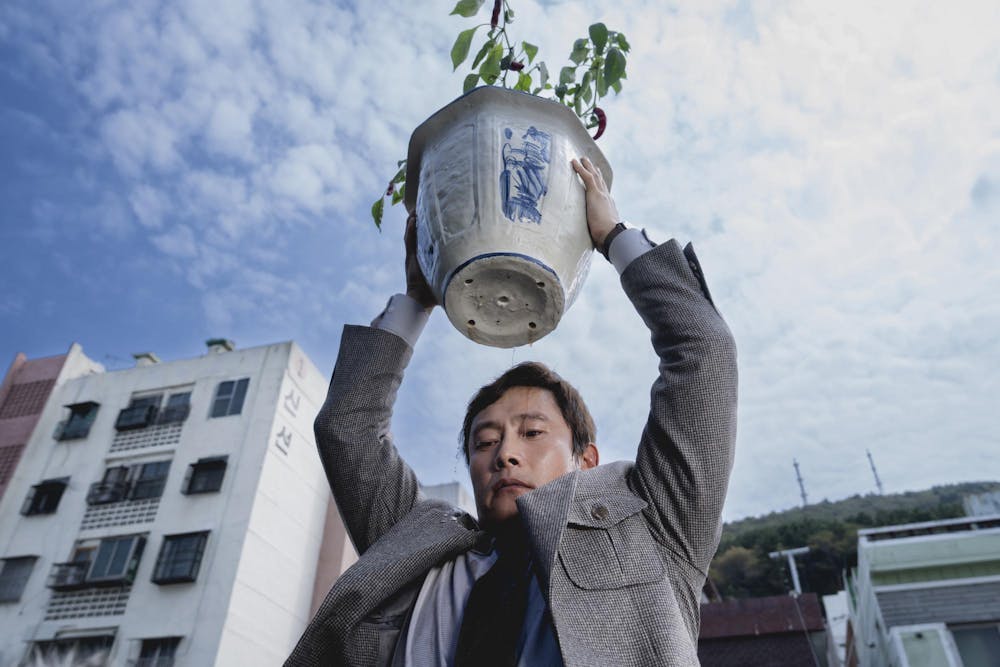
The film opens in a moment of apparent fulfillment. Man-su, (Lee Byung-hun) the protagonist, seems to have reached the life he once dreamed of. After 25 years at his company, he is celebrated with the symbolic gift of an eel; he embraces his family and settles into the house he had long imagined reclaiming from his childhood.
However, that stability collapses almost immediately when an American hedge fund acquires the company and dismisses workers in the name of “business efficiency.” What follows is a series of humiliations as Man-su desperately tries to hand over his resume to the other paper company’s high level executives when he even followed him to the bathroom.
He eventually comes to believe he must eliminate his competitors. He creates a fake job posting for a managerial position at a paper company to collect resumes and identify those who would be more superior in the company's eyes. He then carries out a series of murders targeting the individuals who endanger his chances of securing the position.
Yes, the film operates as a thriller and a dark comedy. Park follows this process in extended detail, sustaining tension while constantly undercutting it with humor.
At its core, the film is about a distorted form of love, which Park has often returned to in his work. Park has consistently brought one of the most unsettling forms of Thanatos — a desire that turns toward destruction as a way of sustaining itself — into contemporary cinema. From his now classic “Oldboy” to “Sympathy for Mr. Vengeance,” death and desire are inseparably intertwined. Revenge becomes an obsession, and characters willingly betray social norms, or even themselves, in a desperate attempt to recover love.
In theory, Man-su could sell his house and take a different job, but none of those options truly exist for him. He feels compelled to protect his family, to maintain the expectations and quality of life he once provided for his wife, and above all, to secure a future in which his young autistic child can become independent through playing the cello. To do that, he believes he must restore the life he once had. Once this logic takes hold, stopping no longer feels possible, even when it leads to killing.
His wife, Miri (Son Ye-jin,) also does everything she can to protect the family, often aiding and abetting the crime. In the film, the idea of “our” family comes before everything else. As Man-su repeatedly says, someone must bring food to the table.
The relationships among the other “middle-aged paper men,” who later become victims of Man-su's spiral, are similarly intense. The men retreat into their own listening room full of vinyl records as Man-su does in his greenhouse. Women carry their loneliness through affairs. They still have moments of outings where hatred and love are mixed, which shows their deep yet complex bond.
Man-su repeatedly sees himself reflected in his victims, and in one scene, he shouts at the first man he attempts to kill, “It’s not about unemployment, it’s about your attitude.”
In that moment, Man-su's words feel less like an accusation than a confession. Thinking about the situation filmmakers face in the age of artificial intelligence, it almost feels both like a tribute to, and a warning for, stubborn craftsmen who refuse to let go of the identities they have built over a lifetime.
It seems like, as this character in the movie does, this filmmaker also has no other choice but to continue to craft every scene with such clarity and detail, with brilliant collaborators. And I, too, had no other choice but to watch this film. I suspect you may feel the same way.


